UK actor Russell Brand sentenced to 10-and-a-half years in jail for rape, sexual assault
Updated 24 minutes ago

Syrian officials claim their government has taken the decision but has not publicly disclosed the move
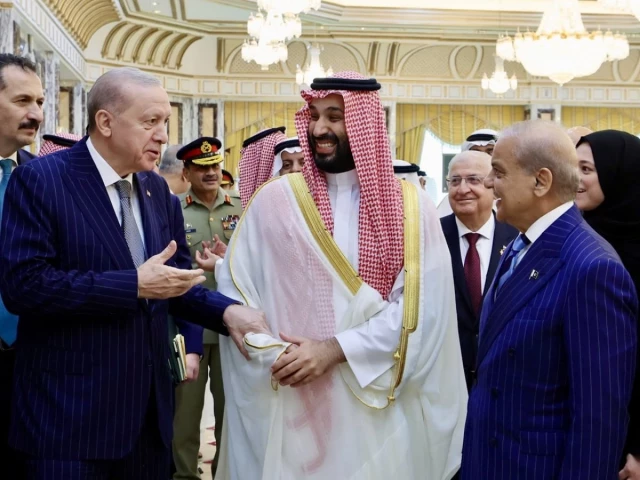
Syria has reportedly decided to join the Makkah Joint Defence Agreement involving Saudi Arabia, Türkiye and Pakistan, according to the Associated Press (AP).
According to a report published on Sunday, two Syrian officials told AP that the Syrian government had already taken the decision to join the Makkah agreement but had not publicly disclosed the move.
However, a regional official said discussions on Syria's potential inclusion in the defence arrangement were still ongoing.
BREAKING: Syria is reportedly preparing to join the Mecca Joint Defense Agreement with Saudi Arabia, Türkiye and Pakistan.
— Clash Report (@clashreport) November 9, 2026
Two Syrian officials said Damascus has already decided to join but has not publicly announced the move, while a regional official said talks remain… pic.twitter.com/MPNhPCXdQY
"One concern is that Syria might ask the other countries for their support against Israel, the regional official said," the report stated.
On Saturday, a Syrian diplomatic source told the Syrian Arab News Agency (SANA) that military agreements with Saudi Arabia were limited to training, exchanging expertise and military consultations, dismissing reports of Syrian troop deployments to Yemen.
The source said Saudi coordination visits to Syria would begin in December, adding that military cooperation “could eventually lead to a mutual defence agreement or to Syria joining the Makkah Defence Alliance, depending on shared interests”.
The Makkah Joint Defence Agreement, signed by Saudi Arabia, Türkiye and Pakistan in August, commits the three countries to regard an attack against any one of them as an attack against all.
The arrangement also envisages closer cooperation in intelligence sharing, defence production, military training and joint exercises involving land, naval and air forces. The trio of countries described the agreement as defensive in nature, saying it is not directed against any particular country and could accommodate other regional states that respect its principles of sovereignty and territorial integrity.
Following the ouster of former Syrian president Bashar Assad in December 2024, Israeli forces seized control of a United Nations-patrolled buffer zone in southern Syria and have maintained their presence there since.
Read: Turkish parliament approves Makkah defence pact with Pakistan, Saudi Arabia
Syrian President Ahmad al-Sharaa has said his government does not seek confrontation with Israel and has called for Israeli forces to withdraw from Syrian territory.
Meanwhile, Syria and Saudi Arabia announced last week that they had signed a military cooperation agreement, without disclosing further details.
During al-Sharaa's visit to Riyadh, the Saudi government also agreed to provide Syria with more than $400 million in financing for post-war reconstruction, including housing and essential infrastructure.
At the onset of November, Syrian Foreign Minister Asaad al-Shaibani said that discussions were underway to evaluate Syria's entry into the Makkah alliance. Shaibani's remarks came during a regional security session at the Manama Dialogue 2026, according to the Syrian Arab News Agency (SANA).
The minister stressed that the region was "in greater need than ever" of developing joint deterrence and defence systems.
The growing alliance
The Makkah agreement could expand beyond its three founding members, with Egypt and Bangladesh emerging as other potential additions.
Turkish Foreign Minister Hakan Fidan said on August 9 that Egyptian membership was being considered, adding that President Recep Tayyip Erdogan wanted the alliance to grow. Fidan indicated that Egypt could join once certain technical matters were resolved.
Cairo had not publicly confirmed any intention to join the arrangement.
Later, Bangladesh also signalled interest in joining the defence pact.
On August 22, Prime Minister Tarique Rahman's foreign affairs adviser Humayun Kobir said Dhaka maintained a positive approach towards joining an economic or defence framework involving Pakistan, Saudi Arabia and Türkiye, while keeping its national interests at the centre of foreign policy.
He also said Bangladesh was strengthening its bilateral relationship with Pakistan.
Bangladesh's interest was reiterated on August 25 when Humayun Kobir, with an updated portfolio of state minister for foreign affairs, confirmed that Dhaka had expressed interest in the Makkah pact.
Foreign Minister Khalilur Rahman subsequently told parliament that Bangladesh would positively consider joining if invited by the founding members, stressing that no decision had yet been taken.









This material may not be published, broadcast, rewritten, redistributed or derived from. Unless otherwise stated, all content is copyrighted © 2026 The Express Tribune.





COMMENTS
Comments are moderated and generally will be posted if they are on-topic and not abusive.
For more information, please see our Comments FAQ