Recovery pleas referred to PHC CJ
Updated 1 hour ago

.
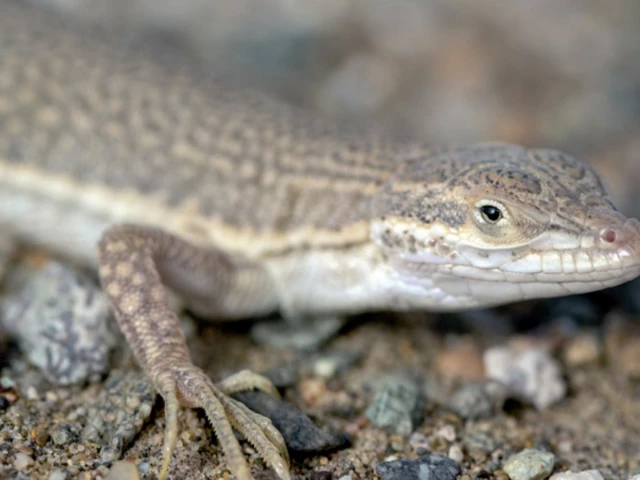
On low sand dunes in western Pakistan, near the borders with Afghanistan and Iran, researchers have identified a desert lizard previously unknown to science.
The species, named Eremias chagaiensis after Chagai District in Balochistan, has a distinctive network of winding brown markings across its back.
An international study reveals a maze-patterned racerunner and resolves a century-old question about another lizard in Balochistan.
The study also provides the first modern specimen- and DNA-based confirmation of Eremias fasciata in Pakistan, more than a century after its first alleged historical report.
The new lizard was documented at four localities during field surveys between 2022 and 2025. Its body reaches 5.7 cm in length, excluding a tail that can be more than twice as long. Unlike the longitudinal stripes typical of many related racerunners, its intricate, maze-like pattern is present in both juveniles and adults.
"Balochistan's deserts are among the least explored places in South Asia. Finding a new lizard here tells us how much is still undocumented," says Rafaqat Masroor of the Pakistan Museum of Natural History, who led the research.
The finding adds to a long but uneven history of herpetological research in Balochistan. Recently, research in northwestern Balochistan has revealed Eremias kakari and two further racerunners, E. rafiqi and E. killasaifullahi by Rafaqat Masroor and Daniel Jablonski, researchers that are collaborating almost a decade.
The new discovery therefore builds on decades of Pakistani and international work, while showing how much remains unresolved.
Appearance, however, did not tell the whole story.
The new species closely resembles Eremias graphica, described from Iran in 2023. Analyses of two mitochondrial and one nuclear gene, together with comparisons of body proportions and scale characters, support its recognition as a distinct evolutionary lineage. In the mitochondrial analyses, E. fasciata, a striped species from the same wider landscape, was recovered as its closest relative. The two species differ by approximately 10.6% in the mitochondrial genes examined.
"At first glance this lizard looked like a species from Iran described in 2023," says Daniel Jablonski of Comenius University in Bratislava and the Natural History Museum Vienna, Austria.
"Appearances can be deceptive. The sand doesn't stop at the border. Surveys in Afghanistan are needed to learn how far this species really lives."
The lizards were observed on loose sand, particularly low dunes and sandy patches near desert shrubs, where they excavate burrows. They were not recorded on the neighbouring gravel plains, which were occupied by E. fasciata. APP















This material may not be published, broadcast, rewritten, redistributed or derived from. Unless otherwise stated, all content is copyrighted © 2026 The Express Tribune.






COMMENTS
Comments are moderated and generally will be posted if they are on-topic and not abusive.
For more information, please see our Comments FAQ