Pakistan capable of intercepting any drones sent from Afghanistan, India: DG ISPR
Updated 2 hours ago

Says military is incorporating AI and emerging technologies to counter evolving warfare threats, as per state media
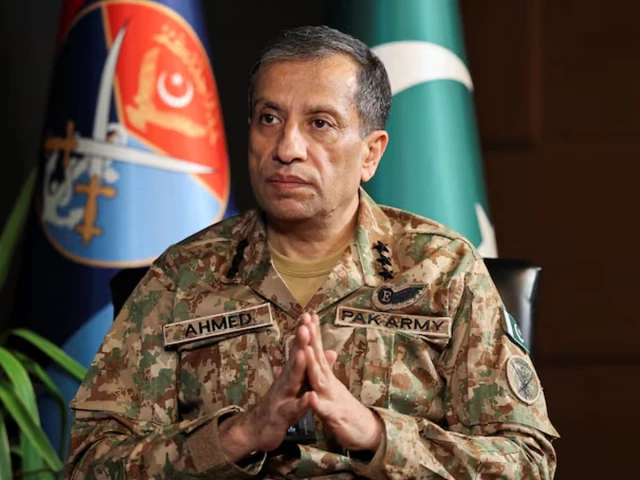
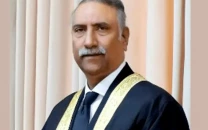
Pakistan is well ahead in operational readiness to counter drone threats from Afghanistan and India and has the capability to intercept any drones sent across its borders, Inter-Services Public Relations Director General Lieutenant General Ahmed Sharif Chaudhry said, adding that the military was incorporating artificial intelligence and other emerging technologies to keep pace with the changing nature of warfare.
The remarks, made during a wide-ranging interview with an international outlet on Friday, were shared by state media on Sunday amid continuing tensions between Islamabad and Kabul.
During the interview on Friday, Lieutenant General Chaudhry said the Pakistan Army was adapting to developments in conventional and non-contact warfare, including drone operations, cyber capabilities and long-range munitions. He added that Pakistani forces had brought down dozens of sophisticated Indian drones during the previous conflict with India.
Director General Inter-Services Public Relations Lieutenant General Ahmed Sharif Chaudhry has said that India is the biggest sponsor of terrorism in Pakistan, while the Afghan Taliban regime is acting as a proxy.@OfficialDGISPR @PakistanFauj @GovtofPakistan #DGISPR… pic.twitter.com/ZsKlYnGps8
— Radio Pakistan (@RadioPakistan) November 1, 2026
Asked whether Pakistan was concerned about the Afghan Taliban's use of drones, particularly in light of the Houthis' use of the technology against Saudi Arabia, DG ISPR said the character of warfare had changed and the military was adapting accordingly.
He stated that the army was preparing for developments in both contact and non-contact warfare, including cyber operations, drones and long-range munitions, while assessing the capabilities needed to address present and future challenges.
He added that the proliferation of non-contact warfare capabilities among non-state actors, including the Taliban, groups referred to as Khawarij and the Houthis, posed a threat to all countries. "These states will have to reconsider and re-evaluate their security architecture," he said.
Asked whether he feared a situation similar to that between the Houthis and Saudi Arabia developing between Afghanistan and Pakistan, he said Afghanistan's drone capabilities were not indigenous.
"There is no drone industry, there is no technology of that sort in Afghanistan. So it's been provided by the sponsors, the terror sponsors, because the biggest terror sponsor here is India," he said.
He alleged that the Afghan Taliban were acting as India's proxy in the context of terrorism in Pakistan.
Read: DG ISPR says Pakistan ‘cautiously optimistic’ on Iran-US mediation, warns against spoilers
Referring to the previous conflict with India, he said New Delhi had sent dozens of sophisticated drones, which Pakistani forces had brought down.
"So we are much ahead where we stand in our own operational readiness," he said, adding that Afghanistan could attempt to send drones but Pakistan had the capability to intercept them.
He also said Afghanistan could not absorb the retaliation Pakistan was capable of delivering.
Asked whether Pakistan's military used artificial intelligence to identify targets, as well as other emerging technologies, Lt Gen Chaudhry said the army was incorporating all technologies required to keep pace with the changing nature of warfare.
He said the rapid transformation of warfare and the pace at which new technologies were being introduced meant professional armies could not afford to fall behind.
However, he declined to discuss specific applications of artificial intelligence, quantum technology and cyber capabilities, saying he could not disclose how the military was using them.
"We use all technologies, absorbing all sorts of technologies that are essential in the changing character of war," he said.
"We are using all sorts of technologies. We are a technology-savvy army," he added.
He again alleged that the Afghan Taliban's drone capabilities had been provided by their sponsors, particularly India, arguing that Afghanistan had neither a drone industry nor technology of its own.
Also Read: Security forces respond to unprovoked firing from Afghan border posts: DC South Waziristan
Lt Gen Chaudhry also described India as the "prime contractor" behind militant groups operating against Pakistan, with the Tehreek-e-Taliban Pakistan (TTP) and Balochistan Liberation Army (BLA) acting as its proxies.
Responding to reports that the Afghan Taliban had accused Pakistan of hosting anti-Taliban elements and coordinating former Afghan government generals and other groups opposed to the regime, he rejected the allegations and accused the Taliban of using non-state actors, militias and mercenaries to pursue their objectives.
"So that's how you play the victim card. They are apt in using non-state actors, militias, mercenaries for their objectives. So they think everyone does that," he said.
"We are a state. Afghanistan is not a state. Afghanistan is still being run by a non-state actor. It's a regime."
He said decades of foreign intervention by the Soviet Union and the United States had allowed multiple agencies and proxy groups to establish roots in Afghanistan. The country, he added, had experienced more than 40 years of foreign interventions, making its situation different from that of Pakistan and other states.
"The forces have gone physically, but still that front of Afghan Taliban is a proxy to multiple parties," he said.
He said the presence of these groups was not merely his assessment but was also reflected in United Nations reports and intelligence assessments by the United States and several other countries.
"How could so many terrorist organisations, the whole alphabet, thrive over there?" he asked.
Questioning the credibility of allegations made by the Afghan Taliban, he cited previous claims by the regime that a person picked up from a street in Kabul was a Pakistani pilot captured in Shalwar Kameez and that Pakistani tanks had been seized.
"It's the same regime which the world has seen, some day picked up a random person from the street in Kabul and said this is a Pakistani pilot that we have captured in Shalwar Kameez. It's the same regime that paraded its own tanks in the streets and said that we have captured Pakistani tanks," he said.
He said Pakistan had drawn conclusions from its experience and believed that armed groups, militias and mercenaries could not be tolerated in any state.
Asked whether isolating the Taliban would help Afghanistan, particularly amid concerns about the impact of the opium ban and reduced foreign assistance to farmers, Lt Gen Chaudhry said Pakistan was not advocating the country's isolation.
Instead, he said, the international community and regional countries should ask the Taliban authorities to act like a state and stop producing opium and supporting militant groups.
"Afghanistan is producing right now; it has only two products: terrorism and drugs. And both are not good for the world and the region and everyone," he said.
He stressed that engagement with Afghanistan was necessary and said Pakistan was also engaging with the authorities in Kabul. However, he said Islamabad demanded that Afghan territory should not be used to support terrorism inside Pakistan.
"We only ask you that don't support terrorism inside Pakistan. Stop harbouring the terrorist leaders," he said.
He alleged that militant groups operating inside Pakistan received their instructions and weapons from Afghanistan. He also claimed that Afghan citizens, including personnel of the Afghan Taliban regime, had been found among militant formations targeted by Pakistani forces.
"We ask them not to do it. If you do it, then there will be a cost, and we are capable of imposing that cost," he said, adding that Pakistan had a clear strategy for imposing such a cost.
The remarks came amid strained relations between Pakistan and Afghanistan due to recurring cross-border terrorism and security concerns. Islamabad has repeatedly urged the Afghan Taliban administration to prevent terrorist organisations, particularly the Tehreek-e-Taliban Pakistan (TTP), from using its territory to launch attacks inside Pakistan.
A day earlier, the Information Ministry maintained that the Taliban regime’s continued refusal to address terrorism was the principal barrier to normal relations and took issue with Kabul’s characterisation of the matter.
“The Taliban leadership continues to blame Islamabad’s policies while conveniently ignoring the single most important issue poisoning bilateral relations: its persistent failure to address terrorism emanating from Afghan soil,” the statement said.
Pakistan maintains that the terrorist nexus extended beyond the movement of terrorists across the border to their training, arming and operational support.
Security officials estimate that up to 70 per cent of the Fitna al-Khawarij terrorists infiltrating Pakistan were of Afghan origin. They further claim that the Taliban regime had allowed leftover US and NATO weapons to reach terrorist groups, including Fitna al-Khawarij and Fitna al-Hindustan.
The security establishment also linked the escalation in attacks to the presence of terrorist infrastructure inside Afghanistan.
In 2026 alone, terrorism emanating from Afghan soil claimed the lives of 1,327 Pakistanis and injured another 2,484, according to figures cited by Pakistani authorities.
Officials said that whenever Pakistani forces targeted terrorist hideouts, the Taliban regime instead moved to defend the militants and their sanctuaries rather than dismantling the infrastructure. The issue, Pakistan has argued, was not confined to TTP.
UN assessments have continued to document the presence of several other militant organisations in Afghanistan, including al Qaeda, the East Turkestan Islamic Movement and Islamic State-Khorasan, reinforcing concerns about the broader militant ecosystem operating from Afghan territory.




This material may not be published, broadcast, rewritten, redistributed or derived from. Unless otherwise stated, all content is copyrighted © 2026 The Express Tribune.






COMMENTS
Comments are moderated and generally will be posted if they are on-topic and not abusive.
For more information, please see our Comments FAQ