Skills, structural change and feminist policy
Updated 1 hour ago

.
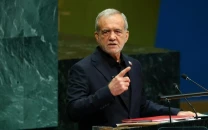
Tehran: President Masoud Pezeshkian now appears frequently on TV to speak to his people. His first plea is to keep calm in testing times; that the government is doing all it can to ease the common man's pain. The riyal has lost three to four hundred per cent of its value in debilitating inflation; traders have cut down business; some have closed shop for being unsustainable, as the purchasing power of the common man in the street takes a huge hit. The discomfort and unease are widespread. The President explains that all attempts at evading a disastrous war with the US failed not because of Iran, but because of the US. And then, 'Iran must make one more effort to get the US to talk and negotiate.' That is a lot of explanation by the President to the Iranian people.
Abbas Araghchi repeatedly refers to the seven-day plan and how it almost met the goals of both sides. This includes opening Hormuz as soon as the US takes immediate steps to lift the naval blockade, remove sanctions and return assets. That is precisely what was contained in the Islamabad MOU, but someone, somewhere, proposed to trade those for control over Hormuz. It was the newly discovered crown jewel that has increasingly lost its lustre – the world adapting to the disruptions in the oil and gas supplies by supplying from global stocks and strategic reserves. It necessitated Iran calling in the Houthis to open the second front to augment disruptions through Bab el Mandeb.
The Red Sea caters to 10-12 per cent of global trade, of which around 10 per cent is oil and petroleum products. Only an additional disturbance of this scale in global trade could bring focus back to Iran, which increasingly felt like a combatant in the ring from which the opponents and the audience had taken leave long ago. Attacks on Saudi Arabia have helped, and the Mecca Agreement partners were back in Tehran trying to appease its sense of forlorn victimhood. The US, too, despite its occupation with polls, was forced to pay attention – in the wrong way. Luckily, the possibility has been successfully thwarted, for now. Having missed the Islamabad MOU bus, Iran seeks the return to talks which can deliver it what it desperately needs – money. The only difficulty is that it will now come at a greater cost – the natural consequence of spurning a deal when the moment was right. Many had then advised that make hay while Hormuz still shines. But when you sweeten your gains to that extent, you risk losing all. All or bust.
Washington: Having faltered and been fooled into a war looking for a cheap win which could deliver political gains at home, Donald Trump was mostly happy to see Iran fading into a distant memory – political and economic cost aside. His naval blockade against Iran was delivering, leaving Iran with an equally painful socioeconomic cost at home. A few rounds of attempted talks at resolution only convinced him that Iran was playing hard to get, and he chose to let the reality of Iran's economic pain sink longer and deeper. Meanwhile, the US doubled its exports of oil and gas to the rest of the world, making hay while the sun shone on international oil prices. At the same time, the political cost of his misstep – entering a war that was neither needed nor essential – had already entrenched his poor standing among voters. The ultimate price will come in the form of the mid-term elections this coming Tuesday.
From a lollypop of a 'regime change' that he was fed through a selective, wimpish air campaign in denial of what had been prescribed by Colin Powell – if America must enter war, it must only be with an overwhelming force – he had rationalised to what may be the USA's premier concern and objective: that Iran may not have a nuclear weapon. Unable to close a deal the first time – thankfully for him and the US; he was once again faulted for literally giving away all – he recovered to focus on what really mattered: the denial of the nuclear weapons route to Iran. Any fresh attack on Iran will thus be aimed at eliminating the threat assumed to be taking shape at the Pickaxe site. He may then revert to his occupation at home while Iran waits for him to lift the sanctions and the blockade, and return the assets. This is a cat-and-mouse game between two nations bent upon showing the other down. They must find their mean, and settle. The world, mostly the poorer ones, will in the meantime learn to fold or scrape through. As will Trump in a couple of years; and as may Iran if it finds no respite from the hardship it has chosen to prove its credentials.
Islamabad: Already spread too far thin in geostrategic terms between its eastern and western borders, and a presumptive indulgence between the US and China in a precarious balance, the initiative to invite itself into a joint agreement with Saudi Arabia and Turkey only meant that our interests were now spread far and wide. As were the concerns. Iran was just too close for comfort, while the Saudis were inevitable partners in keeping us afloat economically. A region so badly in distress has only transferred some of it to Pakistan for its omnipresence. And China has yet to begin making demands. An active western border and deepening strife inland beckon far greater attention than is on offer. Pakistan may be seeking stability for itself as it ventures out to find peace for the region but may find itself hamstrung to deliver what is expected by its regional partners, jading both Saudi Arabia and Iran into a complicated relationship with Pakistan.
Riyadh: Meanwhile, Saudi Arabia continues to rally before an unending assault by the Yemeni Houthis against it. It is another fault line in the Middle East that Saudi enemies have chosen to exploit to maximum effect. The fact that the Saudi Defence minister was in Tehran while his nation was suffering a war – that had also meant to target him and his ministry – goes a long way to explain the predicaments and complexities at hand. While Saudi Arabia fights its war, it also engages from the Mecca JDA platform with an adversary that means harm. Indeed, the risks that the region and especially Saudi Arabia, the largest nation in the GCC and a symbolic head of the Muslim world, entail if the US-Israel duo launches another war on Iran remain true and pervasive. Iran might burn, but then so will the GCC and the rest of the Middle East.
Together, they hope Iran might relent and be realistic enough to not tempt its and the region's fate at the hands of the two men that have come together at such a tenuous time in international politics. Some balls are meant to be 'well left'.







This material may not be published, broadcast, rewritten, redistributed or derived from. Unless otherwise stated, all content is copyrighted © 2026 The Express Tribune.

COMMENTS
Comments are moderated and generally will be posted if they are on-topic and not abusive.
For more information, please see our Comments FAQ