Turkish parliament committee approves Makkah Agreement on joint defence with Pakistan, Saudi Arabia
Updated 1 hour ago

'Agreement envisions integration rather than bloc-building in the region,' says Turkish deputy foreign minister
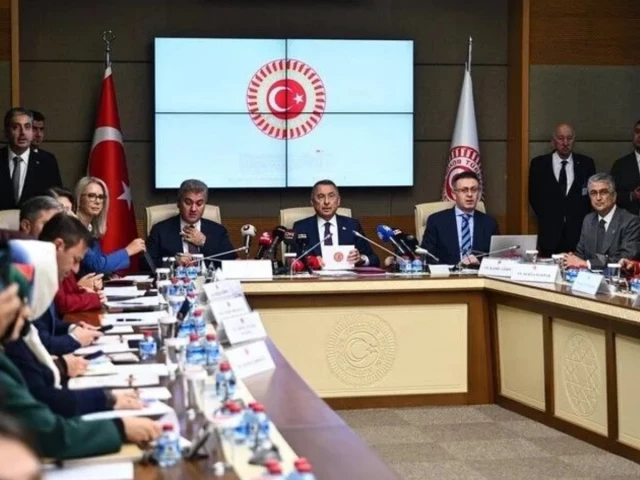
The Turkish parliament's Foreign Affairs Committee on Tuesday approved a bill to ratify the Makkah Joint Defence Agreement between Türkiye, Saudi Arabia and Pakistan.
The bill was approved following deliberations during which Deputy Foreign Minister Levent Gumrukcu answered lawmakers' questions about the agreement.
Speaking at the committee meeting, Gumrukcu said the agreement aimed to strengthen regional security through cooperation and collective defence.
“The Makkah agreement is not only an extension of the special friendly relations between the three countries, but also a concrete product of the regional ownership increasingly needed in our region,” Gumrukcu said.
Read: Pakistan condemns 'reprehensible' Houthi attacks in Makkah, Madinah regions
He recalled that the agreement was signed in Makkah on August 7 by Turkish President Recep Tayyip Erdogan, Saudi Crown Prince and Prime Minister Mohammed bin Salman, and Prime Minister Shehbaz Sharif.
He said Saudi Arabia and Pakistan had completed their domestic ratification procedures and submitted the required official notifications.
Gumrukcu said the agreement marked an initial step toward establishing a regional security framework based on cooperation and collective defence, adding that the three countries aimed to take responsibility for addressing regional challenges rather than waiting for solutions from outside the region.
He said the framework was intended to contribute not only to the security of the three signatories but also to that of the wider region by strengthening dialogue and cooperation based on mutual trust and promoting lasting stability.
Deal ‘envisions integration rather than bloc-building in region’
Gumrukcu stressed that the agreement was entirely defensive in nature and did not target any country.
He said it was open to all regional countries that respect international law, including the principles of state sovereignty and territorial integrity, the prohibition of the use of force except in self-defense, the peaceful settlement of disputes and non-interference in internal affairs.
"The agreement envisions integration rather than bloc-building in the region, embracing an inclusive rather than divisive vision," he added.
Defence cooperation and NATO commitments
Gumrukcu said the agreement envisaged strengthening collective deterrence, holding regular consultations on international security issues, and improving interoperability between the countries' armed forces through personnel exchanges, joint training programs, and military exercises.
It also provides for closer defence industry cooperation, including joint production and technology sharing, stronger joint counterterrorism efforts, and logistical support between the parties in implementing the agreement, he said.
The deputy foreign minister emphasised that the agreement would neither replace nor undermine Türkiye's obligations under its existing alliances and agreements.
He said the initiative was expected to complement Türkiye's participation in multilateral platforms, particularly NATO, by contributing to security and stability across the broader Middle East and supporting European security in light of the interconnected nature of the two regions.
Foreign Affairs Committee Chairman Fuat Oktay also dismissed concerns that the pact could constitute an alternative to NATO.
"There were questions about whether an alternative to NATO was being created. Absolutely not," Oktay told reporters.
"This agreement will not undermine the territorial integrity or sovereignty of the three countries, nor any agreements they have concluded to date," he added.
Oktay said the pact would not alter the countries' legal standing, sovereignty or foreign and defense policies, stressing that it would not disrupt the coherence of Türkiye's foreign policy.









This material may not be published, broadcast, rewritten, redistributed or derived from. Unless otherwise stated, all content is copyrighted © 2026 The Express Tribune.






COMMENTS
Comments are moderated and generally will be posted if they are on-topic and not abusive.
For more information, please see our Comments FAQ