Fact check: Viral video of Noreen and Uzma is old; not of release from Kot Lakhpat jail
Updated 2 hours ago

Hafiz Naeem gives govt 10 days to abolish levy, threatens to resume Islamabad march in mid-November
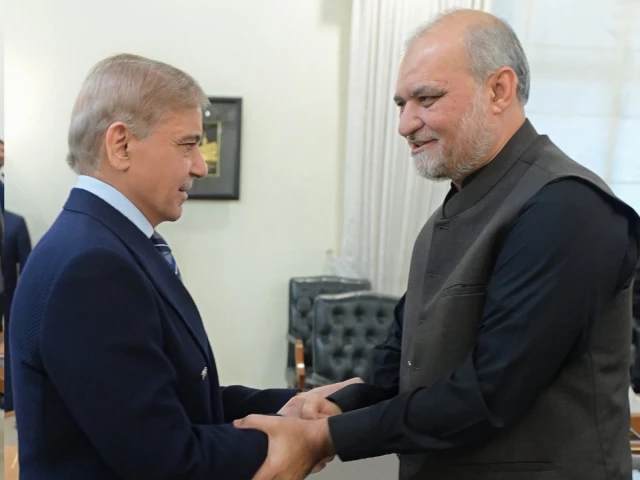
The government and Jamaat-e-Islami (JI) on Tuesday agreed to form a six-member committee to finalise recommendations on expanding the existing petrol relief scheme and preparing proposals for a phased reduction in the petroleum levy.
A statement issued by the PM Office said the understanding was reached during a meeting between Prime Minister Shehbaz Sharif and a JI delegation led by party chief Hafiz Naeemur Rehman at the PM house in Islamabad.
Under the agreement, three members each from the government and JI will examine measures to broaden the scope of the ongoing PM fuel relief scheme to ensure that the maximum number of deserving people benefit from it.
The committee will also prepare feasible proposals for a phased reduction in the petroleum levy for consideration in the budget, according to the statement.
The prime minister nominated Deputy Prime Minister and Foreign Minister Ishaq Dar, Planning Minister Ahsan Iqbal and his adviser on political affairs Rana Sanaullah to represent the government on the committee.
وزیراعظم محمد شہباز شریف سے امیر جماعت اسلامی حافظ نعیم الرحمٰن کی قیادت میں جماعت اسلامی کے وفد کی ملاقات ہوئی. وفد میں جماعت اسلامی کے رہنماء لیاقت بلوچ سید فراست شاہ, نصر اللہ رندھاوا اور عنایت اللہ شامل تھے.
— Prime Minister's Office (@PakPMO) October 27, 2026
ملاقات میں نائب وزیراعظم و وزیر خارجہ محمد اسحاق ڈار، وفاقی وزیر… pic.twitter.com/QxGJ7X1zDh
During the meeting, PM Shehbaz acknowledged the financial burden on the public caused by rising petroleum prices and said the government understood the difficulties faced by people, particularly those belonging to low-income groups.
He said the government was providing relief within its financial capacity in response to the increase in oil prices amid the prevailing regional and international situation. He added that the government was making diplomatic efforts to resolve the regional crisis and restore normalcy.
The prime minister emphasised that the current increase in petroleum prices was linked to regional and international developments rather than government policies.
Briefing the JI delegation, the premier said, “So far 12.6 million people have registered for the fuel relief scheme.”
PM Shehbaz also thanked JI for opting for negotiations to discuss the issue of petroleum prices.
The meeting was also attended by Finance Minister Muhammad Aurangzeb, Economic Affairs Minister Ahad Khan Cheema, Petroleum Minister Ali Pervaiz Malik and Minister of State for Finance and Railways Bilal Azhar Kayani.
The JI delegation included Liaquat Baloch, Syed Farasat Shah, Nasrullah Randhawa and Inayatullah.
Prime Minister Muhammad Shehbaz Sharif meeting a delegation of Jamaat Islami at Prime Minister's House, Islamabad. pic.twitter.com/hA5Oe8jP3T
— Prime Minister's Office (@PakPMO) October 27, 2026
Iqbal also seconded that the government and JI had agreed to form a six-member committee to examine proposals for expanding the PM’s Fuel Relief Scheme and phasing out the petroleum levy in the next budget.
The minister said PM Shehbaz and Rehman had agreed to form the committee after discussions on proposals to provide relief amid rising fuel prices.
“The government representatives will include Deputy PM Dar, Rana Sanaullah and myself,” Iqbal stated.
Addressing a press conference after the meeting, Iqbal said the committee would comprise three representatives each from the government and JI.
The committee would examine ways to extend the relief scheme to more deserving people and explore how the petroleum levy could be abolished through a phased process in the next budget, Iqbal said.
He added that the government had explained its “challenges” to the JI delegation and heard the party’s proposals. Both sides, he said, shared the objective of providing relief to the public, although the government believed that measures should follow a durable and “sustainable” approach.
اسلام آباد : وفاقی وزیر منصوبہ بندی احسن اقبال اور وزیر اعظم کے مشیر رانا ثنا اللہ کی نیوز کانفرنس https://t.co/1cnjyVm2O4
— PMLN (@pmln_org) October 27, 2026
Iqbal said the government recognised the impact of rising fuel prices on ordinary people and that the prime minister was keen to protect vulnerable sections of society from the effects of the increase.
He added that the government would provide relief within its “fiscal limitations”. According to the latest figures he cited, 12.5 million people were benefiting from the fuel relief scheme.
The minister maintained that the increase in oil prices was not the result of government policy but stemmed from a global crisis beyond its control. He said Pakistan had used diplomatic channels to help defuse tensions in the US-Iran conflict, adding that the country’s efforts had been praised internationally.
Iqbal also referred to Field Marshal Asim Munir’s engagement in diplomacy during a meeting in Tehran, saying the efforts were aimed at reducing regional tensions and bringing down oil prices.
He said the government’s options remained constrained for as long as the crisis continued. While it could take popular short-term decisions, he warned, these could have adverse economic consequences within months.
“As you know, the previous government of Imran Khan reduced fuel prices for cheap popularity, and this almost led the country towards bankruptcy,” he added.
Iqbal said every political party had the right to protest, but added that geopolitical developments made internal political and economic stability important.
The government and Jamaat-e-Islami have agreed to constitute a committee to finalize proposals for expanding the Prime Minister's Fuel Relief Scheme.
— Radio Pakistan (@RadioPakistan) October 27, 2026
This was stated by Planning Minister Ahsan Iqbal while addressing a news conference alongside Prime Minister's Adviser Rana… pic.twitter.com/oA2GJ2UxQ0
Meanwhile, Sanaullah claimed 12.7 million people were benefiting from the Rs100-per-litre petrol relief scheme, adding that the number was expected to reach 20 million in the coming days.
“The government is attempting to provide relief to the common and poor man as much as possible, and we appreciate JI’s efforts for this purpose, but we need to make this relief targeted so that it reaches the most deserving people,” he said.
He urged political parties to unite behind Pakistan’s military and political leadership and support efforts to end the US-Iran conflict and promote unity in the Muslim world.
Sanaullah expressed hope that JI would support the government’s peace efforts and work with it to improve public relief measures. He added that the government had carefully considered the party’s proposals and was seeking to expand the resources available for public welfare.
اسلام آباد: اسلام آباد مارچ ملتوی نہیں کیا گیا، جماعت اسلامی کا اسلام آباد مارچ نومبر کے وسط میں دوبارہ شروع ہوگا
— Jamaat e Islami Pakistan (@JIPOfficial) October 27, 2026
حافظ نعیم الرحمٰن کی وزیراعظم سے ملاقات کی تفصیلات اور آئندہ کے لائحہ عمل سے متعلق اہم پریس کانفرنس سے خطاب#لیوی_بھتہ_نامنظور pic.twitter.com/CAyUlAp4F1
Hafiz Naeem gives govt 10 days to abolish levy
However, the JI chief gave the government 10 days to abolish the petroleum levy and provide meaningful relief to the inflation-hit public, warning that his party would resume its long march towards Islamabad in mid-November if its demands were not met.
“The government has promised that relief will be provided. The question is not whether relief will be given, but how and when,” he said after the meeting.
He said the prime minister had assured the party that technical committees would be given eight to 10 days to work out proposals for providing relief. He maintained that the talks had not ended in failure, as both sides had agreed on the need to ease the burden on the public.
Rehman made it clear that JI would continue its protest campaign alongside negotiations and would not accept further delays without concrete action. “The government should do whatever it has to do by mid-November; otherwise, the matter will be taken to the streets again,” he warned.
The JI chief said his party had presented the public’s concerns over inflation and rising petroleum prices during the meeting. He reiterated its demand for the immediate abolition of the petroleum levy, describing it as an unjust tax imposed to generate revenue.
According to Rehman, the government had argued that abolishing the levy would leave a shortfall in the national exchequer and sought more time to work out a solution. He said the government wanted to reduce the levy gradually.
Asked about a proposal to cut the levy by Rs25 to Rs30 per litre, Rehman said the government had put forward various proposals, but JI remained firm on its demand for the levy’s complete abolition.
He claimed that the party’s campaign had already secured a reduction of Rs32 per litre in diesel prices and said the government had now agreed to expand the scope of relief.
Rehman said JI had conveyed a message across the country that public grievances, particularly over inflation and the rising cost of living, could provide the basis for a nationwide uprising.
The JI chief also called on the government to hold local government elections in Islamabad, reiterating that his party would continue to press for action on public issues while awaiting the promised relief.
اسلام آباد: امیر جماعت اسلامی پاکستان حافظ نعیم الرحمان وزیر اعظم سے پیٹرولیم لیوی کے حوالے سے ملاقات کے بعد اہم پریس کانفرنس میں ملاقات کی تفصیلات سے آگاہ کر رہے ہیں#لیوی_بھتہ_نامنظور https://t.co/aQ3yTUINKa
— Jamaat e Islami Pakistan (@JIPOfficial) October 27, 2026
A day earlier, Rehman had warned that his party would march towards Islamabad in mid-November if the government failed to abolish the petroleum levy and provide relief to the public.
Speaking at a press conference in Lahore, he said JI would continue its campaign against the levy until the government accepted its demands. He acknowledged that the government had provided some relief in petroleum prices following the party’s protests but maintained that the measures were insufficient to call off the march.
The JI chief also condemned the imposition of an emergency in Khyber-Pakhtunkhwa, describing it as a violation of human rights, and demanded its withdrawal.
Background
JI’s campaign against the petroleum levy intensified in August, when the party organised demonstrations and sit-ins across the country against rising fuel prices, inflation and what it described as an additional tax burden on consumers. On August 16, JI workers staged sit-ins outside governors’ houses in the provincial capitals, demanding the withdrawal of the levy and a reduction in petrol prices.
The party subsequently expanded its protests to other cities, including Karachi, where it established additional protest camps across Sindh. JI maintained that the government should abolish the levy rather than offer limited reductions in fuel prices.
On September 3, the government and JI agreed to establish technical committees to examine proposals for reducing the petroleum levy and fuel prices. During the first round of negotiations on September 7, the party submitted six proposals to the government, while insisting that its protests would continue until meaningful relief was provided.
However, the negotiations failed to resolve the dispute. On September 12, JI chief announced a long march towards Islamabad for September 20, warning that the party would intensify its campaign if the government did not abolish the levy.
The march began on September 20, with participants travelling from Karachi by train. The caravan moved through Sukkur towards Multan, where Naeem addressed supporters. The march was subsequently suspended after PM Shehbaz telephoned the JI chief and requested that the party postpone its protest to allow further negotiations.
JI agreed to give the government an opportunity for talks but maintained that it had not abandoned its demand. The party’s position was that negotiations and protests could continue simultaneously, with any agreement required to address the complete abolition of the levy.




This material may not be published, broadcast, rewritten, redistributed or derived from. Unless otherwise stated, all content is copyrighted © 2026 The Express Tribune.



COMMENTS (2)
Comments are moderated and generally will be posted if they are on-topic and not abusive.
For more information, please see our Comments FAQ