Army major martyred in IED blast in Pasni
Updated 56 minutes ago

Moscow signals readiness to help ease friction
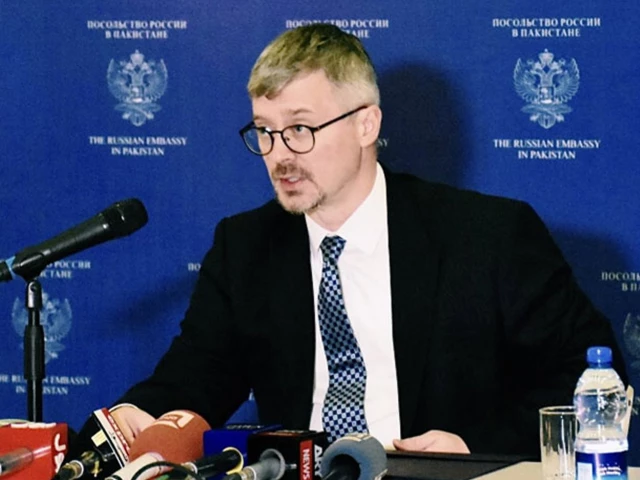
Russia on Monday offered to help defuse tensions between Pakistan and Afghanistan, signaling a potentially greater diplomatic role for Moscow at a time when relations between Islamabad and Kabul have deteriorated sharply over the issue of cross-border terrorism.
Speaking at a roundtable discussion on Pakistan-Russia relations at the Institute of Strategic Studies Islamabad (ISSI), Russian Ambassador to Pakistan Albert Khorev expressed concern over the growing tensions between the two neighbours and said Moscow was ready to contribute towards easing their differences.
Khorev said the continued closure of the Pakistan-Afghanistan border was also affecting Pakistan's trade connectivity with Central Asia and Russia. He hoped the border would reopen and tensions between Islamabad and Kabul would subside.
Significantly, the Russian envoy revealed that Pakistan-Afghanistan tensions figured prominently during Russian Interior Minister Vladimir Kolokoltsev's visit to Islamabad last week. He also referred to recent visits by senior Russian security officials to Pakistan, Afghanistan and India, indicating that Moscow was stepping up its diplomatic engagement in the region.
Kolokoltsev last week became the first Russian interior minister to visit Pakistan, holding talks with the civilian and military leadership, including Field Marshal Asim Munir. His visit coincided with Russian Foreign Intelligence Service chief Sergei Naryshkin's trip to Kabul for talks with senior Taliban officials. Meanwhile, a senior Russian Security Council official was in New Delhi for consultations.
Moscow's willingness to play a role between Islamabad and Kabul is significant because Russia has developed perhaps the closest relationship with the Taliban among major global powers.
Russia last year became the first country to formally recognise the Taliban government in Afghanistan. Moscow has since expanded political and security engagement with Kabul. In May this year, the two sides also signed a military-technical cooperation arrangement, although its full scope has not been made public.
Russia's approach towards the Taliban has at times differed sharply from Pakistan's increasingly critical position. Those differences were evident at the Moscow Format consultations on Afghanistan earlier this month. Russian Foreign Minister Sergey Lavrov praised the Taliban-led administration, while Pakistan continued to press Kabul for concrete action against the banned Tehreek-e-Taliban Pakistan (TTP).
The meeting failed to produce a joint communique, with Pakistan later saying the Afghan side had not accepted the language concerning terrorist networks operating from Afghanistan.
Islamabad accuses the Taliban authorities of allowing the TTP to use Afghan territory to plan and launch attacks inside Pakistan, a charge Kabul denies. Pakistan has insisted that any meaningful dialogue must be accompanied by concrete and verifiable action against such groups.
Despite those differences, Islamabad has left the door open for a possible Russian role. At his weekly briefing on Thursday, Foreign Office spokesperson Sajjad Haider Khan said Pakistan valued its engagement with Russia on Afghanistan and regional security.
He said Islamabad would welcome sincere efforts by friendly countries that could address Pakistan's legitimate security concerns, although he stressed that the Foreign Office was not aware of any separate formal Russian mediation initiative.
"Such efforts should be meaningful and yield tangible progress," the spokesperson said, adding that progress ultimately depended on concrete and verifiable Taliban action against terrorist groups operating from Afghanistan.
Pakistan's Ambassador to Russia Faisal Niaz Tirmizi, who also addressed Monday's discussion, stressed the need for expanding bilateral relationship and efforts to remove practical hurdles in ties.
On trade and connectivity, Ambassador Tirmizi prioritised visa facilitation, direct flights, and arrangements to remove banking and payment barriers. He outlined preparations for a bilateral business forum, including advance meetings between companies, and discussed transport links through Iran, Afghanistan and China.
He called for stronger partnerships between universities, increased student mobility, and cooperation in science, engineering and agriculture. He also highlighted Russian-language education, cultural exchanges, and closer links between the media and creative sectors of the two countries.
Pakistan and Russia have stepped up engagement in recent years in trade, energy, connectivity, counterterrorism and security. The two sides agreed earlier this year to work towards an economic cooperation programme extending through 2030, while officials have also discussed rail connectivity linking Pakistan with Russia and Central Asia.
The latest Russian diplomatic activity comes as Moscow seeks a larger role in Afghanistan and the wider region while Islamabad attempts to persuade regional countries to use their influence with the Taliban to address Pakistan's security concerns.






This material may not be published, broadcast, rewritten, redistributed or derived from. Unless otherwise stated, all content is copyrighted © 2026 The Express Tribune.




COMMENTS
Comments are moderated and generally will be posted if they are on-topic and not abusive.
For more information, please see our Comments FAQ