Guterres, CDF discuss regional security, peace
Updated 1 hour ago

PM says govt wants K-P to develop alongside other provinces
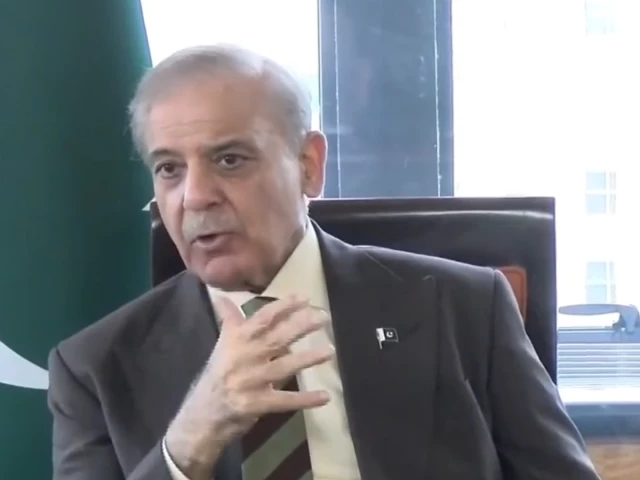
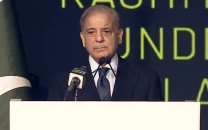
Prime Minister Shehbaz Sharif on Wednesday said rising terrorism in Khyber-Pakhtunkhwa must be stopped "at all costs", the Prime Minister's Office (PMO) said.
According to the statement issued by the PMO, the prime minister made the remarks during a meeting with Federal Minister for Kashmir Affairs and Gilgit-Baltistan Amir Muqam in Islamabad.
During the meeting, matters relating to Azad Jammu and Kashmir (AJK), G-B and K-P were discussed during the meeting. "Rising terrorism in K-P must be stopped at all costs," the prime minister said.
He said the government wanted K-P to develop like other parts of the country and appreciated the sacrifices made by the people of the province in the fight against terrorism.
The statement further added that the federal minister briefed the prime minister on ongoing matters and progress in AJK and G-B. The prime minister directed that effective measures continue to ensure the welfare and development of the people of AJK and G-B and the provision of basic facilities.
Shehbaz said the development of AJK and G-B and the prosperity of their people were among the government's priorities.
Terrorism has risen in K-P over the past month, with a series of attacks targeting police, government officials and civilians across the province.
Govt avoiding last option
Defence Minister Khawaja Asif said the government was trying to avoid imposing governor's rule in K-P, but warned that it could resort to the option if no other way was left.
Speaking to reporters in Islamabad, the minister said that there was nothing impeding the imposition og governor's rule in the province, but the government was trying not to use what he described as the "last option".
"If there is no other way left, then we can use that option," he said.
Asif also criticised the PTI, urging it to "play the role of a political party rather than a terrorist organisation".
"We cannot leave the capital at their mercy so that every two or three months they join hands with the Taliban and march on the capital," he said.
The minister described the Taliban as an "anti-Pakistan power" and said that if the PTI allied with it and attacked the capital, the government had the right and responsibility to protect Islamabad.
Asif also described the PTI's planned long march as an "attack on Islamabad", saying previous attacks on the capital had also been motivated by political parties' efforts to establish their credibility within their own ranks.
He attributed the failure of talks between the government and opposition to internal differences within the PTI.
"Differences within the PTI have intensified," he said, adding that members of the PTI sitting in the National Assembly, its negotiating team and even its allies wanted a solution to the issue that was acceptable to the entire country.
Asked about the PTI's demand for a meeting with Imran Khan before deciding whether to postpone its long march, Asif said he did not know about it.
He instead urged the PTI to look at its record.
Later, in a post on X, Asif accused the K-P government of having "complete collusion" with terrorists and said there were ample examples and evidence of what he called a "facilitator ecosystem", which, he said, could not be tolerated.
Holding 'state hostage'
Adviser to the Prime Minister on Political Affairs Rana Sanaullah said that the government would not accept political demands through pressure tactics or attempts to "hold the state hostage", as the Pakistan Tehreek-e-Insaf maintained that its long march would continue and only Imran Khan could decide when to call it off.
"I want to say this clearly today that no demand can be accepted by holding the state hostage or pursuing the path of political instability," Sanaullah said while addressing a press conference in Islamabad.
He urged PTI to set aside what he described as its politics of instability and prioritise the national interest by resolving differences through dialogue.
Sanaullah said the government remained willing to hold talks but warned that political demands could not be accepted through pressure tactics.
"They should renounce political instability and not give priority to their personal political agenda over the national interest. They should sit for talks and resolve these issues through negotiations. However, despite our desire for talks, under no circumstances should they try to hold the state hostage to have their political demands accepted. This tactic will not be allowed," he added.




This material may not be published, broadcast, rewritten, redistributed or derived from. Unless otherwise stated, all content is copyrighted © 2026 The Express Tribune.






COMMENTS
Comments are moderated and generally will be posted if they are on-topic and not abusive.
For more information, please see our Comments FAQ