Messi readies for final farewell in Argentina send-off
Updated 12 minutes ago

As Hesson’s influence grows, captains appear increasingly powerless, raising questions over authority
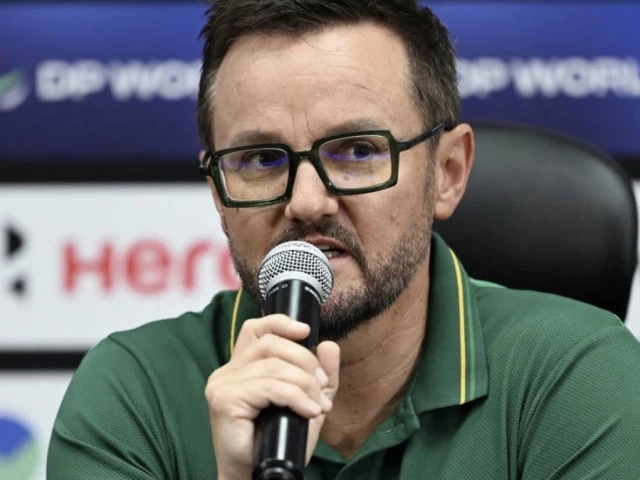
It was only a few months ago that the Pakistan cricket team failed to progress beyond the Super Eight stage of the T20 World Cup. A report emerged afterward that placed the entire blame on coach Mike Hesson, alleging that he had effectively taken over the captain’s responsibilities. Salman Ali Agha was merely used as the face of the captaincy, while the actual decisions were being made by the coach.
The selection committee had initially not included Babar Azam in the squad, but Hesson insisted that he be selected. During matches, he reportedly sent messages to the captain, putting unnecessary pressure on him. Decisions such as dropping Fakhar Zaman in the early matches, delaying the introduction of Usman Tariq into the bowling attack in certain games, or removing him despite taking wickets were also attributed to head coach Hesson and bowling coach Ashley Noffke.
At the time, it seemed almost certain that the coach would soon be sent home. But circumstances took a surprising turn. Hesson not only retained his position; after the coaching staff was removed during the England tour, he even took charge in Test cricket.
Aaqib Javed, who apparently did not like him at all, has now become as close to him as a childhood friend. This is Pakistan cricket for you. Just as Pakistan went from the brink of elimination to becoming world champions in the 1992 World Cup, the coach has similarly survived the threat of dismissal and emerged as an “all-in-one” figure.
The team’s performances do not appear extraordinary. Yet according to the statistics presented by the coach, we are supposedly ahead of even Australia. One wonders why, despite these impressive numbers, we still seem to lose so often.
Now Salman Ali Agha’s departure appears certain. After that, a new captain will be appointed. Perhaps it will be Sahibzada Farhan, who led the young squad at the Asian Games.
Despite winning matches in ODIs, Shaheen Afridi does not appear to be under consideration for the T20 captaincy because he is not a ‘yes-man’ and cannot simply be made to accept decisions against his wishes. Similarly, although Shadab Khan is very close to Hesson because of their association with Islamabad United, it does not appear that he will be given the captaincy immediately. Shadab, too, is not the sort of player who simply agrees with everything.
Salman Ali Agha was used, but he neither performed himself nor managed to lead the team to success. Just as we saw Hesson operating as a “non-playing captain” during the Asian Games, it now seems that Sahibzada Farhan may be the person who suits him best.
Pakistan had a golden opportunity to beat India in the Asian Games final, but astonishing decisions regarding the playing XI and bowling shattered that dream. Hesson appeared completely active from outside the boundary, and his instructions seemed to be followed.
There had initially been talk that a deal had been reached with Babar Azam and that he would be given leadership in all three formats. But after what happened on the England tour, he should consider himself fortunate if he even retains the Test captaincy.
Shaheen may now not even be part of the T20 squad. Otherwise, questions could arise about why he was not made captain. Babar will remain in the team because the authorities seem to have a constant fear that without senior batsmen, it may be difficult to survive 20 overs.
It remains to be seen how long Sahibzada will remain captain if he is appointed. If more defeats follow, he too will be removed and another new face brought in. But that is not the solution to the problem.
Whenever Pakistan has won a major tournament, it was not because of a powerful coach but because the captain was strong. Whether it was Imran Khan, Younis Khan or Sarfaraz Ahmed, they had freedom in making their decisions.
The coach did not select the team and then hand the captain a ready-made playing XI. Decisions about who should bowl when and what the batting order should be were made by the captain. The coach did not stand on the boundary giving instructions.
Even now, Pakistan needs an empowered leader. Whether it is Babar, Shaheen, Sahibzada or Shadab, whoever is appointed should be given complete authority rather than being kept under pressure.
When the team loses, the captain receives the greatest criticism. Therefore, he should also have the freedom to make decisions.
Salman Ali Agha was as responsible for the recent defeats as Hesson was. If the captain has been removed, why has the coach been allowed to stay?
Hesson’s contract is remarkable. He reportedly has the authority not only to help form the initial squad but also to select the playing XI. And he makes full use of these powers.
Sometimes his teams are packed with all-rounders, while at other times five openers are played together. Saim Ayub was a perfectly good batsman, but in the attempt to turn him into an all-rounder, he has effectively been ruined. Now he is struggling with both his batting and bowling.
Constant changes to the batting order have also proved disastrous for the team.
At this point, either Hesson should put in writing that he will win the next World Cup, and then let him do whatever he wants, or he should be told: “Brother, stay within your domain.” This is not tennis, where a non-playing captain can work. Cricket does not operate that way.
The PCB should also establish a separate selection committee comprising people different from the team management.
Everyone remembers the damage caused to Lahore Qalandars when Aaqib Javed was given complete authority in the PSL. Then, when Sameen Rana and Atif Rana came to the forefront and Shaheen Afridi took over the captaincy, the team’s fortunes changed.
Aaqib is now conducting the same Lahore Qalandars-style experiments in Pakistan cricket. He should be kept completely away from team affairs. His opinion can certainly be sought, but the PCB should form a separate selection committee for the squad in which neither Aaqib nor Hesson is included.
Then, perhaps, we might actually see some improvement.
The gold medal slipped away from our hands at the Asian Games. Now, a good strategy needs to be devised for the future. If everyone works within their own area of responsibility, perhaps something positive can happen.
Otherwise, Pakistani fans have already become accustomed to enduring defeats. They will probably endure a few more.











This material may not be published, broadcast, rewritten, redistributed or derived from. Unless otherwise stated, all content is copyrighted © 2026 The Express Tribune.



1727268465-0/Untitled-design-(42)1727268465-0-208x130.webp "roboking in pakistan")


COMMENTS
Comments are moderated and generally will be posted if they are on-topic and not abusive.
For more information, please see our Comments FAQ