Opposition wants PM to initiate dialogue
Updated 21 minutes ago

Defence minister says any enemy of Saudi Arabia is an enemy of Pakistan
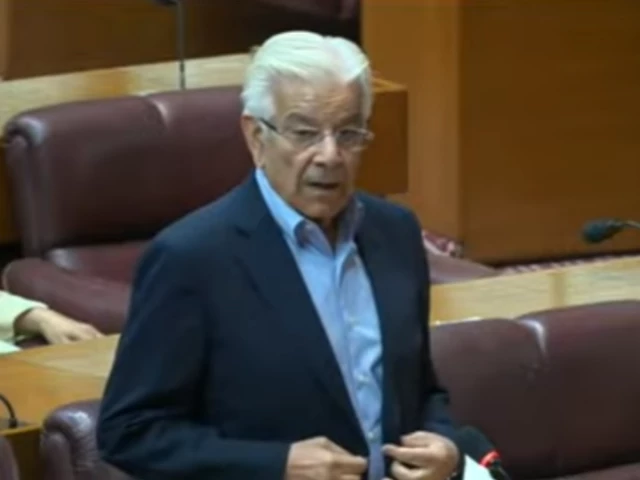
Defence Minister Khawaja Asif on Wednesday said Pakistan was bound by its agreement with Saudi Arabia to come to the kingdom’s defence against any threat, stressing that all available means at Islamabad’s disposal would also be made available to Riyadh.
The remarks come amid continued regional tensions and underline Islamabad’s stated commitment to Saudi Arabia’s security under its bilateral defence arrangements.
“We are bound by this arrangement to defend Saudi Arabia, that means whatever means that are available at our disposal, they’ll be available to Saudi Arabia also,” the defence minister said in an interview with Al Jazeera.
Speaking about the Houthis, Asif said there was “absolutely no doubt” in Pakistan’s position that the group was committing aggression against Saudi Arabia.
“We are there to help Saudi Arabia in any conflict, whether it is coming from Houthis or a country or any other outfit which threatens Saudi Arabia’s security. We will be there to defend them,” he said.
Pakistan’s Defence Minister Khawaja Muhammad Asif says Islamabad will make “whatever means” available to Saudi Arabia under a new mutual defence pact if Riyadh faces threats from the Iran-backed Houthis in Yemen. pic.twitter.com/Qvb9GXTgbT
— Al Jazeera English (@AJEnglish) September 30, 2026
The defence minister described the Houthis as enemies of Saudi Arabia.
“Any enemy of Saudi Arabia is an enemy of Pakistan,” Asif added, stressing that the position should be “very clear”.
On Iran’s relationship with the Houthis, the defence minister said Tehran did not accept the group as its proxy. He explained that some proxies go rogue.
Asif said proxy groups could, over time, develop agendas and capabilities of their own, citing the broader phenomenon of armed groups becoming independent of those who initially supported them.
Read: Pakistan reaffirms support for Saudi Arabia
“Some country, A, B or C, they launch a proxy and then [the] proxy has its own way of multiplying and then becoming a rogue sort of entity,” he outlined.
The Houthis have repeatedly carried out missile and drone attacks against Saudi Arabia since the Yemen war escalated in 2015. Their targets included Saudi military installations, airports, oil facilities and other critical infrastructure.
In September 2019, the group claimed responsibility for drone attacks on Saudi Aramco’s Abqaiq processing facility and Khurais oil field, attacks that temporarily disrupted more than half of Saudi Arabia’s crude production.
The attacks continued in subsequent years, including strikes on Saudi energy infrastructure in March 2022.
More recently, Houthi attacks have again targeted Saudi territory. In September, the group claimed missile and drone strikes on a Saudi military base and other targets, while Saudi authorities reported attacks affecting several cities.
It is worth noting that on September 25, Pakistan, Saudi Arabia and Türkiye senior military leadership strongly condemned attacks targeting the holy city of Makkah as they reaffirmed their commitment to the collective defence of the Kingdom under the Makkah Joint Defence Agreement.
A day after that, Saudi Defence Minister Prince Khalid bin Salman reaffirmed continued joint efforts to confront attacks targeting Makkah and civilian and economic facilities in the Kingdom during a meeting with the Chief of Defence Forces (CDF) and Chief of Army Staff Field Marshal Asim Munir.
Then, on September 27, Defence Minister Asif also reiterated the resolve to implement the Makkah Joint Defence Agreement amid the rising Houthis attacks on Saudi Arabia and said that both Pakistan and Türkiye would stand with Saudi Arabia practically and diplomatically in case of any aggression.
Asif further stressed that protecting Saudi Arabia fell under divine duty.
"If there wasn't an agreement, if Saudi Arabia had been attacked, especially if the sacred cities of Makkah and Madinah were attacked, then we are bound by an eternal agreement; that is, we will protect the House of God and Madinah," he stated in an interview to a private channel.
He also outlined that the "worldly agreement" referring to the Makkah Joint Defence Agreement between Pakistan, Saudi Arabia and Türkiye to protect one another, would operate in all circumstances.






This material may not be published, broadcast, rewritten, redistributed or derived from. Unless otherwise stated, all content is copyrighted © 2026 The Express Tribune.




COMMENTS (2)
Comments are moderated and generally will be posted if they are on-topic and not abusive.
For more information, please see our Comments FAQ