French police clash with protesters as tens of thousands rally over cost of living
Updated 4 hours ago

Officials, political figures, Israeli voices push back on Netanyahu’s attacks, defence of Gaza war
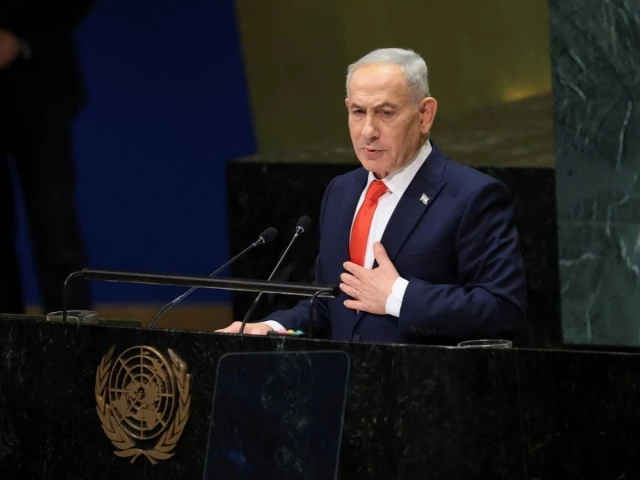
Israeli Prime Minister Benjamin Netanyahu used the United Nations General Assembly podium last week to lash out at governments and public figures critical of Israel, but his accusations were quickly turned against him as he was criticised for deflection and political scapegoating.
Netanyahu’s speech had already been thinned by a massive walkout in the chamber as he approached the podium, to which he responded by calling departing delegates “moral cowards.”
He then spent much of his address defending Israel’s conduct in the Gaza Strip — where Israel’s genocidal attacks since October 2023 have led to tens of thousands of Palestinian deaths — and attacking critics ranging from Turkiye and Qatar to New York City Mayor Zohran Mamdani.
‘Insolent and vile remarks’
Netanyahu portrayed criticism of Israel as the product not only of opposition to its policies but also of disinformation, political hostility and organised efforts to influence public opinion. Others rejected that framing.
Turkiye’s Communications Director Burhanettin Duran asserted that Netanyahu was using the UN platform for “baseless accusations” against Ankara and President Recep Tayyip Erdogan while seeking to draw attention away from Gaza.
Netanyahu’s criticisms of Ankara included hostility toward Israel and taking aim at its regional policies and political record. Duran said the remarks could not obscure the humanitarian catastrophe in Gaza or international legal proceedings that had led to an arrest warrant against the Israeli prime minister.
Read: Six big takeaways from a turbulent week of UN diplomacy
“Netanyahu’s insolent and vile remarks targeting our president cannot cover up his massacres, the humanitarian catastrophe in Gaza, and the proceedings before international law,” Duran said in a statement issued by Turkiye’s Directorate of Communications.
The International Criminal Court issued the warrant for Netanyahu in November 2024 over allegations of war crimes and crimes against humanity.
Qatar, another major focus of Netanyahu’s speech, challenged his contention that Doha was helping drive growing anti-Israel sentiment abroad.
Foreign Ministry spokesperson Majed Al Ansari said Qatar “categorically” rejected the accusation that it was orchestrating a campaign to turn public opinion against Israel. Instead, he argued that Netanyahu was attempting to explain away a deterioration in Israel’s international standing by blaming outsiders.
“Reducing the growing shift in global public opinion, particularly among young people, to allegations of ‘influence campaigns’ is an insult to the awareness and judgment of a generation that is witnessing, in real time and before the entire world, what is taking place on the ground,” Al Ansari said.
He said Israeli leaders seeking to change perceptions of the country should change their policies, respect international law and take responsibility rather than search for “scapegoats.”
Qatar’s deputy ambassador in Washington, Hamad Al-Muftah, went further, pointing directly to the reception Netanyahu received at the UN. “Speaking to a half-empty room during his UN remarks says plenty about the support for this message,” Al-Muftah wrote on X, sharing a black-and-white photo of Netanyahu beside a scowling President Donald Trump as he called Qatar to apologise for deadly Israeli airstrikes earlier this year.
@IsraeliPM speaking to half-empty room during his UN remarks says plenty about the support for this message.
— Hamad AlMuftah (@hmmm1983) September 24, 2026
Blaming Qatar for a political failures does not change the facts. Qatar’s reported funding of American universities has overwhelmingly supported the operation of U.S.… pic.twitter.com/r8MXgZE7QC
He disputed Netanyahu’s description of Qatari financing of American universities, saying much of the funding supported United States universities operating campuses in Doha’s Education City and that the institutions retained control of their academic programs.
Al-Muftah also rejected Netanyahu’s criticism of Qatar for hosting representatives of Palestinian group Hamas, noting that Doha’s contacts with the organisation had enabled it to serve as a mediator in negotiations also involving Israel, the US and Egypt.
“Attacking one of the countries doing the difficult work of mediation does nothing to solve the problem,” he said.
Besides states and leaders, Netanyahu’s broadside also included individuals. Standing in the city Mamdani governs, Netanyahu called him “the antisemitic mayor of New York,” accused him of spreading lies about Israel and claimed Jewish residents had felt less safe since his election.
He also rebuked Mamdani for describing Israel’s actions in Gaza as genocide and for his past statements about the ICC warrant. “You tried to stop me from coming here. You tried to silence me. Well, you can’t silence me,” Netanyahu said.
Read More: Inside the UN walkout: Who left and who stayed for Netanyahu’s speech
Mamdani rejected the accusations, accusing Netanyahu in turn of repeating “baseless lies” to defend Israel’s conduct toward Palestinians.
The mayor had already offered a symbolic response before Netanyahu spoke. Hours earlier, he posted footage of himself planting an olive tree at Gracie Mansion alongside Palestinian families from Gaza, writing: “May peace be our future.”
Netanyahu also pulled US political streamer Hasan Piker into his attack on Mamdani, citing Piker’s controversial 2019 remark that “America deserved 9/11.” Piker has said the remark, for which he later expressed regret over the wording, referred to what he viewed as consequences of US foreign policy rather than the victims of the attacks.
He reacted to his mention during a livestream, questioning why an Israeli prime minister addressing the world body had devoted part of his speech to him while calling attention to Netanyahu’s own comments after the September 11, 2001 attacks.
Little standing to lecture on ‘barbarity’
Criticism of the speech also came from within Israel. Writing in the newspaper Haaretz following Netanyahu’s address, Israeli journalist Gideon Levy challenged the prime minister’s repeated framing of Israel as confronting “barbarity.”
Levy argued that Netanyahu’s focus on the conduct of Israel’s enemies left unaddressed what the columnist described as a profound moral crisis within Israel itself.
He was blunt in his criticism of Netanyahu, arguing that the premier had little standing to lecture others about “barbarity” after the destruction in Gaza.
“If 1,000 babies under the age of a year who were killed by pilots and soldiers aren't a sign of barbarity, then what is barbarity?” he questioned.







This material may not be published, broadcast, rewritten, redistributed or derived from. Unless otherwise stated, all content is copyrighted © 2026 The Express Tribune.

1727268465-0/Untitled-design-(42)1727268465-0-208x130.webp "sisyphus in the land of saviours")

COMMENTS (2)
Comments are moderated and generally will be posted if they are on-topic and not abusive.
For more information, please see our Comments FAQ