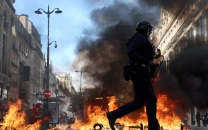
French police clash with protesters as tens of thousands rally over cost of living
Updated 1 hour ago

Trump says he expects more talks with Iran this week, warns Tehran 'overplayed' hand
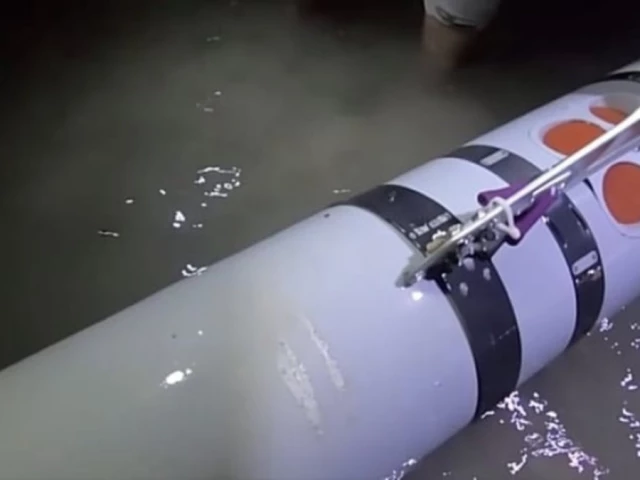
The US military on Sunday denied a claim by the Islamic Revolutionary Guard Corps (IRGC) that it had seized an advanced US underwater drone conducting surveillance in the Strait of Hormuz, Al Jazeera reported.
US Central Command spokesperson Captain Tim Hawkins said that the US maintained “positive control of all of our operational drone assets”, describing the IRGC claim as “clearly desperate”.
Earlier in the day, the IRGC Navy said it had seized a United States Remus 600 autonomous underwater vehicle operating in the Strait of Hormuz and that the vessel was “now in the hands of the force’s specialists to retrieve its information”.
IRGC said the vehicle had been captured using intelligence and electronic warfare capabilities and was being examined by Iranian specialists to recover its data.
Footage showing a second US underwater drone seized in the Strait of Hormuz. pic.twitter.com/8U1balrhLg
— IRNA News Agency ☫ (@IrnaEnglish) September 27, 2026
Trump says he expects more talks with Iran this week, warns Tehran 'overplayed' hand
US President Donald Trump said on Sunday that he anticipated his envoys would take part in negotiations with Iran in the coming days, while adding that Tehran had yet to offer acceptable terms to resolve the ongoing conflict.
"I expect more talks with Iran (this week)," Trump told US news website Axios in an interview, adding: "They want to make a deal, but it is not the deal that I want to make. It is what we would have maybe agreed to a year ago. They overplayed their hand."
Asked whether Washington was considering resuming military strikes against Iran, Trump said the option remained active.
After nixing Iran proposal, Trump tells Axios he expects talks this week https://t.co/YREe8GfiKT
— Axios (@axios) September 27, 2026
The remarks follow indirect diplomatic exchanges last week on the sidelines of the UN General Assembly in New York, where Iranian Foreign Minister Abbas Araghchi met with US envoys Steve Witkoff and Jared Kushner via Qatari mediators.
Tehran reportedly offered to reopen the strategic Strait of Hormuz and restart nuclear talks within a week on the condition that Washington lifted its naval blockade, removed sanctions on oil sales, and reinstated a regional ceasefire.
Trump rejected the proposal on Saturday, as the two nations remain locked in the seven-month Iran war that began with large-scale strikes by the US and Israel in late February.
Iran's army voices readiness for potential renewed US attack
Iran's armed forces were prepared for any renewed US attacks, state media quoted army spokesperson Mohammad Akraminia saying on Sunday, after US President Donald Trump said he rejected an Iranian proposal to reopen the Strait of Hormuz and end fighting.
Akraminia said Iran's armed forces were fully prepared for confrontation and warned that the US would suffer greater damage if it launched another attack on his country.
Iran’s Army spokesperson: Should the enemy perpetrate further aggression, Iran's armed forces shall, with enhanced preparedness and capability, deliver a response more devastating, more extensive, and more resolute than ever before. pic.twitter.com/u7tnCnyIj4
— IRNA News Agency ☫ (@IrnaEnglish) September 27, 2026
War with US 'not over', says Iran's army commander
Separately, Iranian Army Commander-in-Chief Amir Hatami said the war with the US was at a "critical and decisive" stage, Al Jazeera reported.
According to Al Jazeera, Hatami added, “The war is not over; we have won, but we must consolidate this victory, and the aggressor enemy, which has suffered severe blows, must still be ready to receive severe blows from the dear Iranian soldiers.”
Iran’s army chief, Major-General Amir Hatami, says the war with the US is not over and is now in its “critical and decisive” stage.
— Al Jazeera English (@AJEnglish) September 27, 2026
🔴 LIVE updates: https://t.co/3wmSBiCp3Y pic.twitter.com/mdieHuuZKt
“We are proud to be the soldiers of a country that today stands against the embodied evil of the United States and the Zionist regime and has humiliated them,” he stated, adding, “This is Iran, and it is not a place for their excesses and arrogance.”
Responding to the notion that the Iranian government would fall after the series of assassinations that the US and Israel carried out at the beginning of their war, Hatami said that this was a “miscalculation by the enemy,” Al Jazeera reported.
The commander highlighted the assassination of Iranian Supreme Leader Ali Khamenei on February 28, the first day of the war.
He also said Tehran would not accept a situation where it could not trade while foreign powers used the region's strategic waterways. "If Iran cannot trade, if Iran cannot live, no one will be able to trade or live. The Strait of Hormuz is the strait of our dignity and honour, and it will not be allowed for the country's enemies to use this major logistical chokepoint. At the same time, the Iranian people are deprived,” he said, according to Al Jazeera.
Seven killed in strike on market in Yemen, Houthi-run health ministry says
Yemen's Houthi-run health ministry said seven people were killed and 40 injured, including children, in a strike on shops at a market in the Mawiya junction in Taiz province.
Later, Yemen's internationally recognised government said its forces had targeted a Houthi military camp and vehicles at the same junction.
Three military sources within the Yemeni government told Reuters that Houthi militants had recently established a military camp near the market.
Military support to Saudi Arabia ‘defensive’: French FM
French military support being given to Saudi Arabia to help it confront attacks from the Houthis was “strictly defensive,” French Foreign Minister Jean-Noel Barrot said on Sunday.
Barrot's comment, made on state television network France 2, followed President Emmanuel Macron’s announcement on Thursday of French troops, radar units and “defence systems” being sent to Saudi Arabia.
Saudi Arabia has come under repeated missile and drone attacks from the Houthis, after Yemen’s war reignited in July after a years-long truce, adding another front to the Middle East war.
The attacks have targeted Saudi oil installations and the key oil terminal of Yanbu.
Asked whether France’s aid meant that Paris had become a partner in Saudi Arabia’s war against the Houthis, Barrot said: “Absolutely not... This is strictly defensive.”
French military support to Saudi Arabia is “strictly defensive,” says French Foreign Minister Jean-Noel Barrot. Read more: https://t.co/LzmSebe8Ah
— Arab News (@arabnews) September 27, 2026
He added that “since the start of the (US-Israeli) war against Iran, we have deployed military assets to protect our allies, our partners”.
“Does that mean at any time we can be considered co-belligerents? Never.”
Barrot said the scale of the French deployment to Saudi Arabia would depend on what Riyadh requested, as well as “our own capacities and how the situation develops”.
Bessent says Operation Economic Outcast 'delivering results'
US Treasury Secretary Scott Bessent, in a statement on X early Sunday morning, said that following the launch of Operation Economic Outcast, the Treasury Department "imposed targeted financial measures against banks and aviation service providers."
"At my direction, teams were dispatched across the globe to engage with countries and demand action against the Iranian regime," Bessent said. He added that the efforts "are delivering results."
Following the launch of Operation Economic Outcast, @USTreasury imposed targeted financial measures against banks and aviation service providers. At my direction, teams were dispatched across the globe to engage with countries and demand action against the Iranian regime.
— Treasury Secretary Scott Bessent (@SecScottBessent) September 26, 2026
These…
According to the treasury secretary, Turkiye and Oman "announced the cessation of Mahan Air flights to their countries," while the UAE "has halted all flights by Iranian airlines." Bessent also added that "top commercial banks in the UAE and Turkiye have stopped transacting with Iran."
"Even Iran’s leadership has acknowledged the economic toll of the war, as the value of the rial has fallen to record lows," he said.
Bessent concluded his post with writing, "I appreciate the governments of the UK, Turkiye, Oman, and the UAE. We will continue working together as there is more to be done to prevent Tehran from carrying out its terrorist agenda."
Earlier, Iran insisted that only diplomacy can solve its conflict with the US and Israel after US President Donald Trump said he rejected an Iranian proposal to reopen the Strait of Hormuz and end fighting.
"Our conditions are clear, and any move toward reopening the Strait of Hormuz is contingent on these conditions being met," Iranian Foreign Minister Abbas Araghchi posted on social media. "Only a negotiated solution can get them out of this deadlock."
Iran announced a peace proposal last week at the UN General Assembly in New York, saying it had been transmitted to the Americans via Qatari mediators. Trump said on Saturday he rejected the plan and argued that desperation was driving the Iranians’ push for an agreement on the key waterway.
"They want to make a deal to open the Hormuz Strait immediately because they're losing so badly," Trump told reporters at the White House.
Despite Trump's public statements, mediators facilitating Iran's talks with the United States have not officially relayed a US rejection of the plan, according to Araqchi.
"We are waiting for the mediators to convey the definitive views to us, and we will make a decision based on them," Araqchi posted.
Read: Iran awaits US move after WSJ report says Trump rejects peace plan
The US has imposed an economic blockade on Iran to put pressure on Tehran to stop Iranian attacks on vessels in the Strait of Hormuz, which have drastically reduced shipping through the area even as Trump repeatedly asserts that the US controls the waterway.
The Wall Street Journal first reported that Trump had rejected the Iranian proposal, citing unnamed US officials.
It said Trump was privately skeptical that Iran would meet his demands and had told his staff that he sees a renewed bombing campaign as likely after the November US midterm elections.
A US official had said earlier that discussions with Iran through mediators were "positive and constructive."
Pezeshkian says Iran cannot be ''besieged", praises China and Russia
Iranian President Masoud Pezeshkian, during an interview with Al Jazeera, said China and Russia had provided Iran with significant political and economic support, adding that the country could not be “besieged”, IRNA reported.
President @drpezeshkian to Al Jazeera: China and Russia helped us big time politically and economically. Iran can't be besieged. pic.twitter.com/WdzqE6AB04
— IRNA News Agency ☫ (@IrnaEnglish) September 27, 2026
He also said that "the attack on Saudi Arabia's pipelines was carried out neither by Iran nor by the Resistance groups" during the interview.
In an interview with Al Jazeera, Iranian President @drpezeshkian said: The attack on Saudi Arabia's pipelines was carried out neither by Iran nor by the Resistance groups. pic.twitter.com/I3Zldehew7
— IRNA News Agency ☫ (@IrnaEnglish) September 27, 2026
Iran says Hormuz reopening hinges on conditions, diplomacy remains open
Iranian Foreign Minister Abbas Araghchi said that Tehran’s main message during meetings on the sidelines of the 81st UN General Assembly was that reopening the Strait of Hormuz would depend on conditions set by the Supreme National Security Council (SNSC), stressing that Iran had never closed the door to negotiations, while maintaining its rights, IRNA news agency reported.
Speaking to Iranian reporters in New York, Araghchi said Iran had maintained an active diplomatic presence at this year’s UN gathering. President Masoud Pezeshkian returned to Tehran after holding multiple meetings, giving interviews and delivering a major address, the minister said.
The foreign minister noted that he also met with foreign officials and counterparts.
Iran says Hormuz reopening hinges on conditions, diplomacy remains openhttps://t.co/b1L9eeXjD6 pic.twitter.com/qJgv3SVMDi
— IRNA News Agency ☫ (@IrnaEnglish) September 27, 2026
He said Iran’s conditions for reopening the strait were clearly presented and defended in all meetings and conveyed to mediators, who then communicated them to the US side.
Araghchi said Iran had also presented several diplomatic proposals, but had yet to receive a formal response through the mediators. He noted that statements by the US president had been contradictory and said Tehran was awaiting a definitive position before deciding its next steps.
The minister said Iran had demonstrated its strength in military, diplomatic and economic spheres and argued that a negotiated solution based on dignity, justice and legitimate rights was the only way forward.
IRGC Navy warns US warships could be targeted in Indian Ocean
Iran’s Islamic Revolutionary Guard Corps (IRGC) Navy has warned that US warships, including those operating in the Indian Ocean, could be targeted if Washington launches a new war against Iran, Al Jazeera reported.
The navy of the Islamic Revolutionary Guard Corps (IRGC) has threatened to attack US warships, including in the Indian Ocean, if Washington launches a new war against Iran.
— Al Jazeera English (@AJEnglish) September 27, 2026
🔴 LIVE updates: https://t.co/3wmSBiCWTw pic.twitter.com/Edb1yEI70Z
Oman pledges to safeguard Strait of Hormuz navigation, urges Iran-US settlement
Oman pledged on Saturday to continue safeguarding navigation through the Strait of Hormuz while urging Iran and the US to resolve their disputes through a lasting political settlement.
Addressing the 81st UN General Assembly in New York, Foreign Minister Badr Albusaidi said the conflict that erupted earlier this year with US-Israeli strikes on Iran has threatened regional security and disrupted shipping and trade through the strategic waterway.
He said the disruption affected energy security, prices and confidence in the international system.
Albusaidi said Oman is committed to protecting navigation through the strait in line with international law and the UN Convention on the Law of the Sea.
He urged all parties to cooperate with Muscat in efforts to ensure passage through the chokepoint while respecting the interests of countries that depend on it.
The foreign minister also urged Tehran and Washington to resolve outstanding disputes and pursue political understandings that could provide a lasting way out of the crisis.
Albusaidi voiced solidarity with neighboring countries on measures taken to protect their security, sovereignty and territorial integrity.
Conflict has disrupted oil flows, harmed global economy
The Iranians also engaged their Saudi rivals regarding the Strait of Hormuz, underscoring the stakes of a seven-month-old conflict that has disrupted oil flows through a critical shipping lane and taken a toll on the global economy.
Araghchi told reporters at the United Nations on Friday the proposed deal would trigger a seven-day countdown to reopening the strait and a pause in regional fighting.
"If there is seriousness on the US side to come to a deal and reopen the Strait of Hormuz, everything is now prepared," Araghchi said. If the US were to agree, the warring parties could start wider talks "on mutually agreed subjects."
That could potentially include discussions of Iran's nuclear program. Trump has said Tehran must never acquire a nuclear bomb, while a senior Iranian official told Reuters that Iran would show no flexibility over its nuclear program even if the US accepted its peace deal.
Read More: Iranian flights cancelled as new US 'D-Day' sanctions take effect
Iran would grant no concessions over its rights, including enriching uranium or shipping its highly enriched uranium out of the country, the official said.
Iranian President Masoud Pezeshkian, in an interview with the CBS show "Face the Nation", said Tehran was ready for talks on its nuclear program and other issues, but would not accept "bullying or coercion".
"Iran is not seeking war, but will defend itself against pressure, threats and attacks,” Pezeshkian said, adding that it had already agreed that "we're not supposed to develop nuclear weapons".
Previous attempts at diplomacy have failed to end the war, which began on February 28 with US and Israeli attacks.
Since then, the war has alternated between pauses and renewed strikes, killing thousands while degrading the conventional forces of Iran and damaging its already ailing economy.
Iran and its allies have retaliated by extending the conflict throughout the region. Iran has struck US allies in the Gulf with drones and missiles while its Houthi allies in Yemen have targeted Saudi interests.





This material may not be published, broadcast, rewritten, redistributed or derived from. Unless otherwise stated, all content is copyrighted © 2026 The Express Tribune.






COMMENTS
Comments are moderated and generally will be posted if they are on-topic and not abusive.
For more information, please see our Comments FAQ