'Winning peace more important than winning war': Naqvi on US-Iran mediation efforts at Doha security forum
Updated 42 minutes ago

The amount of fine will be determined by authorised officer after providing opportunity for hearing
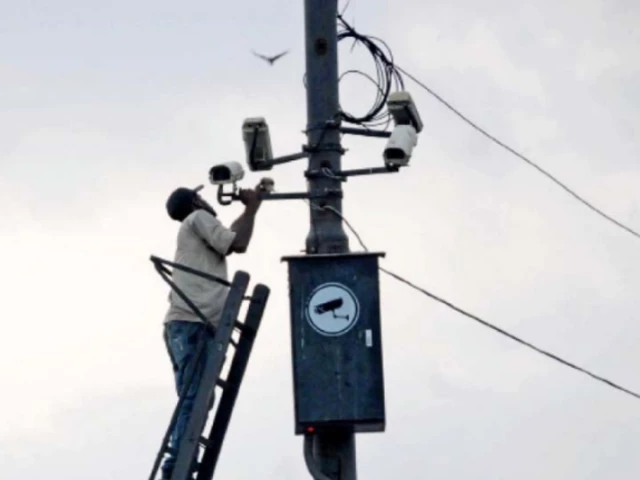
President Asif Ali Zardari, on the advice of Prime Minister Shehbaz Sharif, has approved an ordinance aimed at protecting Islamabad Capital Territory's Safe City cameras and surveillance infrastructure and providing compensation for any damage, said a statement by the President's Office on Saturday.
"The objective of the ordinance is to safeguard the Safe City cameras and surveillance system from damage and to ensure compensation in the event of any damage," it stated.
According to the statement, under the ordinance, financial penalties may be imposed for damaging Safe City cameras or surveillance infrastructure, as well as for "inciting or encouraging such damage".
صدرِ مملکت آصف علی زرداری نے وزیرِ اعظم کی ایڈوائس پر اسلام آباد کیپٹل ٹیریٹری سیف سٹی کیمرا اور سرویلنس انفراسٹرکچر کے تحفظ اور نقصان کی تلافی سے متعلق آرڈیننس کی منظوری دے دی۔
— The President of Pakistan (@PresOfPakistan) September 26, 2026
آرڈیننس کا مقصد سیف سٹی کیمروں اور نگرانی کے نظام کو نقصان سے محفوظ بنانا اور نقصان کی صورت میں اس کی…
It further added that a penalty of up to Rs2 million may be imposed for damage to each Safe City camera or piece of surveillance infrastructure.
"The ordinance also provides that if damage occurs during rallies, processions, sit-ins, protests, strikes or gatherings, the organisers may also be held responsible for the damage," the statement from the presidency said.
Read: Capital to get AI-powered crime watch
The statement said that the amount of the fine and the cost of the damage would be determined by an authorised officer after providing an opportunity for a hearing.
"The relevant person will have the right to appeal against the determination of the fine or damage cost before the District and Sessions Judge, Islamabad, within 30 days," it added.
It stated that if the imposed fine or damage amount was not paid, it may be recovered as arrears of land revenue. The amounts collected through fines and damage compensation would be used for the repair and replacement of Safe City cameras and surveillance infrastructure.
PTI postpones long march
Acknowledging the difficulties and potential consequences of holding a long march amid extensive security and traffic restrictions imposed by the Pakistan Muslim League-Nawaz (PML-N)-led federal and Punjab governments, the Pakistan Tehreek-e-Insaf (PTI) on Friday announced postponing its much-touted long march on Islamabad, originally scheduled for September 27, until October 4.
The decision appeared to render the federal government in a bind as it with the coordination of the Punjab government made an extensive security operation, which included blocking access points to Islamabad for traffic from Punjab with nail-studded metal barriers, erecting walls of shipping containers across the city, and deploying Rangers and large contingents of police.
Addressing a news conference in Peshawar, Khyber-Pakhtunkhwa (K-P) Chief Minister Sohail Afridi, after securing formal approval from the party's political committee, announced that a "sea of people" would leave Peshawar on the new date as part of the party's political strategy.
He said the decision had been taken purely as a political strategy and that the march would now depart from Peshawar on October 4.
The decision had not, however, been endorsed by PTI's allies in TTAP as of the filing of this report, according to sources, who attributed the disagreement to a lack of coordination. K-P CM Afridi said TTAP leaders would join him on stage during the march, while acknowledging differences between PTI and the alliance.
Speculation over a possible postponement had circulated for about 40 hours, with the proposal first discussed at the K-P level during a Zoom meeting, according to party sources. A political committee meeting was subsequently convened to formally approve the decision, which sources said was endorsed without significant debate.
One party leader suggested not announcing a new date for the march, arguing that this would keep the government uncertain about PTI's plans. Asad Qaiser disagreed, saying that postponing the march without announcing a new date could be interpreted as a withdrawal, according to the sources.
The party also informed opposition leader Mahmood Khan Achakzai about the decision. The postponement to October 4 was also reported by multiple outlets following the political committee's decision.
Interestingly, Afridi held two news conferences on Friday. At the first, during the day, he vowed to proceed with the march at all costs but remained vague about its date. At a second news conference after the party meeting, he announced that the march had been postponed to October 4.
Based on Afridi's remarks, the move appeared aimed at allowing the party to mark PTI founder Imran Khan's birthday, which falls on October 5, in Islamabad.
Afridi said October 5, the birthday of PTI founder Imran, would be observed by party workers, who would cut cakes and celebrate a "Victory Day".
The decision to postpone the September 27 march was taken by the PTI political committee. Afridi said a proposal had been placed before the committee two days earlier to defer the march until the first week of October. Following lengthy consultations, the committee agreed to postpone it until October 4.
He said the decision was unanimous and reiterated that the postponement was part of a political strategy.
Afridi claimed that the federal government had become unnerved by the planned march and alleged that all routes leading into K-P had been blocked.
He likened the government's actions to the "same conspiracy" that had preceded the events surrounding East Pakistan and alleged that the measures were aimed at breaking up Pakistan. He questioned what the government hoped to prove by closing the routes.
"We are political people and will pursue a political struggle," Afridi said, adding that those expecting a repeat of the May 9-style operation against PTI were mistaken and that his party would foil "a conspiracy" against it.
He said that if the authorities wanted to arrest people or stop the march, they should come in uniform.
Afridi said PTI respected uniformed personnel, but those arriving in plain clothes would be dealt with differently.
He claimed that Imran could be released within a minute if the courts began functioning properly, adding that the Supreme Court (SC) had ordered the PTI founder's transfer to hospital but the order had not been implemented.
Afridi said all relevant issues had been discussed by the political committee and that the committee had agreed that the march would depart from Peshawar on October 4.
He also referred to a statement made some time ago by Punjab Chief Minister Maryam Nawaz that she feared other provinces rather than India, and questioned the message such remarks sent to K-P.
Afridi criticised Adviser to the Prime Minister on Political Affairs Rana Sanaullah for calling PTI members terrorists and asked what message the federal government was giving to the province.
He alleged that PTI members of the provincial assembly were being picked up and that roads had been blocked along the K-P border.
Afridi insisted that PTI was a political and peaceful movement and alleged that the government wanted to build cases against the party again in a manner similar to those following May 9.
"Our fight is for the supremacy of the Constitution and the law," he said.
'Conspiracy against K-P'
The K-P chief minister alleged that efforts were being made to keep PTI and the establishment locked in confrontation, while planes and vehicles were being purchased.
He further accused the PML-N of effectively becoming the Punjab police and alleged that PML-N leaders were creating a "terrorist" narrative against PTI.
Afridi alleged that some people were being brought into PTI ranks and said he was warning in advance that anyone planning any action against the party should come in uniform.
He said PTI would not raise sticks against uniformed personnel.
Afridi appealed to the chief justice of the SC to take action over "efforts to cut K-P off from Pakistan".
He said the political struggle was a "Test match" and added that PTI had already won the toss.
Afridi said negotiations would continue after the long march and criticised the extensive use of containers in Islamabad, saying the federal capital had effectively been turned into a "container city".
He warned that those who came out on October 4 would not be under anyone's control.
The decision to postpone the march and the new date were also conveyed to Mahmood Khan Achakzai and Senate Opposition Leader Allama Raja Nasir Abbas by PTI Chairman Barrister Gohar Ali Khan, Afridi said.
He reiterated that postponing the long march was part of PTI's political strategy.
The postponement followed days of uncertainty over the September 27 schedule. PTI had previously been preparing for a nationwide protest and long march towards Islamabad, while opposition leaders had been consulting over the timing and political strategy surrounding the mobilisation.
It is pertinent to note that the decision came amid an internal debate over the feasibility and timing of the march, as party sources said there had been a proposal to "exhaust" the federal government and law-enforcement agencies because the federal capital and several routes had already been closed or restricted.
The sources claimed that the PTI had already achieved what it wanted through the march, with roads shut and hundreds of millions of rupees being spent on law enforcement.
The announcement was welcomed by PTI and some members of TTAP, who said the decision recognized the cost to the government of either maintaining the security arrangements until Oct. 4 or redeploying them closer to the new date.
A TTAP leader described the move as a significant setback for the government, saying the chief minister had gained an advantage simply by postponing the march. The leader said measures introduced to restrict PTI's planned mobilisation could ultimately impose a greater burden on the government if they had to be maintained or reinstated.
According to PTI leaders, the march will now leave Peshawar on October 4. Earlier discussions within the party had also considered October 5 to 10 as a possible new window.
The party sources said the decision had nothing to do with the Jamaat-i-Islami (JI), whose own protest march against the petroleum levy had been postponed at the request of the prime minister.
A senior PTI leader said the postponement offered the party two main advantages: it would increase pressure on a government that had taken extensive measures to prevent the march, while also creating an opportunity for negotiations to resume. PTI leaders have, however, said no meaningful negotiations were currently under way.
The decision was rejected by TTAP, whose leader said Mahmood Khan Achakzai and Allama Nasir Abbas had been repeatedly sidelined by the K-P chief minister during consultations on major decisions. The leader said TTAP had also not been consulted before the Sept. 27 date was announced and was again left out of consultations over the latest postponement, describing it as adding "insult to injury."
Asked about the criticism, Afridi said PTI Chairman Barrister Gohar Khan had communicated the party's decision to both leaders.
According to sources, PTI leadership had contacted Achakzai and requested that he announce a new date for the long march. At the time, however, Achakzai had refused to announce its postponement and maintained that the countrywide movement would begin on September 27.
Sources said Achakzai's position was that the movement would begin in Khyber Pakhtunkhwa and other provinces on September 27 and would gradually move towards Islamabad.
The disagreement over postponing the long march between PTI leadership and Achakzai remained unresolved for a time, while efforts to persuade the opposition leader continued.
PTI leadership also continued consultations with opposition leaders over the date of the long march.
Against this backdrop, PTI Chairman arrived in Islamabad from Mianwali to meet Achakzai and other opposition leaders.
Gohar subsequently met Achakzai and briefed him on the PTI's position regarding the long march, according to sources.
The sources said PTI leadership wanted the long march postponed and wanted Achakzai, as opposition leader, to announce the decision.




This material may not be published, broadcast, rewritten, redistributed or derived from. Unless otherwise stated, all content is copyrighted © 2026 The Express Tribune.


1727268465-0/Untitled-design-(42)1727268465-0-208x130.webp "sisyphus in the land of saviours")
COMMENTS (1)
Comments are moderated and generally will be posted if they are on-topic and not abusive.
For more information, please see our Comments FAQ