Vance acknowledges 'failures' in US handling of Iran war
Updated 2 hours ago

Parliament speaker says Iran could join; FM Fidan rejects Yemen crisis as immediate test
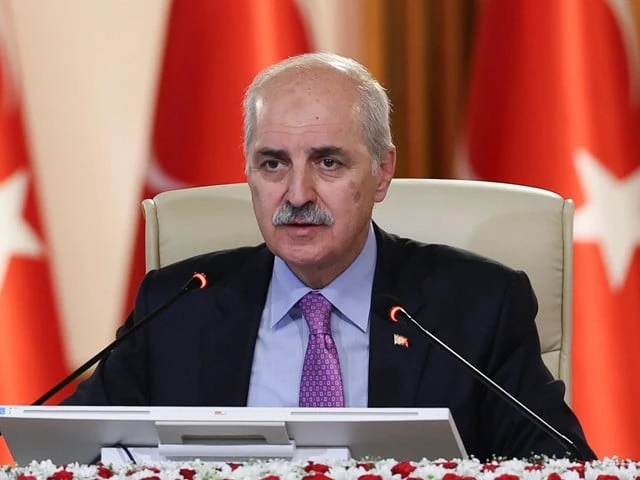
The defence pact between Turkiye, Saudi Arabia and Pakistan could develop into a broader agreement "for the Muslim world" that includes Iran, Turkish Parliament Speaker Numan Kurtulmus said on Friday, adding that it is expected to be submitted for ratification from next month.
The regional powers signed the "Makkah Joint Defence Agreement" in August, weeks before Yemen's Iran-backed Houthis launched attacks against Saudi Arabia in reaction to the wider Iran war. Similar to NATO's Article 5, the pact stipulates that an attack on one ally constitutes an attack on all.
As the three sides holding meetings to lay out the parameters of the accord and assess Riyadh's needs, Turkish Foreign Minister Hakan Fidan has hit back at critics of the pact, saying it was unfair to judge the agreement over the escalation in the decade-long crisis between Saudi Arabia and Yemen.
Kurtulmus told reporters in Ankara that the meetings held as part of the agreement were preparatory meetings. "For international agreements to come into effect, parliamentary approval is needed," he said. "I expect this issue to come on the parliament's agenda in the coming period [next month]," he added.
Asked whether the pact was directed against Iran, Kurtulmus repeated Turkiye's position that the agreement did not target any specific country but was primarily aimed at ensuring the security of states in the region amid conflicts and Israel's "hostile policies".
He added that Tehran could potentially join the pact. "We never see the Makkah Agreement as a pact against Iran, it must not be that way. In fact, we hope the Makkah Agreement can turn into a broader agreement for the Muslim world. Iran can join this agreement too; we hope it will become much stronger with the participation of other regional countries," he said.
Meanwhile, speaking at a seminar in New York, Foreign Minister Fidan compared criticism of the defence pact with NATO's record of collective defence, saying NATO's Article 5 – which provides for collective defence – had been invoked only once in its history.
Addressing former US ambassador James Jeffrey, who was also present at the seminar, Fidan asked him when he had joined the army. Jeffrey replied that it was almost 50 years ago. Fidan then asked how many times Jeffrey had witnessed the activation of Article 5 of the NATO Charter. "Only once," Jeffrey replied.
Fidan then said that despite Article 5 being invoked only once during NATO's history, no one described the alliance as a "paper tiger". He questioned why the newly-established defence alliance should immediately be expected to prove its effectiveness by resolving the crisis in Yemen, which continues for nearly 10 years.
"When it comes to a new defence alliance, they point to a 10-year-old crisis and say: Look, it's not working. We've only just started," Fidan said. He emphasised that the Makkah Joint Defence Agreement between Pakistan, Turkiye and Saudi Arabia was aimed at contributing to peace and stability in the region.
The discussion on Makkah agreement focused on its ability to respond to regional challenges. Fidan rejected "premature expectations from the new alliance", arguing that "an alliance that had only just been established should not be judged against a crisis that had persisted for years".










This material may not be published, broadcast, rewritten, redistributed or derived from. Unless otherwise stated, all content is copyrighted © 2026 The Express Tribune.





1727268465-0/Untitled-design-(42)1727268465-0-208x130.webp "sisyphus in the land of saviours")
COMMENTS (1)
Comments are moderated and generally will be posted if they are on-topic and not abusive.
For more information, please see our Comments FAQ