IMF flags risks to global economy from AI market correction, war and debt
Updated 1 hour ago

Agreement in line with Türkiye’s 2053 net-zero emissions, energy independence goals
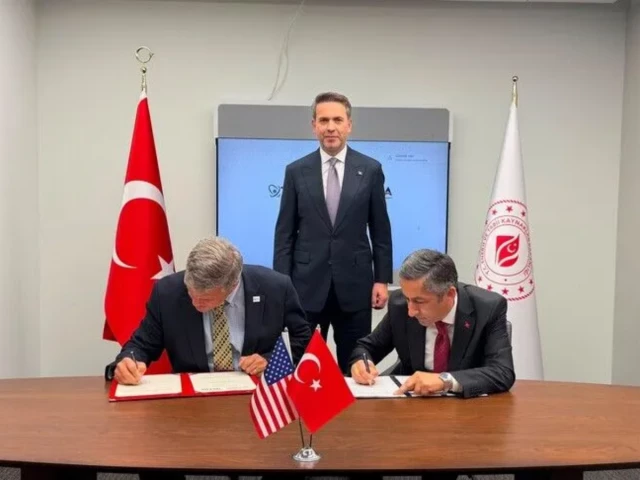
The Turkiye Nuclear Energy Incorporated (TUNAS) and the US Trade and Development Agency (USTDA) signed a grant agreement on small modular reactors (SMRs) and fourth-generation reactors at a ceremony at Turkevi in New York, Turkiye's Energy and Natural Resources Minister Alparslan Bayraktar said Tuesday.
Bayraktar said in a post on the US-based social media platform X that the agreement will enable Turkiye to comprehensively assess the technical, economic and regulatory feasibility of next-generation nuclear technologies.
"In line with our goals of Net Zero Emissions by 2053 and full energy independence, we are committed to diversifying our energy mix," he added.
Read: Turkish president calls for UN Security Council reform, end to veto privilege
"In addition to our large-scale nuclear power plants, we will continue with determination to build a robust and modern energy infrastructure by meticulously exploring the alternatives best suited to our country's needs," he said.
Turkiye-US ties go beyond military cooperation, NATO remains key: Turkish president’s chief adviser
Turkish President Recep Tayyip Erdogan's Chief Foreign Policy and Security Adviser Akif Cagatay Kilic said Monday that Turkiye-US ties extend beyond military cooperation, with NATO remaining a key pillar.
"The relationship that we have with the US is profoundly different to a lot of the relationships that we have around the world," Kilic told a panel titled "Turkiye-US Relations on the Eve of the Centennial."
Read more: US to open two new military bases in Greenland, sources say
The panel was organised by Turkiye's Communications Directorate in New York amid the UN General Assembly week.
It was also attended by Cagri Erhan, deputy chair of the Presidential Council for Security and Foreign Policy, former US Ambassador to Turkiye and retired diplomat James Jeffrey, and former US Ambassador to Azerbaijan Matthew Bryza.
Stressing that the bilateral ties are not solely based on military relationships alone, Kilic added: "But I think NATO is an important part of our relationship."
The region and geography in which Turkiye found itself in the 1950s and 1960s had changed significantly over time, resulting in a very different regional landscape today, he highlighted.
Turkiye's presence stands as a constant factor in the geography, he underlined, adding that Ankara is "a main and pivotal point in stability."
Meanwhile, Erhan stressed the historical aspect of the bilateral ties, saying they date back to the 1830s, when the Ottoman Empire was in place.
He recalled that although the US entered World War I, it never declared war on the Ottoman Empire.
"They declared war to Germans, not Ottomans."









This material may not be published, broadcast, rewritten, redistributed or derived from. Unless otherwise stated, all content is copyrighted © 2026 The Express Tribune.






COMMENTS
Comments are moderated and generally will be posted if they are on-topic and not abusive.
For more information, please see our Comments FAQ