New large docodont fossil sheds light on Jurassic mammaliaform diversity
Updated 21 hours ago

Talks lay groundwork for Trump-Xi summit this week as Beijing's response to proposal remains unclear
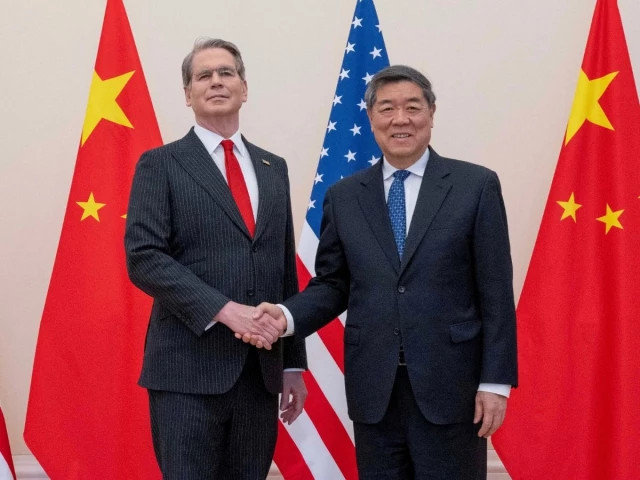
United States Treasury Secretary Scott Bessent and Chinese Vice Premier He Lifeng concluded talks in New York on Sunday with the US side proposing a new AI safety notification mechanism for US President Donald Trump and Chinese President Xi Jinping to consider at their summit this week.
Bessent told reporters that the two sides discussed setting up a new US-China AI dialogue, with a particular emphasis on national security concerns with a notification system for common goals and common threats that would cover AI-related incidents that rise to a national security level.
"We think that, just like with any cross-border activity, that moving from opaque to more transparency between the number one and the number two AI powers in the world is very important," Bessent said at the conclusion of the talks.
Trump and Xi first discussed potential consultations on AI development in May in Beijing, but that forum was never formalised.
The Chinese response to the US proposal was unclear with a state news agency Xinhua readout only briefly acknowledging that both sides spoke about AI. Xinhua characterised the officials as having had "frank, in-depth and constructive exchanges on key economic and trade issues", including implementing agreements reached in earlier rounds of trade and investment consultations.
"Obviously, one or two meetings cannot resolve every issue, but the fact that both sides agreed to continue the dialogue is significant," said George Chen, partner and chair in Digital Practice at The Asia Group consultancy in Hong Kong. "The US–China AI talks will move forward, with future sessions expected to tackle more sensitive topics such as the weaponisation of AI, principles for AI safety, protection of critical infrastructure, and cyber‑attack prevention."
Read: Trump says he will appoint a new AI adviser, without providing details
Chen added that prospects for cooperation on AI remain limited due to the low level of trust between both countries, and Beijing's perception that Washington seeks to contain China's AI development.
Vice Premier He and China's chief trade negotiator Li Chenggang left the talks at JPMorgan Chase headquarters in New York without speaking to media.
US Trade Representative Jamieson Greer said US export controls on sophisticated AI chips and semiconductor manufacturing equipment were not on the agenda for the AI mechanism talks.
Greer added that Sunday's discussions would prepare the groundwork for a "successful summit" between Trump and Xi next Thursday and Friday in Washington. "These are the two most powerful countries on earth, whether it's in trade or AI, and it's imperative that they're able to work together. It doesn't mean there aren't challenges in the relationship. A lot of these are obvious," Greer said.
Read More: Founder of Chinese startup Spirit AI says robot brains set for 2027 breakthrough
The meeting covered other key topics, including plans to "operationalise" a process agreed in May for each side to identify potential tariff cuts on non-strategic goods, called the "Board of Trade."
Greer did not identify a specific list of products that could see such reductions, but he repeated his desire for a "relatively small subset of American and Chinese goods that can be traded in a balanced way, that are non-sensitive." These would be considered as "a class unto themselves."
Potential candidates among Chinese exports include "consumer goods, low-tech items," he said, while US exports for this treatment could include energy, agricultural goods and medical devices, he added.
Greer and Bessent did not mention any progress on improving the flow of critical minerals to US companies, which US officials have said are insufficient despite Beijing's prior commitments to ease restrictions under last year's US-China trade truce.
The discussions point to more incremental progress in avoiding an escalation of tensions in a delicate trade relationship that has major consequences for the global economy.
Unresolved issues
Bessent and Greer did not provide updates on other issues that are unresolved after the May meeting in Beijing between Trump and Xi, including Chinese pledges to increase purchases of US agricultural goods by $17 billion a year and to purchase more than 200 Boeing aircraft.
Trump and Xi must reach a deal that covers AI safety, said US Representative Ro Khanna, the ranking Democrat on the US House Select Committee on Strategic Competition Between the US and the Chinese Communist Party.
Also Read: China, US find new trade ties in services
"The first ask is of Trump and Xi Jinping to come up with an international agreement, and two of the core principles should be one banning any self-improving AI, recursive self-improving AI.…The second is to have safeguards so that AI can't be misused by people for biological nuclear weapons," Khanna said on Sunday, speaking on CBS' Face the Nation program.
Tariff reductions, investment
China's Ministry of Commerce said on Saturday that He would also lead a delegation of Chinese companies to the US that would participate in economic and trade consultations ahead of the summit.
The business delegation, which mirrors a group of US CEOs that Trump brought to Beijing in May, was announced as Trump expressed openness to Chinese automakers building US factories.
US auto industry groups on Friday urged Trump to maintain an effective ban on Chinese vehicle sales in the US on national security grounds.







This material may not be published, broadcast, rewritten, redistributed or derived from. Unless otherwise stated, all content is copyrighted © 2026 The Express Tribune.







1727268465-0/Untitled-design-(42)1727268465-0-208x130.webp "the poor man s burden")


COMMENTS
Comments are moderated and generally will be posted if they are on-topic and not abusive.
For more information, please see our Comments FAQ