K-P emergency fuels PSX sell-off as index drops over 700 points
Updated 31 minutes ago

Pakistan knows its floods risk but yet to build financial tools to price it
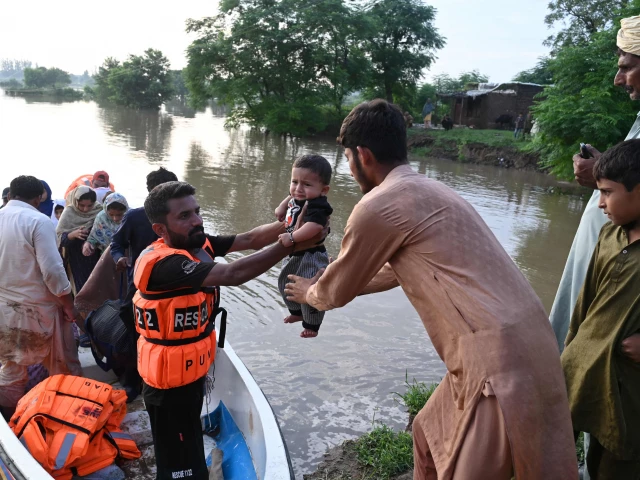
Every monsoon season, Pakistan produces the same headlines: submerged villages, displaced families, ruined crops. The story is always told as tragedy. It is rarely told that it is a balance sheet problem, hiding in plain sight that Pakistan's economic system has simply chosen not to price. That omission is starting to look less like an oversight and more like a structural flaw in how the economy runs.
Let us start with what has already been measured. The floods in 2022 caused an estimated $14.9 billion in damages and $15.2 billion in broader economic losses – roughly 4.8% of GDP wiped out in a single season. Housing absorbed the largest hit, at $5.6 billion, with agriculture, livestock and fisheries close behind at $3.7 billion. GDP growth for that fiscal year was cut nearly half from initial projections and independent estimates suggest 9 to 12 million people were pushed into poverty almost overnight.
None of this was a one-off. A UN report modelling worst-case climate scenarios estimated Pakistan could face average annual losses equal to more than 9% of GDP going forward. And the pattern has already repeated. Flooding in subsequent monsoon seasons has again battered the country's agricultural core, pushing up food prices and straining supply chains once more.
This is not a series of disasters. It is a recurring, semi-predictable cost that shows up in accounts every few years, the way a bad loan eventually shows up on a bank's books. The only difference is that nobody is required to reserve against it. In any functioning risk market, a cost this large, this recurring, and this geographically concentrated would be priced through insurance premiums, lending terms, land valuations or crop financing. In Pakistan, it mostly is not.
Consider agriculture, which accounts for roughly a quarter of GDP and employs half the labour force, yet operates with almost no meaningful crop insurance penetration. Farmers in flood-prone districts of Sindh, which absorbed nearly 70% of total damages and losses in 2022, plant and hope, year after year, with no financial instrument to smooth the blow when the water comes. When it does come, the loss is not absorbed by a diversified pool of capital; it's absorbed by whichever household happened to be standing in its path.
The same is true of housing and small enterprise. Banks lend against flood-exposed property with financing terms that look identical to those for property nowhere near a floodplain. Insurers, where they exist at all for ordinary households, treat monsoon as background weather rather than a modelled risk variable. The result is that climate risk is real, recurring and enormous, and almost entirely unpriced, unpooled and unhedged.
As the risk is not priced in advance, it gets paid for after the fact and disproportionately by people with the least capacity to absorb it. More than 70% of Pakistan's labour force works in the informal sector, largely outside any formal social protection net. When floods hit, these households don't file insurance claims; they sell livestock, pull children from school, or take on informal debt at punishing rates. The floods of yesteryears alone are estimated to have cost roughly 2 million jobs.
This is the quiet subsidy structure of Pakistan's climate exposure; the state and international donors step in after each disaster with relief and reconstruction financing. The reconstruction needs from 2022 alone were estimated above $16 billion, while the underlying risk that caused the damage remains unpriced and therefore uncorrected. Every flood season, the country effectively refinances the same exposure rather than reducing it.
This does not require a political argument about who caused climate change or who should pay reparations for it, the debate that usually swallows this topic. It requires something narrower and more technical, ie, building the market infrastructure to price a known, recurring risk.
That means parametric insurance products for smallholder farmers, where payouts are triggered automatically by rainfall or flood-level data rather than slow claims assessments. Such models are already piloted in Bangladesh and parts of East Africa. It includes differentiated lending terms for property and agriculture in high-exposure zones, so capital naturally migrates away from the riskiest ground over time instead of being incentivised to double down on it.
It means the State Bank and the Securities and Exchange Commission of Pakistan building the regulatory scaffolding for a domestic catastrophe-risk insurance market, rather than leaving climate financing entirely to post-disaster international assistance. None of this, however, eliminates the floods. But it changes who absorbs the cost, and when. Right now, the cost lands entirely on the household, entirely post facto, with no mechanism to spread it across time or across a risk pool. Pricing the risk in advance, however imperfectly, converts a repeated, uninsured shock into a manageable, budgeted cost. That is a more resilient economy, even if the weather doesn't change at all.
Pakistan is not short on climate data. Meteorological modelling, flood-mapping and rainfall attribution studies exist in reasonable depth. What is missing is the translation of that data into financial instruments that ordinary households and small businesses can actually use.
Every year this gap persists, the bill compounds. Reconstruction becomes more expensive than prevention would have been. Displaced agricultural labour shows up later as urban unemployment. Informal debt taken on after one flood makes households more vulnerable to the next.
The climate conversation in Pakistan tends to default to blame on who emitted what, who owes whom. That conversation matters, but it has also become a way of deferring the more immediate question: why hasn't Pakistan's own financial system built the tools to price in a risk it already knows?
THE WRITER IS AN INTERNATIONAL ECONOMIST








This material may not be published, broadcast, rewritten, redistributed or derived from. Unless otherwise stated, all content is copyrighted © 2026 The Express Tribune.






1727268465-0/Untitled-design-(42)1727268465-0-208x130.webp "the poor man s burden")
COMMENTS
Comments are moderated and generally will be posted if they are on-topic and not abusive.
For more information, please see our Comments FAQ