PSX down 481 points on low trading volume
Updated 6 hours ago

Wholesale wheat up Rs42/kg; hoarding, supply chain and storage blamed
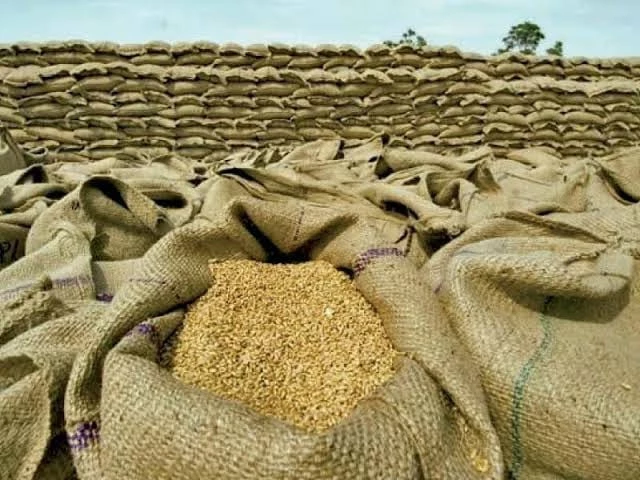
Despite a strong harvest last year, Pakistani households still buy expensive wheat. Millers and grocers charge more for atta every month. The same crop is natural and GMO-free, yet sellers offer it to the world at a discount instead of a premium. Mismanagement, a weak supply chain and an inefficient storage system produce both outcomes at once.
Karachi wholesale numbers show the domestic half of that story. Four months ago, traders sold wheat at Rs90 a kilogramme (kg). The same parcel now crosses Rs132 a kg, a jump of Rs42. Wholesale 2.5 flour has climbed Rs55 to Rs155 a kg. Fine flour has risen Rs45 to Rs157. Chakki flour has risen Rs45 to Rs180. Kisan Ittehad Chairman Khalid Hussain Batth says a 50-kg flour bag now costs as much as Rs8,000 in parts of the market. Poor families cannot absorb that bill. "Flour has become dear in Sindh, Balochistan, Khyber-Pakhtunkhwa and Punjab," he said. "The farmer worries. The consumer worries. Both lose."
Wholesale Grocers Association Chairman Rauf Ibrahim blames last year's deregulation and the absence of a firm support price. He told The Express that the policy served a thin elite – he puts the share at about 5% – rather than the ordinary buyer, and he accuses the same circle of hoarding. He calls last year's farmgate buying near Rs55 a kg an unfair deal for growers. Encouraging production, he says, did not survive poor administration. The federal plan to bring in 750,000 tonnes through the Trading Corporation of Pakistan will not cover national use, he argues, and those cargoes can arrive only in November. Until then, he warns, hoarders will keep lifting atta prices. Karachi needs about 12,000 tonnes of wheat a day. Sindh needs about 24,000 tonnes.
Batth goes further. Pakistan grows wheat, he says, so an import tender marks a policy failure. Officials buy foreign grain while local stocks sit in the system. He asks why the state lifts wheat from small farmers' houses and then pays Passco Rs4,150 per 40 kg after growers received as little as Rs2,100 a maund. He calls a plan to take a million tonnes from Passco anti-farmer. He wants an account of grain seized from homes. Kisan Ittehad, he says, will file a constitutional petition against the wheat policy.
Those accusations sit beside a quieter export failure. Pakistan does not commercialise GM wheat. That identity should help sellers in markets that pay for non-GM grain. It rarely does. Traditional stores, bags and open plinths mix lots, hold moisture and invite pests in fog and rain. Maize suffers more visibly: humidity in informal sheds lets aflatoxin develop and knocks parcels out of strict export limits. Wheat loses milling value the same way. Modern silos use sensors that tell a manager when humidity rises so the lot can be dried before toxins and insects destroy the price. Without that kit, a non-GM cargo sells as a risky bulk cargo.
Louis Dreyfus Company (LDC) uses that gap as its commercial case. The merchant dates to 1851, when Léopold Louis-Dreyfus moved Alsace wheat to Basel in Switzerland. LDC entered Pakistan in 2010 and has traded here for about 15 years, first in cotton and other lines, and it imported soybeans while it built a local book. It now handles cotton, grains, oilseeds, pulses, rice and sugar. On September 2 it opened a 40,000-metric-tonne grain store in Multan, its first owned industrial site in the country. In December 2025 it signed a clean-bulk terminal deal at Karachi Port with AD Ports' KGTML.
LDC Country Head for Pakistan and Head of Grains and Oilseeds Muhammad Danyal frames the price penalty in dollars. If comparable wheat trades near $290 a tonne, Pakistani sellers often accept about $270 – a $20 discount – "because buyers price quality risk, not a non-GM badge." Investing in logistics, he says, serves suppliers and customers, supports a more resilient grains chain and creates local jobs. LDC Head of South and Southeast Asia Rubens Marques calls Pakistan a key grains destination in a region that depends on connected farm trade, as per a company statement.
The crop arithmetic explains why a 40,000-tonne box matters as a signal, not as a national fix. Official planning still uses about 115 kg of wheat per person a year. Output sits near 30 million tonnes; consumption runs closer to 31 million. Rice adds several million tonnes. An agricultural country still imports pulses, including Australian chickpeas. Punjab has told firms to buy at Rs3,500 per 40 kg in the AprilMay window and has offered to cover about 70% of financing cost on a Kibor-linked structure so private aggregators can hold grain. Under that design, sellers can move stock later in the season as carrying costs rise; a 10% September margin on Rs3,500 implies about Rs3,850 per 40 kg. The LDC country head points to that calendar as the state's attempt to put private cash into a chain it no longer wants to run alone.
The limits stay structural. Smallholders dominate the countryside and lack a reason to grade grain for a commercial silo. Climate cuts both ways in LDC's reading: an El Nino-dry pattern can still meet short-run water from glacier melt, even as climate risk hangs over the longer term. Neither fact replaces warehouses. Passco's open stores lose more grain than covered godowns. Millers dispute moisture in official issues. The private sector and Punjab talk of new silos. Chinese investors talk of joint ventures. Until sensors, drying and identity-preserved storage become common, Pakistan will tax its own consumers at the shop and discount its own farmers on the world market: two prices, one failure, and a Multan silo that shows the missing middle without filling it.













This material may not be published, broadcast, rewritten, redistributed or derived from. Unless otherwise stated, all content is copyrighted © 2026 The Express Tribune.









COMMENTS
Comments are moderated and generally will be posted if they are on-topic and not abusive.
For more information, please see our Comments FAQ