Gaza hospital generators stop operating amid shortages of fuel, oil: Health Ministry
Updated 2 hours ago

In a joint foreign ministers' statement, 12 countries vow restrictions on trade with illegal Israeli settlements
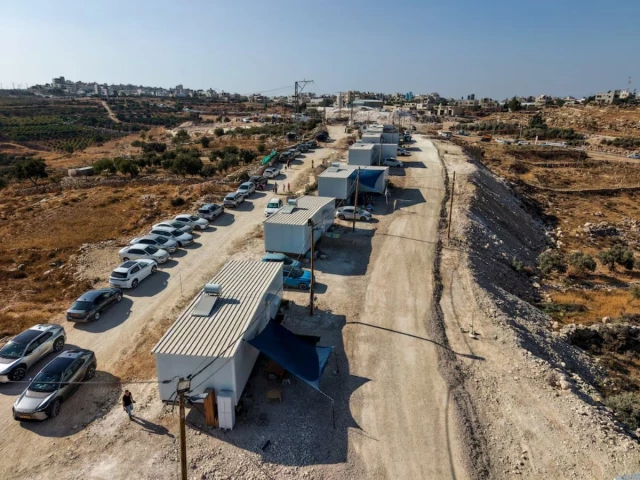
Britain on Tuesday announced a trade ban on goods made in Israeli settlements in the occupied West Bank in coordination with France and Canada, the latest sanctions to target Israel as it faces growing diplomatic isolation.
British Foreign Minister Ed Miliband said Britain could no longer simply "call out" injustice and suffering, but told the House of Commons that the country now had to "act" to oppose the expansion of settlements.
"Today we refuse to be bystanders to further suffering and to the destruction of the two-state solution," Miliband said, referring to Britain's long-held support for the two-state idea, which Israel opposes.
Watch my parliamentary statement on Israel and Palestine in full: pic.twitter.com/aVTJUrnQeE
— Ed Miliband (@Ed_Miliband) September 8, 2026
Read: 'West Bank facing systematic ethnic cleansing'
The US, through its ambassador to Israel, has already criticised Britain's new sanctions, while two Israeli ministers called for measures to be taken against Britain.
Miliband, who became Britain's foreign minister in July, also said Britain's position is that the occupation in the West Bank is unlawful, and that London believes that there is ethnic cleansing of Palestinians in areas of the West Bank.
France and Canada to join UK in banning goods from Israeli West Bank settlements
— FRANCE 24 English (@France24_en) September 8, 2026
➡️ https://t.co/fYhXnAuMjT pic.twitter.com/xoCfDgbayp
The impact on the £6 billion ($8.12 billion) of annual bilateral trade is likely to be minimal, with details unclear on how the UK will differentiate between goods originating in West Bank settlements and products made in Israel.
According to Bloomberg, British diplomats privately told the Americans that the sanctions being imposed on settlements were largely "symbolic” and would not have a "material impact" on Britain’s broader "trade and security relationship" with Israel.
Israeli reaction
Two prominent Israeli ministers reacted angrily to the move. Finance Minister Bezalel Smotrich called for the British ambassador in Tel Aviv to be expelled, while National Security Minister Itamar Ben-Gvir asked Netanyahu to close the British Consulate in East Jerusalem, which is accredited to the Palestinian Authority in the West Bank.
Read More: Extremist Israeli ministers call for retaliation against UK over looming sanctions
Israeli President Isaac Herzog meanwhile accused Britain of interfering in Israel's upcoming elections, due in late October.
Sanctions on Israel from the UK - or any other nation - will prove to be a grave miscalculation, a gross interference in the democratic elections of a sovereign nation, and a decision that will fall on the wrong side of history.
— יצחק הרצוג Isaac Herzog (@Isaac_Herzog) September 8, 2026
Sanctions are not a solution – dialogue is. I say… pic.twitter.com/ZKjLENRQtG
The focus of recent concerns is Israel's E1 settlement project in the West Bank not far from Jerusalem, which would cut across land the Palestinians seek for a future independent state and which Miliband said put the two-state solution at risk.
Smotrich on Tuesday announced the advance of plans for 1,000 new homes in two other settlements in the West Bank.
The United Nations, Palestinians and most countries regard settlements as illegal under international law. Israel disputes this.
Britain in 2025 joined other countries to recognise a Palestinian state as a means to promote a two-state solution, and in June it sanctioned Israeli networks involved in financing, enabling and carrying out violence in the Israeli-occupied West Bank.
Israel-UK relations have become increasingly strained in recent years with London criticising Israel's conduct in Gaza, the expansion of settlements in the West Bank and rising settler attacks on Palestinians.
US Ambassador to Israel Mike Huckabee told the BBC that the sanctions amounted to "discrimination against the Jewish people". He warned they could potentially limit the UK's ability to do business in some US states that prohibit companies that boycott Israel from being eligible for state government contracts, procurement or public investment.
"This is an irrational action... if the UK is really interested in dealing with issues they feel like are wrong, where are the sanctions against North Korea, China, Russia?"
— BBC Radio 4 Today (@BBCr4today) September 8, 2026
US Ambassador to Israel Mike Huckabee, who has accused the UK government and Ed Miliband of 'Jew hate'… pic.twitter.com/kPdVVudWn3
Goods originating from settlements are mainly agricultural, including fresh produce and wine, and make up only a tiny fraction of Israel's total trade flows.
The Israeli prime minister's office and foreign ministry did not immediately respond to requests for comment.
Miliband said on Tuesday that Britain, France and Canada were joining the Netherlands, Ireland, Belgium, Spain and Norway in banning goods or planning to ban goods from the West Bank.
12 countries vow restrictions on trade with illegal Israeli settlements in joint statement
In a "Joint Foreign Ministers' Statement on the Two-State Solution", 12 countries announced plans on Tuesday to introduce national restrictions on trade in goods with Israeli settlements that were illegal under international law, French Foreign Minister Jean-Noel Barrot announced.
"Today, France, the United Kingdom, Canada, Denmark, Spain, Finland, Ireland, Iceland, Norway, Poland, Portugal and Sweden confirm their intention to impose national restrictions on trade in goods with settlements that are illegal under international law and/or to support European restrictions to this effect," said a joint declaration issued by Barrot.
The statement reaffirmed that the 12 countries were "seriously considering" adopting such restrictions or other measures in accordance with their national procedures.
"In this regard, France, the United Kingdom and Canada welcome the significant measures already taken by Ireland, Spain, the Netherlands, Norway and Belgium, and will propose national measures to prohibit trade in goods originating from settlements," it added.
For more than 70 years, successive Canadian governments have held the position that a two-state solution is the way forward for long-term peace that also addresses Israel’s legitimate security concerns. Illegal settlements in the West Bank significantly undermine these… pic.twitter.com/geteRLuLWk
— Anita Anand (@AnitaAnandMP) September 8, 2026
The declaration decried actions taken by the Israeli government in the West Bank that undermined the possibility of a two-state solution.
"The situation is rapidly deteriorating as settler violence and settlement expansion have reached unprecedented levels, including the unacceptable decision to issue tenders for the E1 settlement project," it underscored.
They also stressed the need for protecting the possibility of a two-state solution and vowed their determination to work for a just and lasting peace.
"We firmly oppose any action resulting in the annexation of Palestinian land and the forced displacement of Palestinian populations," the declaration said.
It further urged Israel to immediately halt the expansion of illegal settlements and civilian administrative powers while ensuring that settlers responsible for violence were held accountable for their actions and investigating allegations involving Israeli forces.
Israel's foreign minister says it is closing British consulate in East Jerusalem
Israeli Foreign Minister Gideon Saar said on Tuesday that it was closing Britain's consulate in East Jerusalem, accredited to the Palestinian Authority in the West Bank, after London announced it was imposing sanctions on goods from Israeli settlements.
Saar also said Britain would no longer be able to allowed to participate in the US-led coordination mission for Gaza in Israel, that British training of Palestinian Authority forces in the West Bank would be terminated, and that some elected UK officials and other nationals would be banned from entering Israel.
"The British move is morally distorted, and constitutes blatant interference in the affairs of a sovereign state and its electoral process," he said, labelling what he described as accusations made by Miliband earlier as "outrageous lies".
Israel’s Foreign Minister Gideon Sa’ar:
— Clash Report (@clashreport) September 8, 2026
We are shutting down the British consulate in Jerusalem.
We will expel British representatives from the International Gaza Support Center in Kiryat Gat. pic.twitter.com/VGcLoLJARR
Saar said that he had coordinated Israel's response with Netanyahu. Israel will hold an election in late October.
UK’s trade restrictions on illegal Israeli settlements ‘bilateral issue’: UN
The UN described the UK’s decision to restrict imports from illegal Israeli settlements in the occupied West Bank on Tuesday as a “bilateral issue” between London and Israel.
Asked whether UN Secretary-General Antonio Guterres had a reaction to the announcement, spokesman Stephane Dujarric said the move was a sovereign decision by the UK.
“I think the secretary general's position and the UN's position on the illegality of settlements in the occupied West Bank is crystal clear, to say the least,” Dujarric told reporters.
Asked whether purchasing products from settlements and the illegality of the settlements were linked, Dujarric distinguished the issues.
“There’s the illegality of the settlements, the issue of trade between Israel and the United Kingdom is an issue, is a bilateral issue,” he said.
US 'not going to do' trade ban against illegal Israeli occupiers as UK: Rubio
US Secretary of State Marco Rubio told reporters on Tuesday in Miami that Washington had no plans to follow the UK's lead in taking action against illegal Israeli occupiers.
Asked about London's move, Rubio said Britain had briefed Washington beforehand but stressed the decision was the UK's. "Well, they alerted us to it. We don't have any announcements, obviously," he said. "These are decisions that they make."
"Obviously, we're not going to do what the UK did. We saw their announcement today, but I don't have any comment on it right now," he said, before departing for Colombia.
Rubio said Washington was wary of any escalation in the occupied West Bank. "We don't want to see some uptick in violence, or an uptick in conflict or tensions in the West Bank at a very tenuous time in the region," he said. "There's always tenuous times."
He linked the issue to broader US diplomatic efforts, arguing that it "has implications as well on our ability to make progress about Gaza and the 20-point plan and the Board of Peace that we're very committed to."
.@SecRubio on the United Kingdom banning imports from Israeli West Bank settlements: "Obviously we're not gonna do what the U.K. did. We saw their announcement today, but I don't have any comment on it right now." pic.twitter.com/gA3Hat31B5
— CSPAN (@cspan) September 8, 2026




1700422050-0/image-800x600-(54)1700422050-0-208x130.webp "marriyum says punjab cm s rising popularity behind criticism over uk trip terrorism remarks")



This material may not be published, broadcast, rewritten, redistributed or derived from. Unless otherwise stated, all content is copyrighted © 2026 The Express Tribune.


1727268465-0/Untitled-design-(42)1727268465-0-208x130.webp "elite survival pact")



COMMENTS
Comments are moderated and generally will be posted if they are on-topic and not abusive.
For more information, please see our Comments FAQ