Asif, Tarar fire fresh salvoes at PTI after talks deadlock
Updated 4 hours ago

Right's groups seek independent scrutiny of the corridor’s environmental, social and transport impacts
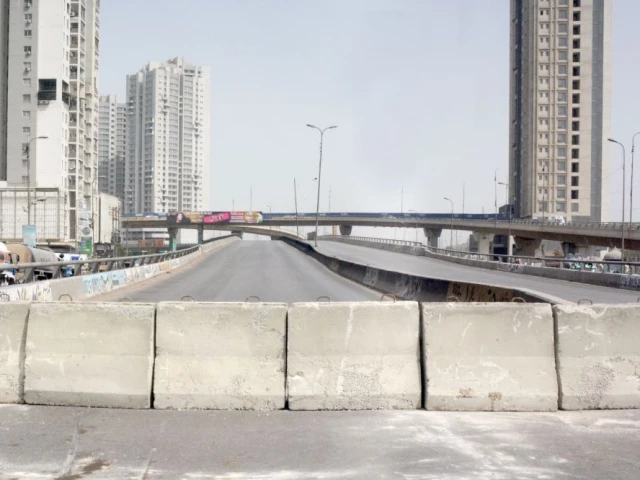
Environmental and social rights organisations have raised serious concerns over the proposed 16.5-kilometre Karachi Port to Qayyumabad Corridor (KPQC), calling for independent reviews of key environmental, social and transport issues before approval.
The objections were submitted during a public hearing held by the Sindh Environmental Protection Agency (SEPA) on August 18, attended by residents of Defence, Clifton and Qayyumabad and civic and rights groups. Green Chamber, Climate Action Center Karachi and Sindh Indigenous Rights Alliance submitted a 22-page document arguing that the Environmental and Social Impact Assessment (ESIA) relies on general assessments and lacks sufficient data, modelling and enforceable mitigation measures.
The proposed four-lane freight corridor will connect Karachi Port with Qayyumabad, with links to Shahrah-e-Bhutto and M-9. The objectors called for quantitative comparisons of road, rail, hybrid and traffic-management options in terms of cost, freight capacity, travel time, emissions, biodiversity, social impacts and climate risks.
They also questioned the ESIA's “No Project” assessment, saying existing infrastructure, freight time windows, port-gate management, Northern Bypass improvements, intelligent transport systems, logistics and rail freight should be examined before ruling out alternatives.
A major concern is China Creek, where the project includes an approximately four-to-five-metre-high earthen embankment. The organisations said it could alter tidal exchange, water flow, sediment movement, salinity, flood levels and mangrove growth. They demanded an independent two-dimensional hydrological and sediment-transport study covering tides, rainfall, storm surges, flooding and future sea-level rise.
They also called for detailed assessment of affected mangroves, including species, area, health, regeneration and ecosystem services, and recommended a No-Net-Loss Framework. Seasonal surveys of migratory birds, coastal organisms, fish breeding grounds and mangrove-dependent species were also proposed.
Air quality and noise were another concern. The groups demanded receptor-level modelling of PM2.5, PM10, NOx and SO2, particularly around schools, hospitals, residential areas and port routes. They noted that ESIA monitoring recorded noise levels above the 65-decibel commercial standard, including readings of 68.5, 67.6, 67.9 and 69.5 decibels. They said cumulative noise impacts, particularly from nighttime freight traffic, require further assessment.
The objections also warn that the corridor could shift congestion rather than eliminate it. Qayyumabad, Korangi Crossing, Baloch Colony Road and port approaches require detailed network modelling and traffic counts. The organisations further called for public transport, walking and cycling to be included in the assessment.
Although the project reportedly minimises land acquisition through existing medians and elevated structures, the groups said this does not eliminate impacts on privacy, views, accessibility, property values and livelihoods.
Particular concerns were raised over Bhutta Village and Gulshan-e-Sikandarabad, with organisations opposing their classification as “unrecognised” or “illegal” and citing historical records, including a 1951 Karachi map, to establish their links to fishing communities. They called for a separate historical and social assessment and an Indigenous Fishermen Community and Livelihood Baseline Assessment.
Gulshan-e-Sikandarabad residents have opposed the expressway's route through the settlement, while ABSA College for the Deaf and Altamash Institute raised concerns over access, dust, vibration and construction impacts. The groups also sought separate consultations for women, persons with disabilities and other vulnerable groups, along with independent reviews of hydrology, biodiversity, transport and social safeguards.
They also urged authorities to assess the rail option, noting Karachi Port's existing railway connection. Rail capacity, terminals, connectivity and last-mile requirements should be examined alongside a road-rail system.
Before approval, the organisations called for independent hydrological and sediment studies, mangrove protection, multimodal transport analysis, livelihood and property surveys, traffic-management and road-safety plans, air and noise modelling, an assessment of induced demand, and independent third-party monitoring.
They also demanded renewed public consultation after detailed designs are prepared and publication of a Response Matrix showing which objections were accepted or rejected and why. A grievance redress mechanism should also be established before construction.














This material may not be published, broadcast, rewritten, redistributed or derived from. Unless otherwise stated, all content is copyrighted © 2026 The Express Tribune.


1727268465-0/Untitled-design-(42)1727268465-0-208x130.webp "roboking in pakistan")



COMMENTS (5)
Comments are moderated and generally will be posted if they are on-topic and not abusive.
For more information, please see our Comments FAQ