What a week at Oxford taught me about character formation
Updated 21 hours ago

Real origin of this conversation lies in global market projections and fears of a wider recession

On August 15, 2024, I produced an hour-long video commentary for my YouTube channel (@fptalks) and tried to publish it. For some magical reason, it would not upload from Pakistan. I used several service providers, VPNs and other means. When all attempts failed, despite trying for nearly 20 hours, I gave it to a friend travelling abroad to try to publish from there. They dutifully did this within hours and did not encounter any issues. The video titled "Adani, Hindenburg, SEBI and the missing big picture" (https://www.youtube.com/watch?v=Ig3m7rcc7JE) is still online. Here is a condensed version for your convenience:
"I initially did not want to touch the Adani, Hindenburg, and SEBI issue to avoid alienating anyone, given the immense power of the Adani Group and the Modi government. However, watching the Indian media mishandle this story, often missing the forest for the trees due to a lack of competence, made me realise that a much bigger picture is being ignored.
Last January, Hindenburg Research released a meticulously documented report accusing the Adani Group of cooking its books and manipulating stocks. Hindenburg has a history of targeting weak or manipulative companies, taking short positions, and profiting when those stocks fall. They have a strong track record of bringing down corporate giants, and now they have released fresh allegations.
The real origin of this conversation lies in global market projections and fears of a wider recession. Looking around the world, the US and European markets do not currently have the fundamental exposure that would trigger a severe global economic collapse. In Asia, Japan's economic stagnation is already factored in, and China's structural issues are managed by a highly efficient bureaucracy that quickly rebalances systemic problems.
Then comes India. Pretending the Indian economy has no structural problems or contagion risks is foolish. A decade ago, the non-performing asset (NPA) crisis was massive. Former RBI Chief Dr Raghuram Rajan tried to tackle it, but after a change in government, he was let go, leading to a decade of opacity. We do not actually know the true extent of the problem today.
Many suspect the economic numbers are cooked. The touted growth figures severely contradict the lack of employment and the crippling cost-of-living crisis facing the working and middle classes. When strongmen are at the helm, often relying on ideology and a muscular image rather than sound economics, data manipulation is common.
Meanwhile, conglomerates like Ambani and Adani have grown exponentially into larger-than-life entities dominating both the conversation and the business landscape. We should not fool ourselves into thinking all corporate operations are perfectly sound; just look at past internal conflicts like the one within the Tata Group and the tragic death of Cyrus Mistry.
The latest Hindenburg allegations expose a critical failure of regulatory independence. SEBI's own leadership is now facing scrutiny. When the state actively paralyses its regulatory bodies to shield a favoured corporate monopoly, all transparency vanishes. Global markets and international lenders rely on this transparency. If they sense the system is rigged, foreign direct investment will flee. Western stakeholders will simply cut their losses and pull their capital to avoid contagion. Creating an artificial bubble around a single conglomerate is unsustainable, and when it inevitably deflates, it threatens to drag the broader economy into a severe recession.
The nexus between big business and corrupt politicians is an untenable model. If you think the rich can survive a civilisational collapse in ivory towers, consider two examples. First, look at Bangladesh. Sheikh Hasina was deeply entrenched, having appointed the Chief Justice and the Army Chief, and having dismantled the opposition. Yet, when the people took to the streets, she had to flee to save her life. Second, consider the film Don't Look Up, where corrupt billionaires and politicians ignore an imminent threat, only to meet a disastrous end after trying to escape the consequences of their greed.
Selfishness and greed will get these elites nowhere. They need to start cooperating with authorities and stop dismantling regulatory frameworks. If they do not, it is their funeral. Our generation may have tolerated these excesses, but the younger generation will not let itself suffer the same way."
Two years on, here is where we stand. The Adani-Hindenburg confrontation eventually resulted in the SEBI chief's departure and Hindenburg abruptly shutting up shop. The Adani group was later implicated in a bribery scandal, which led to a US Department of Justice probe. With the change in the US administration, the parties settled, and the charges were dropped. Meanwhile, FDI in India has nearly flatlined. Net FDI inflows cratered from about $28 billion in 2022-23 to just $960 million in 2024-25, before a tepid rebound to $6.95 billion the following year.
Meanwhile, the Indian government does not seem to have learned any lessons. In the heyday of Operation Sindoor, PM Modi went to NITI Aayog, the body that replaced the planning commission, and returned claiming India had surpassed Japan to become the world's fourth-largest economy. I challenged the claim back then, but who listens? In hindsight, it has proven to be a blatant lie. India has slipped one position and is now sixth, behind the UK.
It seems whenever the Modi government faces turbulence, it manipulates numbers to look good. A recent controversy was generated when the Ministry of Statistics and Programme Implementation claimed an inflated 7.8 per cent GDP growth rate, a figure critics argue was engineered by shifting the base year and artificially depressing baseline data. Despite such statistical gymnastics, the underlying reality of widespread joblessness and a grinding cost-of-living crisis remains impossible to mask with headlines. Two years on, young people are making their presence felt on the streets, as I predicted.
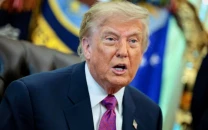
But the problem is not just a financial contagion which could ambush the global economy like a bolt from the blue. The bigger concern is the Indian government's insistence that its claims be treated as the final word. Whether we like it or not, India has immense influence in the world. The Canadian PM who accused Indian intelligence operatives of killing Canadian citizens is out and forgotten. The US President who mocked Modi's water-drinking was declared unfit and dropped from his party ticket. The British PM, last seen resisting Modi's hug in a viral clip, is gone and called incompetent. Indian censorship contagion is withering free speech worldwide. How can it be allowed to stand?













This material may not be published, broadcast, rewritten, redistributed or derived from. Unless otherwise stated, all content is copyrighted © 2026 The Express Tribune.

COMMENTS (5)
Comments are moderated and generally will be posted if they are on-topic and not abusive.
For more information, please see our Comments FAQ