Pakistan Army successfully test-fires extended-range Fatah-2 hypersonic ballistic missile
Updated 2 hours ago

Research urges targeted investment, stronger institutions and local participation for inclusive growth
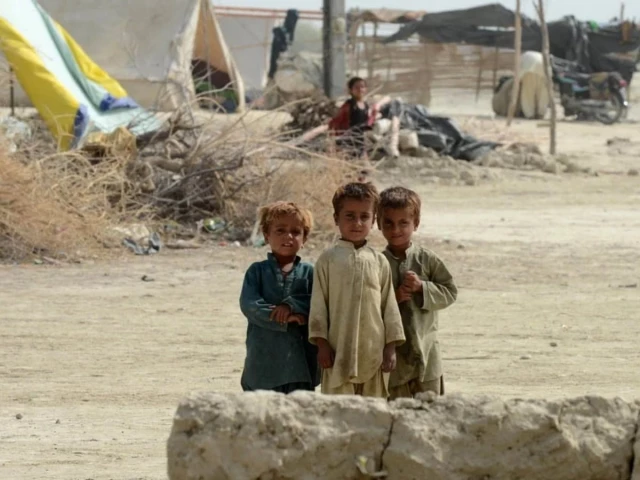
Despite sitting atop vast mineral wealth and holding Pakistan's most strategically important coastline, Balochistan remains the country's most impoverished province.
Now, a new study argues that lessons from China's extraordinary poverty-reduction journey could help transform the region, if adapted carefully to local realities. Dr Siraj Bashir Baloch, in a research paper examining China's anti-poverty model, contends that while Beijing's political system cannot be replicated, several of its policy instruments offer a roadmap for addressing multidimensional poverty in Pakistan's largest and most marginalised province.
The research — titled “China's Anti-Poverty Model and Lessons for Balochistan: Policy Options for Inclusive and Sustainable Development in Balochistan” — comes as the province continues to grapple with entrenched deprivation that extends far beyond income.
Read: Balochistan’s mineral wealth belongs first and foremost to its people: PM Shehbaz
According to the study, millions in the province face simultaneous deficits in education, healthcare, clean water, sanitation, electricity, and market access. Rural districts including Awaran, Chagai, Kharan, Kech, and Dera Bugti suffer from what the paper describes as "interconnected economic, social, institutional, and geographical" barriers that perpetuate poverty across generations.
“Balochistan is a paradox of rich natural resources and yet underdeveloped, poverty-stricken communities," the research states. The province contributes significantly to Pakistan's natural gas and mineral output, including copper, gold, coal, and chromite, yet sees limited local value addition or employment generation from these industries.
The China example
China's poverty alleviation success represents one of modern history's most dramatic economic transformations. Since launching economic reforms in 1978, Beijing lifted hundreds of millions from extreme poverty, officially declaring the eradication of absolute rural poverty in February 2021.
The researcher identifies several pillars of this success that hold relevance for Balochistan. Foremost is China's shift from broad-brush welfare programs to "Targeted Poverty Alleviation" (TPA) in 2013 — a data-driven, household-level approach that identified specific causes of deprivation for individual families rather than treating poor regions uniformly.
Local officials were assigned to poor villages, interventions were customised, and outcomes were rigorously monitored through digital databases and performance accountability systems.
The study also highlights China's massive infrastructure investments in rural roads, electricity, telecommunications, and irrigation, which connected isolated communities to markets and services. Combined with agricultural modernisation, vocational training, rural industrialisation through township enterprises, and digital inclusion via e-commerce platforms, these measures created diversified income sources rather than dependency on cash transfers.
"China focused on productive employment, enterprise development, infrastructure, and local economic transformation instead of providing only income support," the research states.
Adaptable lessons for Balochistan
The research emphasises that wholesale replication of China's centralised model is neither feasible nor desirable given Pakistan's federal structure and different governance traditions. However, several principles can be localised.
First, the paper recommends evidence-based, district-level targeting of vulnerable populations rather than one-size-fits-all provincial programs. Given Balochistan's vast and varied geography — spanning deserts, coastlines, and mountainous terrain — interventions must account for local ecological and socioeconomic conditions.
Read more: Pakistan, China deepen IT, agriculture ties
Second, infrastructure-led development should prioritise rural connectivity, renewable energy, modern irrigation, and digital networks. The study argues that improving roads and telecommunications would immediately reduce transaction costs for farmers and herders while opening access to education, healthcare, and financial services.
Third, human capital investment must take centre stage. Balochistan lags behind other provinces in literacy, technical skills, and health outcomes. The research calls for expanded technical and vocational education (TVET), particularly for women and youth, alongside primary healthcare strengthening and maternal health services.
“Investment in human capital should not be considered solely as a social investment, but as an investment in productivity, employment, and sustainable poverty reduction,” the paper states.
Fourth, the study urges development of agriculture, livestock, and fisheries value chains through agro-processing, storage facilities, and market linkages. With water scarcity worsening due to climate change, the research recommends climate-smart agriculture, efficient irrigation, and watershed management modelled partly on Chinese water conservation techniques.
The CPEC factor
A significant portion of the research focuses on the China-Pakistan Economic Corridor (CPEC) and Gwadar Port as potential catalysts for inclusive development. However, the researcher warns that infrastructure alone is insufficient.
"To achieve equitable inclusion in new economic opportunities, local employment, training, procurement, community enterprises, and benefit-sharing arrangements need to be put in place and be transparent," the paper argues.
Without deliberate policies ensuring local participation, corridor projects risk concentrating benefits in limited geographical areas while bypassing the province's most vulnerable populations.
The study recommends leveraging CPEC to establish special economic zones, mineral processing facilities, and vocational training centres that specifically target Baloch communities, ensuring the province's strategic location translates into tangible livelihood improvements.
Governance challenges
The research does not shy away from acknowledging formidable barriers. Weak institutional capacity, poor inter-agency coordination, lack of monitoring and evaluation, and governance gaps have historically undermined poverty programs in Balochistan.
The study suggests strengthening local institutions, creating integrated provincial poverty databases, and implementing results-based management systems inspired by China's accountability mechanisms — adapted to Pakistan's democratic context.
Water scarcity, low industrialisation, gender inequality, and climate vulnerability are identified as structural constraints requiring urgent attention. The paper states that women in Balochistan face particularly severe barriers to education, healthcare, and economic participation, making gender-inclusive policy design essential.
Looking forward
The study advocates shifting from welfare-oriented poverty alleviation to a sustainable development strategy that builds resilience and creates equitable economic opportunities. This requires coordinated action across federal and provincial governments, with community participation at the planning and implementation stages.
"An adapted, context-sensitive anti-poverty framework inspired by China's development experience can contribute significantly to reducing socio-economic disparities in Balochistan," Dr Baloch concludes, while cautioning that success depends on sustained political commitment, institutional reform, and locally sensitive adaptation rather than copying foreign models.
As Pakistan struggles to meet Sustainable Development Goal targets amid economic instability, the research offers a timely reminder that even resource-rich regions can remain trapped in poverty without integrated, long-term strategies that address the structural roots of deprivation.















This material may not be published, broadcast, rewritten, redistributed or derived from. Unless otherwise stated, all content is copyrighted © 2026 The Express Tribune.






COMMENTS
Comments are moderated and generally will be posted if they are on-topic and not abusive.
For more information, please see our Comments FAQ