Pakistan successfully test-fires first extended-range Fatah-2 hypersonic ballistic missile
Updated 26 minutes ago

Meets IFC Regional VP for the Middle East and Central Asia Imad Fakhoury to discuss matters of mutual interest
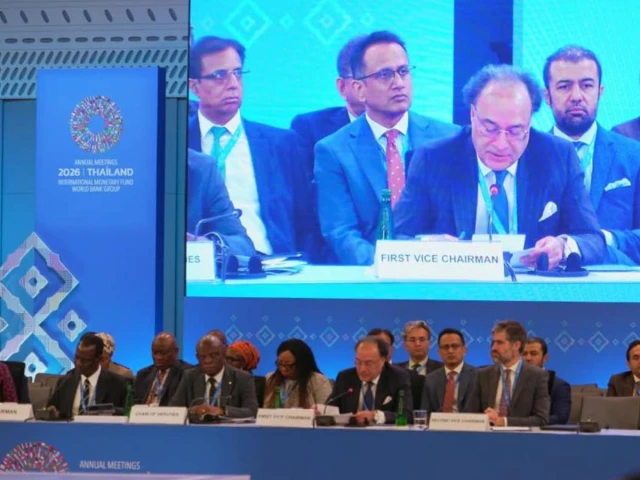
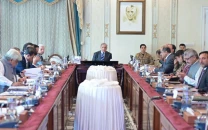
Finance Minister Muhammad Aurangzeb on Tuesday reaffirmed Pakistan’s commitment to strengthening the collective influence of G-24 and advancing the interests of developing economies as the incoming chair, a statement issued by the ministry said.
He was speaking as the first Vice-Chair of the G-24 at the finance ministers' and central bank governors’ meeting held on the sidelines of the World Bank Group– International Monetary Fund (IMF) Annual Meetings in Bangkok, Thailand.
Aurangzeb highlighted the challenges facing developing economies, including fragmentation disrupting trade and investment, climate shocks eroding development gains, restrictive financial conditions and widening financing gaps.
Finance Minister Calls for Reform of International Financial Architecture at G-24 Meeting, Reaffirms Pakistan’s Commitment as Incoming Chair
— Ministry of Finance, Government of Pakistan (@Financegovpk) October 13, 2026
Federal Minister for Finance and Revenue, Senator Muhammad Aurangzeb, speaking in his capacity as First Vice-Chair of the G-24 at the… pic.twitter.com/qhQrZ88oNr
The minister stressed that reform of the international financial architecture must keep pace with the challenges and called for timely support for countries undertaking difficult reforms while confronting external shocks beyond their control.
He outlined three priorities for the G-24 focused on restoring development as the central objective of the international financial system, making the Bretton Woods institutions more representative and responsive, and building a development-oriented international financial architecture.
Read: Govt eyes raising $1b from privatisation
Aurangzeb also emphasised cooperation among members and institutional partners to advance a more representative, resilient and development-centred international economic order.
FinMin discusses trade, investment and development cooperation with SFD CEO
Aurangzeb also conducted a meeting with Sultan Abdulrahman Al-Marshad, Chief Executive Officer of the Saudi Fund for Development (SFD), on the sidelines of the World Bank Group–IMF Annual Meetings in Thailand.
During the meeting, the finance minister expressed condolences over the loss of lives in recent incidents in Saudi Arabia and thanked the Kingdom for its longstanding support to Pakistan. He also highlighted Pakistan’s improving macroeconomic position and renewed access to international capital markets.
Finance Minister Discusses Trade, Investment and Development Cooperation with Saudi Fund for Development CEO
— Ministry of Finance, Government of Pakistan (@Financegovpk) October 13, 2026
Federal Minister for Finance and Revenue, Senator Muhammad Aurangzeb, met with H.E. Mr. Sultan Abdulrahman Al-Marshad, Chief Executive Officer of the Saudi Fund for… pic.twitter.com/FzfxiJYeh6
The discussions focused on expanding trade and investment, strengthening private-sector engagement, following up on the bilateral investment protection agreement, and exploring opportunities for refinery upgrades.
Both sides noted satisfactory progress on SFD-supported projects and emphasised the importance of developing a fresh pipeline of projects.
According to a statement issued by the finance ministry, the SFD reaffirmed its continued support to Pakistan within its mandate.
Calls for coordinated action on population growth, job creation
The finance minister also called for coordinated national efforts to address Pakistan’s rapid population growth, stressing the need to integrate population planning with health, education and employment policies while speaking at a World Bank roundtable titled “Transforming Demographic Transition into Human Capital Gains and Job Creation” in Thailand.
The minister announced plans to establish a National Population Council led by the prime minister.
He said the proposed council would help bring fragmented initiatives under a comprehensive framework through coordinated federal and provincial action, sustained political commitment and measurable outcomes.
Finance Minister Outlines Establishment of National Population Council, Calls for Integrated Action on Human Capital and Job Creation at World Bank Roundtable
— Ministry of Finance, Government of Pakistan (@Financegovpk) October 13, 2026
Federal Minister for Finance and Revenue, Senator Muhammad Aurangzeb, speaking at the World Bank’s roundtable on… pic.twitter.com/Oqubr9Ho5T
Aurangzeb highlighted women’s education and workforce participation as key priorities in managing the country’s demographic transition. He also stressed the importance of engaging religious leaders to promote awareness about birth spacing.
Drawing on experiences from Indonesia, Bangladesh and Iran, the minister underscored the need to learn from approaches adopted by other countries to address population-related challenges and improve human development outcomes.
He said Pakistan’s ability to benefit from its demographic dividend would depend on developing a skilled workforce and promoting private-sector-led growth capable of generating employment opportunities.
The finance minister identified freelancing, information technology-enabled services and digital skills as areas with potential to increase young people’s earnings and boost the country’s exports.
He stressed that population management could not be pursued in isolation, calling for an integrated approach linking population planning with investments in health and education and policies aimed at expanding employment.
Meeting with International Finance Corporation's Imad Fakhoury
Separately, the finance minister also met with International Finance Corporation (IFC) Regional Vice President for the Middle East and Central Asia Imad Fakhoury in Bangkok.
In a statement issued on social media, the finance ministry said that discussions focused on strengthening IFC support for private-sector-led growth and jobs, and translating macroeconomic stability into sustainable growth.
The meeting also reviewed IFC’s expanding portfolio, small-business financing, entrepreneurship, capital markets, and green and digital bonds.
Read more: IMF raises inflation forecast to 9.9%
Discussions also covered mining infrastructure and value addition, affordable housing and developer financing, and agricultural development through improved storage, cold chains and electronic warehouse receipt financing. The statement further highlighted that both sides explored greater private-sector participation in livestock development and support for pharmaceutical exports through stronger regulatory standards and investment.
Furthermore, the meeting deliberated infrastructure cooperation focused on public-private partnerships in water services, advanced electricity metering and financing mechanisms for provincial projects.
Finance Minister Discusses Private-Sector Growth, Investment and Development Cooperation with IFC Regional Vice President
— Ministry of Finance, Government of Pakistan (@Financegovpk) October 13, 2026
Federal Minister for Finance and Revenue, Senator Muhammad Aurangzeb, met with Mr. Imad Fakhoury, IFC Regional Vice President for the Middle East and Central… pic.twitter.com/P7U8gIAvFf
During the meeting, Aurangzeb also reaffirmed commitment to Reko Diq copper and gold mining project and appreciated IFC’s financing leadership.
According to the IFC portal, the Reko Diq project, put on hold on April 25, entails the development of a greenfield open-pit mining operation with processing facilities to produce copper-gold concentrate.
“The mine includes two open pits, a processing plant, several low-grade ore stockpiles, two waste rock dumps, a tailings storage facility (TSF), a heavy fuel oil power plant and photovoltaic solar plant, and other auxiliary infrastructure. The project will produce 200-250 kt of copper per year,” it stated, adding, “Reko Diq is one of the world's largest undeveloped copper and gold deposits, with an expected mine life of 40+ years.”
It further outlines that the sponsors contemplate a possible expansion of the project, which includes increasing copper production to 400kt per year and building the related infrastructure.
“It will be one of the largest copper mines globally when fully developed,” the IFC project description concludes.








This material may not be published, broadcast, rewritten, redistributed or derived from. Unless otherwise stated, all content is copyrighted © 2026 The Express Tribune.

COMMENTS
Comments are moderated and generally will be posted if they are on-topic and not abusive.
For more information, please see our Comments FAQ