Pakistan committed to strengthening defence ties with Brazil: CDF Munir
Updated 1 hour ago

Court says IWT between two countries remains fully in force, as India has no justification for suspending agreement
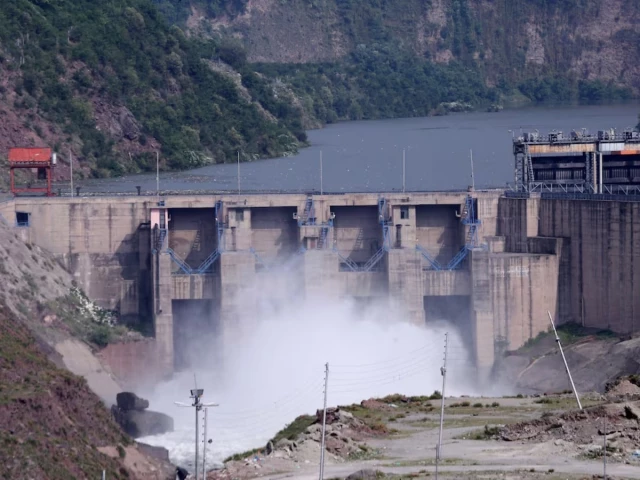
India must limit work on a hydroelectric plant in the Indian Illegally Occupied Kashmir (IIOJK) and uphold a water-sharing treaty with Pakistan, which it suspended over tensions with its neighbouring country, the Permanent Court of Arbitration (PCA) said on Monday.
For over six decades, India and Pakistan have amicably managed the Indus River system through the IWT transboundary water-sharing agreement signed on September 19, 1960. Last year in April, India suspended the treaty in the wake of the Pahalgam attack. However, Islamabad has multiple times warned India of consequences for regional peace and security if it sought to deprive Pakistan of waters allocated to it under the Indus Water Treaty (IWT).
The Hague-based court said the IWT between the two countries remained fully in force, as India had no justification for ending or suspending the agreement.
"India must observe its obligations under the Treaty, including those relating to the design and operation of its hydro-electric projects on the Western Rivers," the intergovernmental court said.
The court said a neutral expert, appointed by the World Bank, would judge by July 2027 whether the construction of hydroelectric plants in the Himalayan region was in line with the treaty.
Agreeing with a demand by Pakistan, the court said India was not allowed to build the dam wall and power intake structure at the Ratle Hydro-Electric Plant above certain levels until 90 days after the neutral expert's decision.
🔸 #PCA Press Release | The Indus Waters Western Rivers Arbitration (Islamic Republic of Pakistan v. Republic of India) 🔸
— Permanent Court of Arbitration (@PCA_CPA) August 31, 2026
𝗧𝗵𝗲 𝗖𝗼𝘂𝗿𝘁 𝗼𝗳 𝗔𝗿𝗯𝗶𝘁𝗿𝗮𝘁𝗶𝗼𝗻 𝗜𝘀𝘀𝘂𝗲𝘀 𝗔𝘄𝗮𝗿𝗱 𝗼𝗻 𝘁𝗵𝗲 𝗦𝘁𝗮𝘁𝘂𝘀 𝗼𝗳 𝘁𝗵𝗲 𝗜𝗻𝗱𝘂𝘀 𝗪𝗮𝘁𝗲𝗿𝘀 𝗧𝗿𝗲𝗮𝘁𝘆 𝗮𝗻𝗱… pic.twitter.com/0QWASt85Cw
Pakistan welcomes Hague court ruling
Pakistan welcomed a ruling by the PCA that India’s decision to place the IWT in “abeyance” was not permissible under the treaty or applicable international law.
"Pakistan welcomes this finding by the court that interim measures are warranted, as well as the measures ordered by the court. The government of Pakistan will now be giving careful consideration to the detail of the award and decision, pending their publication, and how these may best assist in finding a pathway back to the parties' engagement under the treaty in a manner that reflects the binding legal obligations of both sides under the treaty," the Ministry of Information said in a statement on X.
According to the ministry, the court prohibited India from concreting the RHEP dam wall and power intake structure above specified levels until 90 days after the neutral expert’s final decision, which is expected in July 2027.
"Further, the court also imposed a reporting measure relating to the construction schedule until shortly after the neutral expert’s final decision,” it added.
The statement said that the government had taken note of a press release issued by the court announcing that it had delivered its award on the status of the IWT and its decision on interim measures to the parties.
The ministry said the award and decision had not yet been published by the court, but were expected to be released within the next week or so.
According to the government, the court unanimously concluded that “India’s decision on ‘abeyance’ of the treaty is not permissible under the treaty or other applicable rules of international law” and that “the treaty has not been terminated or its operation suspended and rather remains fully in force”.
India’s decision on ‘abeyance’ of the treaty is not permissible under the treaty or other applicable rules of international law, and accordingly “that the treaty has not been terminated or its operation suspended and rather remains fully in force"
“India remains bound by and must observe its obligations under the treaty, including those relating to the design and operation of hydro-electric projects on the western rivers and associated dispute settlement," it said.
*Ministry of Information and Broadcasting, Government of Pakistan*
— Ministry of Information & Broadcasting (@MoIB_Official) August 31, 2026
*Press Release*
The Government of Pakistan takes note of the Press Release issued a short time ago by the Court of Arbitration in The Hague in the Indus Waters dispute noting that it has today issued to the…
India rejects court's ruling
The Indian foreign ministry said in response to the court's ruling that it categorically rejected an order of the PCA to uphold a water-sharing treaty with Pakistan that New Delhi suspended over diplomatic tensions with its neighbour.
"This so-called Court of Arbitration has no jurisdiction whatsoever to pronounce on India's sovereign decisions," India's Ministry of External Affairs said in a statement.
"Its pronouncements, now or in the future, will have no effect on India's actions in connection with the projects being undertaken by India."
The statement said that India's 2025 decision to hold the IWT in abeyance remained in force.
In May, PCA in the Hague upheld its earlier award supporting the continued validity of the IWT, ruling that India cannot unilaterally suspend the agreement.
The tribunal reaffirmed that the treaty remained in force, rejecting arguments that either party may withdraw or suspend it without mutual consent. It said the legal framework governing the sharing of the Indus river system continued to bind both India and Pakistan.
The ruling related to long-running disputes between the two countries over hydroelectric developments on the western rivers of the Indus system. Pakistan has repeatedly raised concerns that Indian run-of-river projects could reduce downstream flows and harm agricultural output.
Last year in August, the PCA also ruled in favour of Pakistan on issues of general interpretation of the IWT, saying that India would let flow the waters of the Western rivers for Pakistan's unrestricted use.
Read More: Pakistan vows to protect its interests under IWT
The Hague-based PCA issued a binding Award on the interpretation of the IWT on August 8, 2025. The case was brought by Pakistan in 2016. The court says that awards of a court of arbitration and the decisions of a Neutral Expert are final and binding on both parties.
The PCA has also ruled that the specified exceptions for the generation of hydro-electric plants must conform strictly to the requirements laid down in the IWT, rather than to what India might consider an "ideal" or "best practices" approach.
What is IWT?
For over six decades, India and Pakistan have cooperatively managed the waters of the Indus River system, a vital resource for both nations. Despite enduring conflicts, the 1960 IWT has remained a cornerstone of their bilateral relations, facilitating shared access to water resources.
The origins of the IWT can be traced back to the Partition of British India in August 1947, when India and Pakistan became two independent nations. Both countries, now home to over 1.6 billion people, have historically relied heavily on the rivers flowing from the Himalayas for irrigation and agriculture.
The division of the Punjab province, which was extensively developed under British rule with an integrated irrigation system, created an immediate need for an agreement on the equitable sharing of the river waters between India and Pakistan. This was essential to prevent any future conflicts over this vital resource, particularly given that the new border separated the territories through which these rivers flowed.
After nine years of negotiations, facilitated by the World Bank, the IWT was signed in September 1960 by then-Indian PM Jawaharlal Nehru and former Pakistani president Ayub Khan. India was given control over the three eastern rivers—Ravi, Sutlej, and Beas—while Pakistan was assigned control over the three western rivers—Indus, Jhelum, and Chenab. As part of the treaty, India is required to allow the waters of the western rivers to flow into Pakistan, with only a few exceptions.
The treaty also allows India to develop hydroelectric projects on the western rivers, but these projects must adhere to strict conditions. They must be "run-of-the-river" projects, meaning that they cannot significantly alter the flow or storage of water, ensuring that Pakistan’s water rights as the downstream riparian country are not adversely affected.
How it works
At the heart of the ongoing dispute between India and Pakistan lie the design features of two Indian hydroelectric power projects: the Kishenganga (330 megawatts), inaugurated in 2018, and the Ratle (850 megawatts), which remains under construction. Although neither project is being financed by the World Bank, both have drawn objections from Pakistan over alleged violations of the IWT.
The crux of the disagreement concerns whether the technical specifications of these plants infringe upon the Treaty’s stipulations. Both projects are situated in India, on tributaries of the Jhelum and Chenab rivers—rivers which, along with the Indus, are designated as “Western Rivers” under the IWT.
According to the Treaty, Pakistan has unrestricted use of these rivers, while India is permitted to construct hydroelectric facilities on them under specific conditions. These projects must conform to design constraints outlined in the Treaty’s annexures, ensuring that they are "run-of-the-river" and do not significantly alter water flow or storage to Pakistan’s detriment.
How will it impact Pakistan?
The IWT grants India limited rights to develop hydroelectric projects on the western rivers—Jhelum, Chenab, and Indus—through "run-of-the-river" schemes.
These are designed to generate electricity without significantly altering the natural flow or storage of water. While this provision allows India a degree of development, the treaty also safeguards Pakistan’s interests by allowing it to raise objections to any design that may affect downstream water flow.
Pakistan, which receives roughly 80 per cent of the water in the Indus river system, relies heavily on these rivers. Of the 16.8 crore acre-feet of water in the system, India is allocated around 3.3 crore acre-feet. At present, India uses slightly more than 90 per cent of its permitted share, leaving Pakistan deeply dependent on the remainder.
Also Read: Arbitration court upholds Pakistan's stance on Indus Waters Treaty
This dependence is profound. The Indus river network—comprising the Jhelum, Chenab, Ravi, Beas, and Sutlej—forms the backbone of Pakistan’s agricultural sector. It sustains a population of tens of millions, fulfilling 23 per cent of the country's agricultural water needs and directly supporting nearly 68 per cent of rural livelihoods.
Any disruption to this supply could trigger widespread consequences: reduced crop yields, food insecurity, and further economic instability, particularly in regions already burdened by poverty and an ongoing financial crisis.
Compounding the issue is Pakistan's limited water storage capacity. Major dams such as Mangla and Tarbela have a combined live storage of just 14.4 million acre-feet (MAF)—a mere 10 per cent of the country’s annual entitlement under the treaty. In times of reduced water flow or seasonal variability, this shortfall in storage leaves Pakistan acutely vulnerable.
What are India’s rights under the treaty?
Despite Pakistan’s heavy reliance on the Indus waters, the treaty does afford India certain rights. It allows the development of 13.4 lakh acres of irrigation in Jammu and Kashmir and Ladakh. However, as of now, only 6.42 lakh acres are being irrigated in these Union Territories. Furthermore, the treaty permits India to store up to 3.60 million acre-feet of water from the western rivers—although little to no such storage infrastructure currently exists in Jammu and Kashmir.
India is also entitled to build run-of-the-river dams on the Jhelum, Chenab, and Indus. While these are not meant to obstruct water permanently, the technical leeway they offer enables India to temporarily restrict flow—giving it a strategic edge in times of diplomatic tension.
Relations between the two nations took a marked downturn after India revoked Jammu and Kashmir’s special autonomy in August 2019. Since then, trust between New Delhi and Islamabad has eroded further. In this increasingly volatile geopolitical climate, many experts argue that the most viable path forward is a return to the cooperative spirit in which the treaty was originally signed.
Escalation follows suspension of IWT
Escalation between Pakistan and India began on April 22, 2025, when an attack in Pahalgam killed 26 people. India immediately blamed Pakistan for the incident. However, Pakistan categorically rejected the Indian blame.
In response, India undertook a series of hostile actions the next day, on April 23, 2025, including suspending the 65-year-old IWT, cancelling visas for Pakistani citizens, closing the Wagah-Attari border crossing, ordering the shutdown of the Pakistan High Commission in New Delhi, and reducing diplomatic staff at each other's embassies.
Tensions further escalated in the early hours of May 7, 2025, when missile strikes hit six cities in Punjab and Azad Jammu and Kashmir (AJK), destroying a mosque and killing dozens of civilians, including women, children, and the elderly.
Read More: French intelligence official confirms downing of Rafale by Pakistan
In a swift military response, Pakistan’s armed forces shot down Indian warplanes, including Rafale jets. The confrontation intensified again in the early hours of May 10, 2025, when India targeted several Pakistani airbases with missile strikes. In retaliation, Pakistan launched Operation Bunyanum Marsoos, damaging Indian military installations, including missile storage sites, airbases, and other strategic targets.
On May 10, 2025, US President Donald Trump announced that a ceasefire had been reached following intense diplomatic efforts overnight. Minutes later, the agreement was confirmed separately by Pakistan’s Foreign Minister Ishaq Dar and the Indian foreign secretary.
















This material may not be published, broadcast, rewritten, redistributed or derived from. Unless otherwise stated, all content is copyrighted © 2026 The Express Tribune.





1727268465-0/Untitled-design-(42)1727268465-0-208x130.webp "the poor man s burden")
COMMENTS (9)
Comments are moderated and generally will be posted if they are on-topic and not abusive.
For more information, please see our Comments FAQ