FinMin seeks BB rating, $1.5b financing
Updated 10 hours ago

Adding AI course to old curriculum is not same as reforming education for AI economy
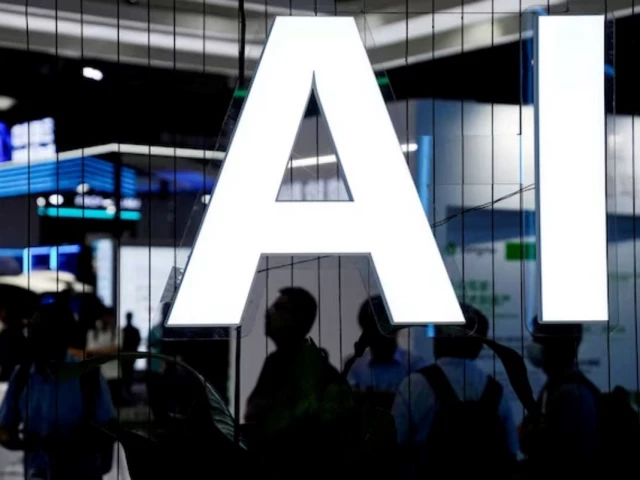
For generations, Pakistan sold its young people a simple proposition: study hard, obtain a degree and enter the workforce at the bottom of the professional ladder. The first job might not be glamorous, but it provided something invaluable – experience. A junior accountant became an accountant, a trainee programmer became a software engineer, and a young journalist learnt the craft by doing it.
That ladder is now being shaken. Artificial intelligence (AI) is not necessarily going to eliminate all these professions. But it is rapidly changing the tasks that traditionally gave young workers their first opportunity. The routine work once assigned to interns and entry-level employees – preparing reports, drafting basic text, analysing simple data, handling customer queries or conducting preliminary research – can increasingly be performed with the assistance of AI. The danger is not simply that AI will destroy entry-level jobs, thus creating an unusual diamond-shaped hierarchical structure rather than the normal pyramid one.
This should be a matter of particular concern for Pakistan. The country is producing large numbers of university graduates while its economy is struggling to create sufficient high-quality employment. For families sending children to private universities, the stakes are even higher. Four years of tuition and expenses represent a substantial investment. Yet a degree is no longer a guarantee that the graduate will find meaningful employment.
Nor is the traditional escape route – leaving Pakistan – as straightforward as it once appeared. For decades, Pakistan has relied on the international market for its educated workforce. Doctors, engineers, accountants and IT professionals have sought opportunities abroad. The rise of remote work created another possibility: a graduate could remain in Pakistan while selling professional services overseas. But the global labour market is undergoing the same technological transformation. A Pakistani graduate is no longer competing simply with a graduate in another country. He or she is competing with professionals everywhere who are increasingly equipped with AI tools – and sometimes with automated systems capable of performing the underlying task.
This makes the question of what universities teach far more urgent. Pakistan's education system cannot continue to define employability primarily through the possession of a degree. By the time a student graduates, some of those tasks may already have been automated, outsourced or substantially transformed. There are encouraging signs that the government recognises the problem. On August 12, Pakistan launched its first-ever National Youth Employment Policy. The initiative includes measures to expand employment and entrepreneurship opportunities, with a 35% quota for women and a 10% annual quota for young startups. The government has also emphasised IT and AI, with plans for young Pakistanis to receive training abroad.
This is an important beginning. But it should also prompt a more uncomfortable question: are we preparing young people for the labour market of tomorrow, or merely making them better competitors for the jobs of today? A youth employment policy cannot succeed in isolation from education policy. The government has begun moving in that direction. In June, the planning ministry directed an immediate review of university degree programmes to prepare young people for Industrial Revolution 4.0 and 5.0. There is also the ACT AI programme, designed to provide AI skills to students across roughly 100 universities.
Such initiatives are welcome. But adding an AI course to an old curriculum is not the same as reforming education for an AI economy. The next generation of workers will require a different combination of abilities. Technical literacy will remain essential, but it will increasingly mean the ability to work with AI, data and digital systems rather than simply knowing how to perform tasks manually. Equally important will be critical thinking and judgement. When an AI system can produce an answer in seconds, the valuable human skill will be determining whether the answer is correct, incomplete or biased.
Students will need problem-solving skills, creativity and analytical ability, because machines are becoming better at executing defined instructions while humans remain responsible for deciding which problems are worth solving. They will also need the skills often dismissed as secondary to technical education: communication, teamwork, adaptability, emotional intelligence, leadership and the ability to work across disciplines.
These so-called soft skills may become harder currency in the AI economy, not less. A machine can generate a presentation; it cannot easily build trust with a client. It can draft an email; it cannot take responsibility for a difficult decision. It can analyse information; it cannot replace human judgement in every ambiguous situation. The ability to learn continuously may ultimately become the most important skill of all. A graduate entering the workforce in 2030 may find that what he learnt in the first year of university is outdated by graduation. Education can no longer be treated as something completed before employment begins. Learning must become a permanent part of working life.
This has profound implications for universities. Employers should have a much greater role in curriculum design. Internships should provide genuine workplace experience rather than merely satisfy a graduation requirement. Students should graduate with portfolios demonstrating what they can actually do, not just transcripts showing what they studied. Universities should also reconsider how they assess students. If AI can produce an essay, presentation or piece of computer code, simply banning its use does not solve the problem. Assessment must increasingly test reasoning, originality, application and the ability to defend one's work.
Most importantly, Pakistan should stop treating university education, vocational training and employment as separate policy silos. The new youth employment policy can provide the employment bridge. AI-skills initiatives can provide the technological foundation. University curriculum reform can provide the academic foundation. But these measures will work only if they become part of one coherent system. Otherwise, Pakistan risks creating a contradiction: a government preparing young people for a future economy while universities continue preparing them for a labour market that is rapidly disappearing.
The first National Youth Employment Policy is therefore significant. Its success, however, should not be measured simply by the number of certificates issued or young people placed in jobs. The real test will be whether a Pakistani graduate can compete in 2030 – in Karachi, Dubai or London – because he or she possesses something more valuable than a degree. That something will be the ability to use technology without being replaced by it; to question information rather than merely consume it; to solve problems rather than perform instructions; to communicate and collaborate; and, above all, to keep learning.
Pakistan does not merely need more employable young people. It needs an education system capable of continually producing employability. That is the challenge that lies beyond the jobs of today – and before the jobs of tomorrow.
THE WRITER IS A FINANCIAL MARKET ENTHUSIAST AND IS ASSOCIATED WITH PAKISTAN'S STOCKS, COMMODITIES AND EMERGING TECHNOLOGY














This material may not be published, broadcast, rewritten, redistributed or derived from. Unless otherwise stated, all content is copyrighted © 2026 The Express Tribune.









COMMENTS
Comments are moderated and generally will be posted if they are on-topic and not abusive.
For more information, please see our Comments FAQ