UNDP moves to address liquidity crunch
Updated 2 hours ago

.
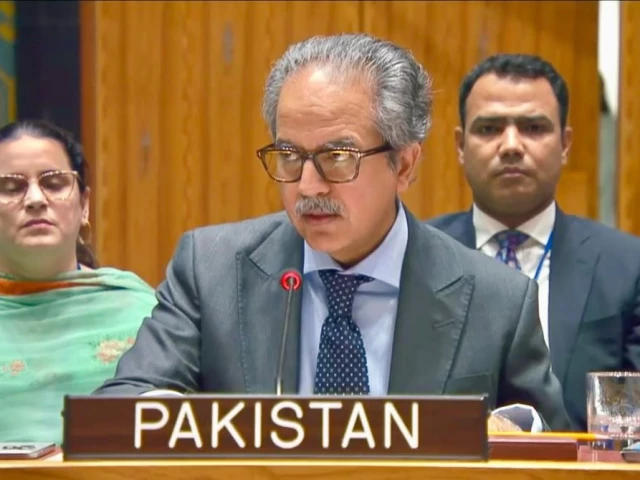
Pakistan has challenged the UN Security Council during a monthly briefing on the Middle East, questioning how Palestinian civilians continue to be killed and Israeli military strikes persist if a ceasefire is supposedly in effect.
"If the ceasefire is holding - as we have been told - then how are strikes continuing and civilians being killed?", asked Ambassador Asim Iftikhar Ahmad, permanent representative of Pakistan to the UN, while underscoring that a truce "was the first, most essential step" of the US 15-point peace plan for Gaza.
"Despite the clear position of this Council and repeated calls for their cessation, Israel's illegal settlement activities continue unabated," he told the 15-member Council.
The advancement of the so-called E1 settlement project, which would effectively sever the northern and southern part of the West Bank, is particularly alarming, and a "dangerous escalation", the Pakistani envoy said.
"Beyond threatening the territorial contiguity of a future Palestinian state, the project places thousands of Palestinians at risk of forcible displacement.
"Highlighting that settler violence has also reached alarming levels, the Pakistani envoy said, noting that the UN recorded approximately 190 attacks per month in early 2026, which is "unacceptable and warrants urgent action".
Ambassador Ahmad said that Israel's forcible entry Tuesday into the UN Relief and Works Agency for Palestine Refugees in the Near East (UNRWA) Kalandia Training Centre in occupied East Jerusalem is "particularly troubling".
And he called out the continued withholding of over $6 billion in Palestinian clearance revenue, which is undermining the Palestinian Authority's ability to provide essential services.
"These revenues must be released without delay," he said. At the same time, the Pakistani envoy said notable efforts have been undertaken to advance peace and take the process, envisaged in the Board of Peace, forward.
However, he pointed out that despite the mediation efforts by the US, Egypt, Qatar, and Turkiye, Israel's continued military escalations and rejection of the roadmap threaten to derail this diplomatic process.














This material may not be published, broadcast, rewritten, redistributed or derived from. Unless otherwise stated, all content is copyrighted © 2026 The Express Tribune.






COMMENTS
Comments are moderated and generally will be posted if they are on-topic and not abusive.
For more information, please see our Comments FAQ