WHO warns escalating conflict in Yemen takes 'devastating toll'
Updated 4 hours ago

Nearly 1,500 missing in Nepal and China after devastating Himalayan flood
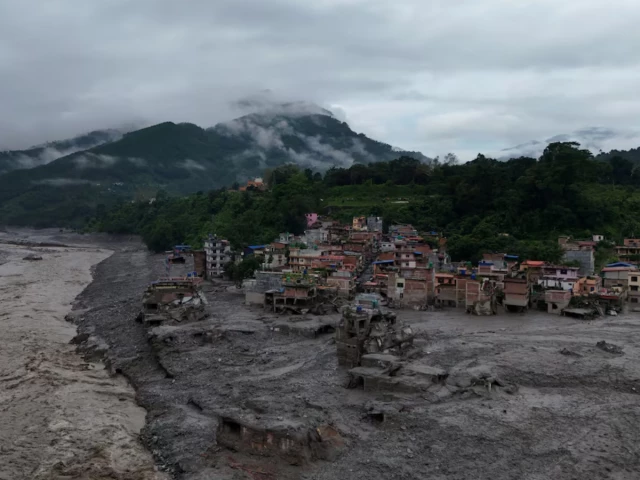
Search and rescue operations backed by helicopters and drones continued Thursday as the death toll from devastating flash floods along the Nepal-China border rose to 362, with more than 1,500 people missing and communication lines disrupted.
Nearly 1,500 people, including at least 800 foreigners, are missing across Nepal and China's Tibet, authorities said, after a wall of mud and rock collapsed into a Himalayan river, sending catastrophic floods through towns and valleys.
Rescuers in Nepal used helicopters to search for survivors and drop emergency supplies to thousands cut off after Wednesday's disaster swept a rugged mountainous region thronged by trekkers and pilgrims linking Lhasa in Tibet with the Nepalese capital of Kathmandu.
"This will go up, as we have resumed the search and more bodies are expected to be recovered," police spokesperson Abi Narayan Kafle told Reuters.
Among the missing tourists from more than two dozen countries, 177 were from India, 63 were from the United States, 34 from Australia, 33 from Britain and 25 from Canada.
The tally of missing in Tibet's Gyirong county was 558, Chinese state broadcaster CCTV said on Thursday, including 260 foreign nationals.
Verified videos showed crushing masses of water and debris sweeping away dozens of people at a border crossing in Gyirong, with homes, roads and power projects washed away further downstream in Nepal.
Read: Hundreds missing after devastating flood hits Nepal-Tibet border, 95 bodies recovered
"It was a huge gush of mud coming straight towards us," said Keshav Prasad Baral, a 68-year-old survivor being treated in hospital.
"As it got closer, it kept rising higher and higher. When I saw it enter our home, I tried to grab my wife's hand and take her to the terrace. But she was swept away by the mud." A helicopter ferried him to safety four hours later. "My wife is still somewhere beneath the mud," he added. "She's gone."
Another survivor said he saved himself by clinging to a mango tree as he watched the house where he had been working disappear.
Emergency deliveries begin
In the hardest-hit districts, helicopters are dropping tents, food and other emergency supplies provided by neighbouring India, said Raja Ram Basnet, a spokesperson for Nepal's army. More than 5,000 army and police rescue personnel were mobilised to look for survivors and find bodies.
Early reports from Nepali officials suggested an earthquake in the area could have caused the lower part of a glacier to collapse and trigger the floods.
The US Geological Survey said an earthquake with magnitude initially reported as 4.4 was in fact seismic energy generated by the collapse of glacial rock and ice, followed by debris flow.
Chinese authorities have identified risks from a still-dammed lake located in Gyirong, upstream from the mudslide and flood-stricken Tibet-Nepal border crossing that could significantly complicate rescue efforts in the mountainous site, CCTV reported on Thursday.
Many of the victims were making a pilgrimage to Kailash Mansarovar, a high-altitude site in Tibet revered by Hindus and Buddhists among others. Mount Kailash, which Hindus believe to be the abode of Lord Shiva, lies on the banks of Lake Mansarovar, also held sacred in various religions.
The US State Department said it was sending a disaster response adviser and providing assistance of $500,000.
The United States sends our condolences to those impacted by the devastating floods in Nepal and mourning the loss of their loved ones. We are in touch with the Government of Nepal and we stand ready to assist.
— Bureau of South and Central Asian Affairs (SCA) (@State_SCA) August 26, 2026
Canada was also closely following the situation, Prime Minister Mark Carney said on X, describing the floods as "absolutely devastating".
The flash floods along Nepal’s Bhotekoshi River are absolutely devastating.
— Mark Carney (@MarkJCarney) August 26, 2026
Canadians are thinking of all those in distress right now, those who have lost a loved one, and all those who are still waiting for answers.
Our government is closely following the situation and…
UN teams and partners were sending supplies and personnel to support affected Nepali communities, Secretary-General Antonio Guterres said.
I am saddened by the severe flooding in Nepal & China, which has claimed many lives, left people missing, and caused widespread destruction.
— António Guterres (@antonioguterres) August 26, 2026
I extend my condolences to the families of the victim, and I wish a swift recovery to those injured. My solidarity is with all those…
Australian Prime Minister Anthony Albanese said details on the disaster were scant. "Nepal ... is a developing country," he said. "It doesn’t have the resources that an event like that would have in Australia, so information is difficult."
We extend our deepest sympathies to those affected by the significant flooding in Nepal and Tibet, China.
— Anthony Albanese (@AlboMP) August 26, 2026
Australians in the affected area should follow the advice of local authorities.
We are aware of a number of Australians in the area and officials are urgently working to…
Sagar Pandey, the chief executive of a Himalayan tourism operator, said 15 Indian-Australians on a pilgrimage tour with the company were missing.
"There are no human-made things, no human settlement left. Everything is just flat," he told Reuters after flying over the zone in a helicopter. "So anyone in the hotel, the restaurant, or the car, I believe that everybody is gone."
Videos show people swept away while fleeing
Security footage captured on the Chinese side of the border showed many people fleeing from a torrent of rock, mud and water that destroyed buildings and vehicles.
People seeking information about family members missing from the affected areas of Nuwakot and Dhading gathered outside a Nepali army training centre that was the base for helicopter rescue operations, the images showed.
In the affected areas, layers of mud metres thick swathed homes, trees and vehicles. Helicopters ferrying survivors hovered overhead all day.
An initial study of Planet Labs satellite imagery showed a landslide of ice and rock unleashed a flood carrying debris in the Lhende River, about 20 km (12 miles) northeast of the Nepal-China Rasuwagadhi border crossing, Nepal disaster management officials said on X.
Television images showed collapsed homes, floating cars and a metal bridge being washed away, while witnesses said the waters engulfed entire villages.
"There is devastation everywhere we look," said Tula Bahadur BK, a health worker in Rasuwa.
"The settlements next to the river have been completely swept away. Five of my own relatives are missing.
Nepal, China warn of fresh flood risks
Nepal and China both warned on Thursday of fresh risks of flooding in the Himalayas as two lakes that have developed on either side of their border threaten to burst in a region still grappling with this week's catastrophic flood.
Search and rescue operations are still underway in debris-strewn valleys and hillsides, with nearly 1,000 people still missing after Wednesday's flood struck the border regions of Nepal and China's Tibet, killing at least 362 people.
Both countries have blamed the flood on a glacier collapse that pushed rock, ice, mud and debris into river systems in the mountains.
Nepal's disaster authority issued a notice on Thursday warning that a lake formed by debris blocking a river at the flood site is rising and at risk of bursting.
"Residents of the lower banks... passengers, rescuers engaged in rescue operations, and all concerned are requested to exercise special caution and stay in safe places away from the river banks and risky areas," the authority said.
China warned that 3 million cubic metres of water - the equivalent of about 1,200 Olympic swimming pools - are expected to flow into an already dammed lake on its side of the border over the next three days, creating a high risk of a breach, with peak flow expected around Sept. 1.
The formation of a barrier lake was captured in aerial footage by a Chinese rescue team on Thursday, state broadcaster CGTN reported.
The footage showed masses of brown water accumulating in a basin with no visible outlet. The water had already submerged bushes and trees and appeared to push against a barrier of debris and stones.
More rain expected
Rainfall forecast over the coming week will exacerbate the threat, Chinese state media said, citing the Chinese water resources ministry.
"The volume of water is continuing to increase, and so is the risk," Zhu Jinfeng, a researcher at the water resources ministry's hydrology department, told state broadcaster CCTV.
Heeding the warning, some rescue workers in Nepal began moving towards higher ground on Thursday.
Among them was Pawan Koirala, who began moving away from the river bed along with his team of 13 after the warning was issued.
"We are here for rescue and don't want to be near the danger zone," he said.

















This material may not be published, broadcast, rewritten, redistributed or derived from. Unless otherwise stated, all content is copyrighted © 2026 The Express Tribune.






COMMENTS
Comments are moderated and generally will be posted if they are on-topic and not abusive.
For more information, please see our Comments FAQ