PTI long march enters fourth day, heads to Khyber as party rallies behind K-P CM
Updated 15 hours ago

Advanced technology gives terrorists in K-P an edge over police amid limited resources
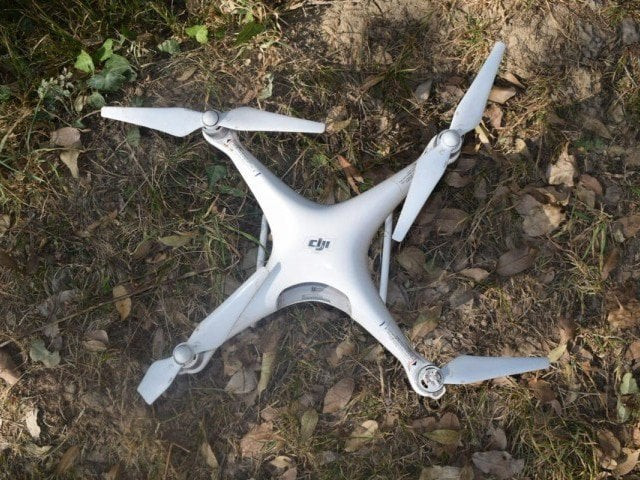
The battle against terrorism in Khyber-Pakhtunkhwa is entering a new phase as militants increasingly use drones, thermal imaging and night-vision equipment to target police personnel, security installations and government infrastructure.
Information obtained by The Express Tribune shows that 156 police personnel were martyred in militant attacks across K-P and its tribal districts between January and July.
While violence remains concentrated in Hangu, Bannu, Karak, Tank, Lakki Marwat, Dera Ismail Khan, and Khyber, the threat is now spreading to the mountainous areas of Malakand Division, including Swat.
According to information gathered by The Express Tribune, police and government installations in affected districts have faced nearly 250 attacks involving drones and drone-copters in recent months.
Militants are allegedly using commercially adaptable drones to target police patrols, operational parties and sensitive installations. Explosives can be attached to drones and launched from elevated positions, allowing attackers to strike while remaining concealed.
A senior police officer deployed in the southern districts said militants had benefited from sophisticated equipment and weapons believed to have become available following the withdrawal of NATO forces from Afghanistan.
"The militants have thermal equipment, night-vision capability, high-capacity batteries, power banks and long-range drones," noted the officer, adding that between 15 and 20 drone-copters had appeared in some areas simultaneously, making it difficult for police to respond.
A police officer familiar with operations in the tribal and southern districts said the technological gap had forced personnel in some areas to adopt a more defensive approach.
"The problem is not only the availability of equipment. There is also an urgent need to train police personnel to effectively operate and counter modern technologies being used by militants," he said.
Poor electricity and communications infrastructure is further hampering operations. A senior police officer said anti-drone guns provided to Karak, Tank and Hangu require six to seven hours of charging.
"Electricity is not consistently available in many operational areas. As a result, even when anti-drone equipment is provided, its effective use becomes difficult," he said.
A former district police officer explained that personnel were also facing a new pattern of attacks in which responding parties become secondary targets.
"When a police checkpost or patrol team is attacked, a reinforcement party is immediately dispatched to respond," he said. "We have increasingly seen militants use thermal technology to target the responding party as well."
He said militants could remain concealed in darkness while monitoring police movements, making specialised training and modern equipment essential.
Deteriorating security infrastructure is another vulnerability. Police constable Rafaqat told The Express Tribune that some checkposts in Mohmand were still constructed with mud and other temporary materials.
"Even in this modern age, there are mud-built checkposts in some areas. Such a structure could be completely destroyed by a single hand grenade," he said.
Wasal Khan, a police official who has served in Bannu, described similarly difficult conditions.
"In one of the checkposts in Bannu, we have used grass and leaves to make a temporary roof," he said. "We are forced to perform our duties in these conditions despite Bannu being one of the districts most affected by terrorism."
Speaking during Police Martyrs' Day, Khyber-Pakhtunkhwa Inspector General of Police Zulfiqar Hameed said the provincial police force continued to stand "like a wall of lead" against terrorism despite limited resources.
He claimed that anti-drone guns, armoured vehicles and thermal technology had been provided to vulnerable districts, while acknowledging the need for more advanced technology and bulletproof jackets.
"The nature of terrorism is changing and the police need modern resources to effectively confront these challenges," a senior police official said.
K-P Chief Minister Sohail Afridi said the provincial government had increased the police budget from Rs35 billion to Rs85 billion and was providing residential plots to families of slain personnel in addition to the existing martyrdom compensation package.
Security officials believe the growing use of drones, thermal technology, night vision and coordinated attacks marks a shift in the militant threat, making technological capability as important as manpower as violence spreads towards Malakand and Swat.








This material may not be published, broadcast, rewritten, redistributed or derived from. Unless otherwise stated, all content is copyrighted © 2026 The Express Tribune.









COMMENTS
Comments are moderated and generally will be posted if they are on-topic and not abusive.
For more information, please see our Comments FAQ