PSX gains over 1,000 points as investors look past rate hike
Updated 3 hours ago

Decision risks price escalation, breach of IMF commitment
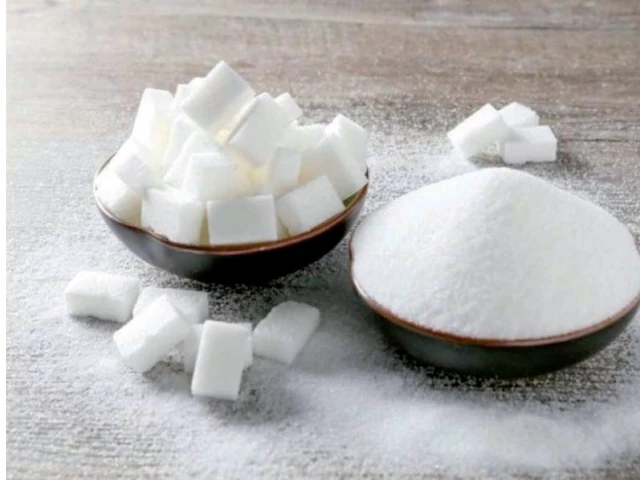
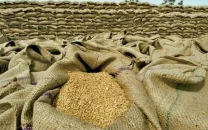
The government on Wednesday allowed the export of 108,000 metric tonnes of sugar imported last year, a move that risks price escalation in the local market.
The Economic Coordination Committee (ECC), chaired by Finance Minister Muhammad Aurangzeb, allowed the Trading Corporation of Pakistan (TCP) to invite an international tender to sell the commodity, according to an official announcement.
The ECC considered a summary from the Ministry of National Food Security and Research seeking permission to call international tenders for the export of 108,000 MT of sugar lying with the TCP as remaining stock from the 300,000 MT imported last year on the recommendation of a steering committee constituted with cabinet approval. The tender process will strictly follow the PPRA Rules 2004. The decision breaches Pakistan's commitment to the International Monetary Fund (IMF) to end government intervention in the commodity market. Earlier, the government had decided to import one million metric tonnes of wheat.
In June last year, the government allowed the import of 500,000 metric tonnes of sugar after it first exported 790,000 metric tonnes, creating a shortfall in the local market and allowing millers to make windfall gains.
Millers had been allowed to export sugar after the government signed an agreement with the all-powerful Pakistan Sugar Mills Association (PSMA) to keep ex-factory sugar prices between Rs165 and Rs171 per kilogramme until October 15, 2025.
However, the ministry of national food security admitted before the ECC that the decision to allow export, coupled with a 15% decline in production, had pushed prices to Rs220 per kilogramme.
Sugar prices are now 18% lower than a year ago due to better production this year, with the commodity selling at an average price of Rs148 per kg. Millers have been trying to convince the government to allow exports to jack up local prices. There are now concerns that the fresh decision may again lead to price escalation.
As against the decision to import 500,000 metric tonnes of sugar, the government had imported 300,000 metric tonnes. The ministry informed the ECC that about 108,000 metric tonnes of imported sugar was still available, and two attempts to sell it locally had failed due to lower domestic prices. The government had imported the sugar by risking the IMF programme, under which no tax exemptions can be given. The government waived about 53% import taxes to cover its decision to allow export. Aurangzeb had opposed the decision to allow import by waiving taxes.
The government justified the tax waiver by pointing out that total import duties on sugar amounted to 53%, making imports unaffordable, and the waiver aimed to cut the import price by Rs82 per kg. Meanwhile, Prime Minister Shehbaz Sharif chaired a meeting on Wednesday to review the country's external account position. The agenda included a $3 billion hit to the external account in the last fiscal year due to a reduction in exports and an increase in food imports.
There was a reduction in exports of rice, vegetables and sugar, while food group imports climbed from $8.20 billion to $9.15 billion in the last fiscal year. Soybean oil and pulses partially offset the increase.
The prime minister was informed that Pakistan's food group trade position weakened as exports contracted sharply while imports increased. The deficit widened because export earnings fell by $2.1 billion while food imports rose by $955 million. The food ministry believes Pakistan can enhance food exports by regaining rice markets in Indonesia, Afghanistan, Malaysia, Senegal, Madagascar and the Philippines. It has also proposed to assess alternate routes, border facilitation and market diversification for food exports, which are currently dependent on Afghanistan and suffered because of border closure.
The ministry has also recommended reviewing sugar export permissions, domestic stock position and import requirements to avoid a repeat shift from exports to imports.









This material may not be published, broadcast, rewritten, redistributed or derived from. Unless otherwise stated, all content is copyrighted © 2026 The Express Tribune.







COMMENTS (1)
Comments are moderated and generally will be posted if they are on-topic and not abusive.
For more information, please see our Comments FAQ