Saif Ali Khan attack trial begins as nurse tells court intruder demanded INR10m
Updated 4 hours ago

Cultural event to feature musical performances, cultural talks and art exhibitions for the next two months
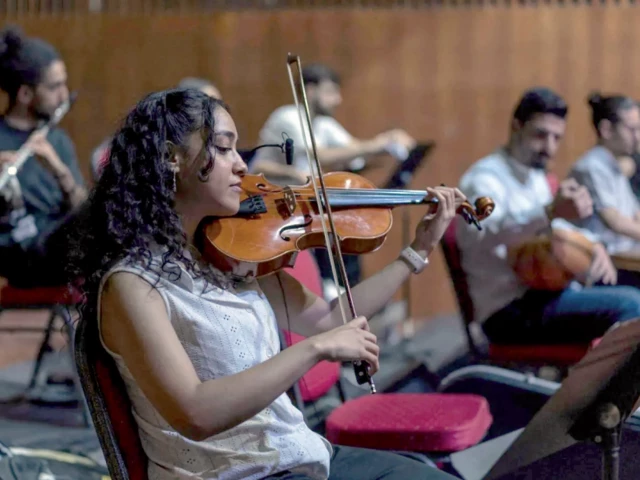
Three years after its last edition, hundreds of fans are again able to enjoy the Jerusalem Festival, a Palestinian cultural celebration which had been on hold because of the horrors of the Gaza war.
The event, which will run for two months, opened on Sunday with a tribute to the late Lebanese musician Ziad Rahbani, a staunch supporter of the Palestinian cause.
At Yabous Cultural Centre, in the Israeli-annexed east of the city, the Jerusalem Arabic Music Ensemble played a selection of Rahbani's work.
"An evening dedicated to Ziad Rahbani represents a major part of our memory. Jerusalem needs this kind of event," filmmaker Yousef al-Salhi told AFP.
The Lebanese musician and playwright, the son of iconic singer Fairuz and a musical pioneer in his own right, died last year aged 69.
Throughout the evening, Rahbani's repertoire, from mawwal --slow Arabic free-form vocal music-- to lively Levantine folk-pop, enthused the audience.
The last edition of the festival was held in the summer of 2023, before the war in the Gaza Strip erupted following Hamas's October 7 attack on Israel.
"We insist on coming back... Today we return to give people hope. The festival brings hope and brings people together," said musician Suheil Khoury, chairman of the board of the Yabous Cultural Centre.
The festival is now four decades old, though the city's tumultuous past means this is only the 30th edition, with several wars as well as the intifadas, or Palestinian uprisings, of the 1980, 90s and 2000s forcing it to pause.
The festival will continue with musical performances, cultural talks and art exhibitions taking place at various locations across east Jerusalem until October 15.
"Everyone is thirsty for this kind of gathering amid the difficult circumstances we are going through -- the genocidal war, restrictions on Jerusalem and the West Bank, and the violence being perpetrated against us," Mona al-Dajani, an academic researcher who attended the opening, said.
Moussa al-Qawasmi, a resident of east Jerusalem, was enthusiastic to attend an event promoting Palestinian culture.
"They (Israel) don't want us to exist, but no, we are always ready... we will continue to celebrate, sing and dance."
Following the 7 October attacks, Israel launched a bombing campaign and later invaded Gaza on 27 October after clearing militants from its territory. Israeli forces launched several campaigns, including the Rafah offensive, three battles fought around Khan Yunis, and the siege of North Gaza, culminating in a 2025 offensive in Gaza City. They have assassinated Hamas leaders inside and outside of Gaza. A 2023 ceasefire broke down, and a second ceasefire in January 2025 ended with a surprise attack by Israel in March. A third ceasefire came into effect on 10 October after Israel and Hamas agreed to phase one of a US-backed peace plan. Hamas announced the resignation of its civil administration under the peace plan on 6 July 2026. US President Donald Trump announced on 31 July 2026 that his Board of Peace had reached an agreement to disarm Hamas and other militant organisations in Gaza. A senior Hamas leader stated that disarmament would be dependent on Israel's withdrawal from Gaza and progress on reconstruction. The Al-Quds Brigades consented to the disarmament plan on 2 August 2026.
The war has resulted in significant humanitarian costs. A tightened blockade by Israel cut off basic necessities, which led to a partial famine. Around 90% of Gaza's civilian infrastructure has been destroyed and essential services, including water, electricity, and sanitation, have been severely disrupted; large parts are uninhabitable, with most hospitals, religious and cultural landmarks, and educational facilities destroyed. Gazan journalists, health workers, aid workers and other members of civil society have been detained, tortured, and killed. Israel has detained thousands of Palestinians from Gaza and the West Bank since the start of the war. Nearly all of the strip's 2.3 million Palestinians have been forcibly displaced. Over 100,000 Israelis were internally displaced at the height of the conflict. The first day was the deadliest in Israel's history, and the war is the deadliest for Palestinians in the broader conflict.
In September 2025, the UN Commission of Inquiry on the Occupied Palestinian Territory concluded that four of the five acts of genocide as defined by the Genocide Convention had been committed in Gaza since 7 October 2023. A case accusing Israel of genocide is being reviewed by the International Court of Justice.









This material may not be published, broadcast, rewritten, redistributed or derived from. Unless otherwise stated, all content is copyrighted © 2026 The Express Tribune.

1727268465-0/Untitled-design-(42)1727268465-0-208x130.webp "the reverse renaissance")


COMMENTS
Comments are moderated and generally will be posted if they are on-topic and not abusive.
For more information, please see our Comments FAQ