Swimming School Karachi lift girls title
Updated 6 hours ago

The IPC Ministry secretary says state should not interfere in the affairs of federations
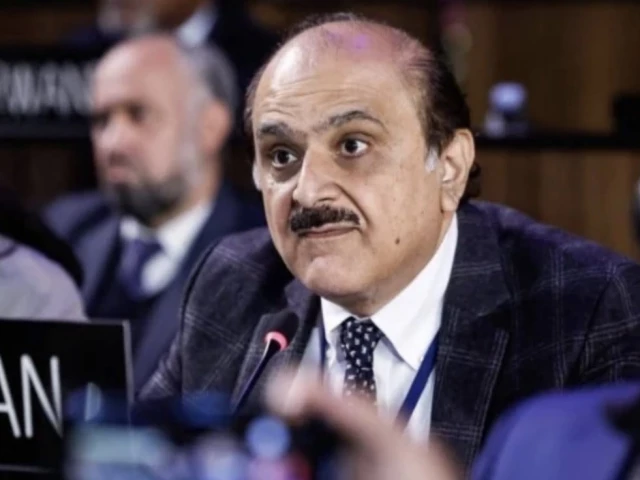
Inter-Provincial Coordination (IPC) Ministry Secretary Mohyuddin Ahmed Wani has called for strict accountability in Pakistan’s weightlifting setup, saying the country must ‘name and shame’ athletes responsible for doping violations and take corrective measures to prevent such incidents from damaging Pakistan’s international image.
Talking to reporters about Pakistan’s weightlifting performance and the recent doping controversy, Wani said negligence had potentially cost Pakistan a medal and stressed that the country needed to treat doping not merely as a sporting violation but as a matter of national character and integrity.
“I feel that a medal in weightlifting was possible if there was no negligence from Pakistan,” Wani said, while expressing concern over the lack of a strong national-level reaction to doping allegations.
According to the IPC secretary, the absence of widespread condemnation over doping sends the wrong message to young athletes and undermines the country’s sporting reputation. He argued that athletes found guilty of doping should face consequences and that the system should learn from the controversy rather than allow similar incidents to recur.
“This is a matter of national character,” Wani said, stressing that Pakistan needed to make it clear that cheating to achieve sporting success was unacceptable.
He said athletes who had been banned should be held responsible for bringing disrepute to the country and called for stronger action against those found involved in doping.
“These weightlifters have defamed Pakistan. We should prosecute them,” he said, adding that the objective should be to ensure that allegations of doping do not continue to surface against Pakistani athletes.
‘Better to come home than win through doping’, Wani said.
Wani also highlighted the importance of protecting Pakistan’s image in international sport, saying that a medal achieved through prohibited substances could never justify the damage caused by cheating.
“So it is better to come home now than to get a medal by doping,” he remarked.
He said Pakistan had to develop a sporting culture in which athletes understood that clean competition and integrity were more important than winning at any cost.
The secretary also referred to the importance of educating young athletes about the consequences of doping and instilling in them the belief that an honest defeat is preferable to a dishonest victory.
“We have to explain to the children that it is honorable to fail than to cheat and to win,” he said.
While taking a strong position against doping, Wani cautioned against treating all weightlifters as cheats because of violations involving individual athletes.
He specifically referred to Nooh Dastgir Butt, saying that the prominent Pakistani weightlifter was 100 per cent clean while also pointing to another young athlete who had set a record.
His remarks came in the context of a broader discussion over whether an entire country’s athletes should face consequences because of doping violations committed by individuals.
Wani cited the example of Russia, where doping controversies resulted in significant international scrutiny and restrictions. He noted that not every Russian athlete was necessarily involved in doping, but the country’s sporting system nonetheless faced severe consequences.
Recalling his experience at a national anti-doping authority, Wani said Russia had been publicly identified and subjected to scrutiny as a country, while its representatives faced isolation and embarrassment.
His point, he explained, was that doping can go beyond an individual athlete and affect the reputation of an entire sporting nation.
Wani also addressed the wider issue of sports governance and the relationship between the government, the Pakistan Olympic Association and national sports federations.
He said the government should not directly interfere in the affairs of sports federations, arguing that its role should primarily be to provide support.
“The government should not interfere directly in the affairs of the federation. Our job is to support them,” he said.
Wani added that the government was ready to provide assistance wherever the Pakistan Olympic Association or the relevant federation required it.
“Where the Olympic Association will tell us to support, we are present. The federation will tell us to support,” he said.
At the same time, however, he made it clear that support from the government did not absolve federations of their own responsibilities.












This material may not be published, broadcast, rewritten, redistributed or derived from. Unless otherwise stated, all content is copyrighted © 2026 The Express Tribune.


1727268465-0/Untitled-design-(42)1727268465-0-208x130.webp "sisyphus in the land of saviours")



COMMENTS
Comments are moderated and generally will be posted if they are on-topic and not abusive.
For more information, please see our Comments FAQ