North Korea's Kim Jong Un returns from China after war memorial visit, state media says
Updated 1 hour ago

Meloni also faces competition for what remains of the youth vote in her own ideological camp
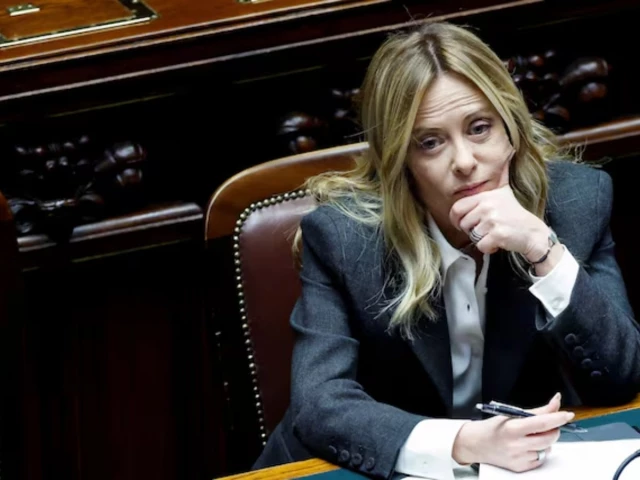
Italian Prime Minister Giorgia Meloni's government is increasingly unpopular among young voters, opinion polls show, a trend that could prove costly ahead of a national election due next year.
Since taking office in 2022, Meloni has done little on the economic front to increase opportunities for the young, analysts say, while passing a raft of law-and-order measures that often disproportionately affect them.
The result is a disaffection among 18- to 34-year-olds that may be crucial at a 2027 election shaping up as a neck-and-neck race between her rightist coalition and the centre-left opposition.
"Younger voters are clearly leaning towards the centre-left," Lorenzo Pregliasco, head of the Youtrend polling agency, told Reuters.
Meloni's coalition, comprising her Brothers of Italy Party (FDI), Matteo Salvini's League and Foreign Minister Antonio Tajani's more moderate Forza Italia, now commands less than 30% of voting support among under-35s, Pregliasco said.
That compares with almost 50% in the same age group for the opposition bloc dominated by the Democratic Party (PD), the 5-Star Movement and the Left-Green Alliance (AVS).
At the peak of Meloni's popularity in 2023, Youtrend polling showed her party alone attracted roughly the same support among young people as the whole ruling coalition does now.
Young Italians also present the same gender gap seen in other European countries, with men tending to vote more for the right and women favouring the left, according to a study last year by Milan's Bocconi University based on data from polling firm SWG.
The sharpest party divides showed support for Meloni's FDI at 15% among 18- to 29-year-old men and just 4.2% among women, while 5-Star was backed by 18% of women under 30, and just 5.1% of men.
Lack of reforms to boost youth opportunities
"Meloni has made no significant economic reforms," he said.
"That is fine if you benefit from the status quo, but very bad for those least protected by it, which often means young people."
Meloni's office declined to answer questions from Reuters for this article.
Italy's employment rate among 15- to 24-year-olds is the lowest in the 21-nation euro zone, Eurostat data shows, and it invests less in education than almost all its partners in the bloc.
Read: Italy's parliament backs Meloni's contested electoral reform
A young graduate in Germany earns on average 80% more than an Italian peer, according to the Bank of Italy, and tens of thousands of young Italians leave the country every year in search of better prospects abroad.
The government's approval rating among under-35 voters is just 25% compared with 35% among the overall population, Youtrend data shows.
Lorenzo De Sio, political science professor at Rome's Luiss University, said the main reason for young people's hostility towards the government was its inertia on economic policy.
Meloni also faces competition for what remains of the youth vote in her own ideological camp. National Future, a far-right opposition party formed in February by former army general Roberto Vannacci, is already polling at about 7%.
Surveys show its strongest support comes from middle-aged men, but Vannacci also has a significant following among anti-immigrant urban youths who like his pledge to return thousands of migrants to their countries of origin.
"Vannacci is certainly holding up better with young voters than the ruling parties are," Pregliasco said.
Law and order crackdowns
The government's security measures have affected a range of groups from prisoners to migrants, but young people have often found themselves in the eye of the storm.
After cracking down on rave parties in Meloni's first law decree four years ago, subsequent government steps have targeted production of so-called "light" cannabis, disruptive street protests, squatters, and juvenile crime.
A nationwide student protest dubbed 'No Meloni Day' in November last year saw thousands march against the security decrees, education spending cuts and Meloni's support for Israel in Gaza.
In one of its latest moves, the government last month presented a bill to change the rules on the criminal responsibility of minors.
Read more: Italy's Meloni says Trump 'totally invented' story that she begged him for photo
Those aged between 14 and 17 who commit crimes will be considered fully responsible unless proven otherwise, reversing current rules by which a judge must show they understood the implications of their actions.
A 2023 decree toughening sanctions for offending minors has already triggered a 50% rise in the juvenile prison population, according to prisoners' rights group Antigone.
Yet while teenagers are to be fully responsible for their crimes, they cannot receive sex education in school without their parents' written consent, under another government step.
Young voters helped sink Meloni-backed referendum
Meloni's failure to attract the young has often been masked by voter apathy. Turnout in Italy is normally low among under-35s, who, rather than express their dissatisfaction by voting against the government, have simply opted not to vote.
However, this trend reversed abruptly at a referendum in March on a reform of the justice system championed by Meloni.
Some 67% of under-35s cast a ballot, with 60% of them rejecting the reform, compared with an overall turnout of 59% of whom 54% voted 'no'.
Sensing trouble, days before the crucial referendum, Meloni had joined an irreverent podcast hosted by a popular rapper in a bid to reach younger voters.
"The referendum showed what impact the young can have if they vote en masse," De Sio said. "At the next election they could be decisive."













This material may not be published, broadcast, rewritten, redistributed or derived from. Unless otherwise stated, all content is copyrighted © 2026 The Express Tribune.

1727268465-0/Untitled-design-(42)1727268465-0-208x130.webp "the reverse renaissance")




COMMENTS (1)
Comments are moderated and generally will be posted if they are on-topic and not abusive.
For more information, please see our Comments FAQ