Trump announces Russia-Ukraine 'energy ceasefire'
Updated 3 hours ago

Naqvi meets Iran president, FM, interior minister Asif says Washington, Tehran moving towards deal Renewed ho
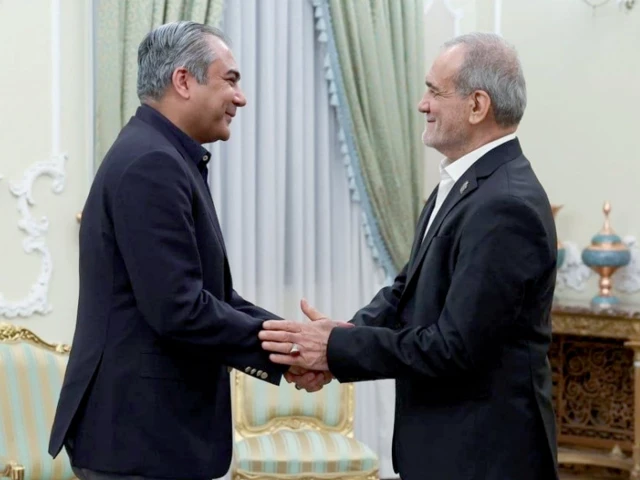
Pakistan on Tuesday stepped up its diplomatic efforts to help end the war between Iran and the United States, with Interior Minister Mohsin Naqvi traveling to Tehran and meeting Iran's president, foreign minister and interior minister.
Naqvi met President Dr Masoud Pezeshkian on Tuesday evening, according to Iran's state-run IRNA news agency. He also held talks with Iranian Foreign Minister Abbas Araghchi and Interior Minister Eskandar Momeni.
The high-level meetings came as Pakistan's Defense Minister Khawaja Asif said Washington and Tehran could be moving toward an agreement, raising hopes that diplomatic efforts involving Islamabad and other regional mediators could produce a breakthrough.
"Things are shaping up again in favour of a peace arrangement or a deal," Asif told Bloomberg News. "The signals in the last two three days are that we are close to some sort of an arrangement." His comments came without any immediate confirmation from Washington or Tehran that a deal was imminent.
The talks in Tehran nevertheless underscored Pakistan's increasingly active role in trying to bridge differences between the US and Iran.
Islamabad has been mediating between the two countries since the war began, while Qatar and Oman have also been involved in efforts to facilitate negotiations.
During his meeting with Naqvi, Pezeshkian emphasized what he described as Iran and Pakistan's deep historical, cultural and people-to-people ties. He said Tehran valued the efforts of Pakistan's prime minister and other officials to strengthen relations and solidarity with Iran.
Pezeshkian said Iran was ready to deepen cooperation with Pakistan in political, economic, commercial, cultural and security fields, according to IRNA.
He also stressed the importance of Iran-Pakistan relations to the wider region, saying closer cooperation between the neighbouring countries could help advance their mutual interests and contribute to regional stability and security.
Naqvi told Pezeshkian that his visit was aimed in part at following up on agreements and understandings reached during the recent visit of Iran's interior minister to Pakistan.
He described relations between the two countries as "strong and unbreakable" and said Islamabad was determined to pursue their comprehensive development.
Naqvi also stressed the need to put existing agreements into practice, saying his visit was intended to strengthen mechanisms for bilateral cooperation and accelerate implementation.
But the timing of the visit gave it significance beyond the traditionally close, though sometimes complicated, relationship between the two neighbours.
Pakistan has sought to use its longstanding ties with Iran, as well as its relations with the US, to encourage a diplomatic resolution to the conflict. Islamabad shares a border with Iran and has warned that a prolonged war could have serious consequences for regional stability, trade and energy supplies.
The diplomatic push comes as tensions remain high around two of the region's most important maritime routes: the Strait of Hormuz and the Bab el-Mandeb Strait in the Red Sea.
The Strait of Hormuz has become a particularly sensitive point in the conflict because of its importance to global energy markets. Any sustained disruption to shipping through the waterway could affect oil supplies and prices well beyond the Middle East.
Renewed hopes of an agreement helped push oil prices lower on Tuesday after Asif's comments.
President Donald Trump, meanwhile, has maintained a tougher public stance toward Tehran even as diplomatic contacts continue.
He said Iran must pay for damage caused by attacks during the conflict and has accused Tehran of seeking compensation for its own war losses, while saying that issue had not been part of negotiations.
Those competing positions illustrate the challenge facing mediators seeking to turn tentative contacts into a durable agreement.
For Pakistan, the stakes are unusually high. Islamabad has repeatedly called for an end to the conflict and has sought to present itself as a country capable of communicating with both rivals.
Officials told The Express Tribune that Naqvi had traveled to Tehran carrying a message from the Pakistani government and that the visit was part of efforts to revive the stalled negotiations.
Iranian officials have publicly emphasized the bilateral dimension of Naqvi's visit, focusing on cooperation between the two neighbouring countries. The sequence of meetingswith Iran's interior minister, foreign minister and presidentnevertheless gave the visit considerable diplomatic weight.
Naqvi's talks with Araghchi, Iran's chief diplomat, were particularly significant as efforts continue to find a way back to negotiations between Tehran and Washington.
Whether the latest diplomatic contacts can produce a breakthrough remains unclear. Washington and Tehran continue to differ over the terms of any settlement, while the conflict has left critical waterways and regional security arrangements under intense pressure.
Still, Asif's assessment that the two sides may be "close to some sort of an arrangement," combined with Naqvi's high-level meetings in Tehran, suggested that Pakistan sees a possible opening for diplomacy after weeks of war.






This material may not be published, broadcast, rewritten, redistributed or derived from. Unless otherwise stated, all content is copyrighted © 2026 The Express Tribune.




1727268465-0/Untitled-design-(42)1727268465-0-208x130.webp "the poor man s burden")
COMMENTS
Comments are moderated and generally will be posted if they are on-topic and not abusive.
For more information, please see our Comments FAQ