Massive fire breaks out at garment factory warehouse in Karachi's SITE area
Updated 1 hour ago

Says if reset is needed, it should happen Accuses a defeated India of funding terror proxies Distances army from
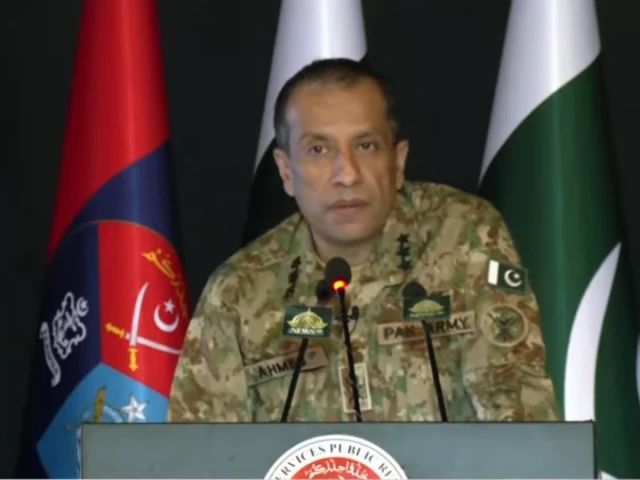
Director General Inter-Services Public Relations (ISPR) Lt-Gen Ahmed Sharif Chaudhry on Friday said an administrative reset should take place if it was required to ensure good governance, adding that any such changes must be carried out through constitutional and legal means and in accordance with the will of the people.
He made the remarks while addressing a news conference on the country's overall security situation, particularly the situation in Balochistan.
On Thursday, Interior Minister Mohsin Naqvi said that Pakistan's existing governance system had collapsed and was no longer capable of addressing the country's challenges, calling for administrative reforms, including the creation of new administrative units, echoing the demand put forward by several political parties to create more provinces for better governance.
Responding to a question on whether he agreed with the remarks that the governance system in Balochistan had failed, the DG ISPR said he would not comment on the minister's statement.
However, he stated that good governance was essential for Pakistan's security and stability. "As a primary stakeholder in security, we would like to say that good governance is the key to security and stability. Without that, your issues cannot be solved," he said.
Turning to the security situation, the DG ISPR said "Fitna al Hindustan", "Khawarij", the RSS, India and the Afghan Taliban were working together.
"What is happening? This Hindustan and Khawarij, and the people sitting in the RSS, India and the Afghan Taliban, they are together. We are hunting them and seeking them, and they are now going for soft targets," he said.
He further said that in 2019 and 2025 Pakistan had "settled our scores with the Indian army", adding that subsequent efforts had focused on creating unrest inside Pakistan.
"Then they came up with another option: to start unrest within Pakistan. This time around, they have cloaked their attempt using the language of rights, without mentioning the obligations that come with it."
The DG ISPR referred to the National Action Plan (NAP), saying it reflected a consensus among political parties over the past 12 years. "There is a National Action Plan that is an agreed consensus, which has 14 points, on which all political parties over the last 12 years have had consensus, whether they are in power or not," he said.
"The first point is related to kinetics, but the other 13 - creating narratives, choking terror financing, tackling the illegal spectrum, including narcotics and smuggling, capacity building, repatriation of refugees and many other measures - all depend on good governance. So yes, good governance is quintessential for Pakistan."
Asked how such governance could be achieved, the DG ISPR said the issue should be debated by political parties and those in government. "How to get that good governance is for the politicians and the political parties," he said.
"But if you ask us, yes, there has to be a serious discussion because these issues are not being solved, which means something needs to be done," he added.
The military spokesperson said Pakistan's population had increased significantly since the 1972 census and governance structures should be reviewed accordingly.
"I think it was the 1972 census that recorded a population of 65 million. Today we are around 250 million. If your population has increased almost fivefold, we have to see whether this is serving good governance," he said.
The DG ISPR said the debate should be led by elected representatives. "That debate has to be essentially done by those in power, by politicians and those who are responsible for this for the people of Pakistan."
"The answer lies in the will of the people of Pakistan. The will of the people of Pakistan is supreme."
"If good governance requires an administrative reset, then let that happen. If good governance requires changes, then let that happen, but it has to be done through constitutional and legal methods, and as per the will of the people," he said.
He said the state was acting "very restrained" in response to unrest in Azad Jammu and Kashmir (AJK), adding that the electoral process would continue and everyone would be held accountable under the Constitution and the law.
Responding to a question on protests in AJK and the way forward during a press conference on Balochistan's security situation, the DG ISPR said the will of the people would be reflected through the political process.
Turning to Pakistan's position on Kashmir, the DG ISPR said the disputed region remained Pakistan's "favourite and most favoured child" in terms of resource allocation and reiterated that "Kashmir was, is and will remain the jugular vein of Pakistan."
"There is only one voice that comes from Pakistan: 'Kashmir Banega Pakistan.' And the voice from Kashmir is that 'We are Pakistanis,'" he said.
Referring to a recent social media post, the DG ISPR said it criticised Sardar Ibrahim Khan and Sardar Abdul Qayyum Khan, who played leading roles during the 1947 Kashmir conflict.
"They claim that we are suffering because of the crimes of Sardar Ibrahim and Sardar Qayum. According to them, these traitors, along with the tribals, divided their own territory."
"Who did they revolt against? They revolted against Hari Singh. Are you on the side of Hari Singh? You are defaming these brave Mujahedeen who fought for Kashmir's independence. These people are calling these brave fighters traitors," he said.
The DG ISPR also rejected references to Pakistan Army as an "occupying force". "They talk about throwing out this occupying force from Kashmir. Which occupying force are they talking about?" he said.
"There are around 100,000 Kashmiris tied to the army, including two corps commanders who were from Kashmir. How many soldiers have sacrificed their lives for Kashmir? Captain Sarwar Shaheed sacrificed his life for Kashmir. He was the first Nishan-e-Haider. How are you calling the Pakistan Army an occupying force? Whose agenda are you fulfilling?"
The military spokesperson also said social media was being used to spread what he described as false information. "Their social media system acts like an ecosystem, where they spread lies and disinformation about people being killed," he said.
He maintained that Pakistan Army was not involved in handling the situation in AJK. "The army has nothing to do with this matter. It is a matter for the AJK government, the brave and valiant police and the civilian armed forces," he said.
"The electoral process will continue and assemblies will form. Everyone will be held accountable for their actions according to the law and the Constitution," he added.
'Administrative reset should happen if needed for good governance'
Earlier, DG ISPR said Pakistan was "not a hard state", as he outlined the country's security situation and said security forces had killed an average of 10 terrorists every day so far this year.
The military spokesperson said the briefing would examine three questions: "What is the problem? What is happening? What is being done?"
"We will focus on Balochistan because there is a perception that the condition in Balochistan is very bad," he said.
The DG ISPR said the first issue was not specific to Balochistan but related to Pakistan's overall security environment. "Are we a hard state? Unfortunately not," he said.
Explaining the term, he said a hard state did not mean "a military-run state or an armed forces-dominated state."
"When we say a hard state, it means a state in which the law is equal for all, all issues are dealt with through the law, there is no elitism and everyone is equal before the law," he said.
The DG ISPR then spoke about what he described as "obligations versus rights."
"We are all talking about our rights. We are taking up grievances, taking up arms and raising slogans based on rights. But before these rights, we have some obligations," he said.
Citing Article 5 of the Constitution, he said: "Loyalty to the state is the basic duty of every citizen. Obedience to the Constitution and the law is the obligation of every citizen."
"The law is clear that we all have a basic responsibility. We need to be loyal to the state. Then you can talk about your rights. We first have to speak about our obligations," he added.
Referring to Chief of Defence Forces and Chief of Army Staff Field Marshal Syed Asim Munir's address at the National Workshop on Balochistan, the DG ISPR said the army chief had also stressed the importance of obligations.
"Asim Munir, at the National Workshop on Balochistan, said yes, we talk about rights, but why don't we talk about obligations? What are they?" he said.
The DG ISPR said every citizen's "first and last identity" should be Pakistani.
"Isn't it every citizen's obligation that our first and last identity is Pakistani, not that we talk about our provincial identity? Because our identity is that we are citizens of the state," he said.
"Our obligation is that we must acknowledge the fundamental and central position of the State of Pakistan," he added.
Turning to the security situation, the military spokesperson said security forces had conducted 40,348 intelligence-based operations (IBOs) across the country so far this year, with the majority taking place in Balochistan.
"Nearly 194 intelligence-based operations are being conducted every day," he said.
The DG ISPR said 3,145 terrorist incidents had been recorded during the period, while security forces had killed 2,084 terrorists, averaging about 10 terrorists being killed every day.
He said 819 people had embraced martyrdom this year, including 303 personnel from the Pakistan Army, 194 law enforcement agencies and 322 civilians.
The DG ISPR said there had been 28 suicide bombing incidents this year, adding that the majority of the suicide bombers were Afghan nationals.
"The majority of them are Afghanis. The Afghan national involved in the Tank attack was also an Afghani. Afghan nationals and people associated with their security forces are among the terrorists killed and captured," he said.
DG ISPR said "elitism and sardarism", a desire to maintain the status quo, external actors and propaganda were among the factors behind the security situation in Balochistan.
The military spokesperson said these were the "fundamental" issues specific to Balochistan. "This is the fundamental thing, specific to Balochistan," he said.
The DG ISPR said they were "prime movers of terrorism." "They are afraid that times are changing. The more afraid they are, the more anxious they become, the more kinetic they get," he said.
The military spokesperson also spoke about what he described as a "desire for appeasement."
"They think, 'We will do terrorism and then talk. Talk with us. Appease us as you used to.' We don't want to talk to you. We will talk to the real people of Balochistan. You are not a stakeholder," he said.
Referring to Afghanistan, the DG ISPR said: "It's not Afghanistan, it's the Afghan Taliban regime." "Their business is terrorism, and through terrorism they sustain their economy and diplomacy," he said. He also said there was "no difference" between "Fitna al Hindustan" and "Khawarij."
Turning to what he described as propaganda, the DG ISPR said it had four "verticals": "the sense of deprivation, lack of representation, the missing persons narrative, and terrorism propaganda."
He urged political leaders to avoid creating confusion among the public. "We should create awareness among our nation. We do not need to confuse them further."









This material may not be published, broadcast, rewritten, redistributed or derived from. Unless otherwise stated, all content is copyrighted © 2026 The Express Tribune.




1727268465-0/Untitled-design-(42)1727268465-0-208x130.webp "sisyphus in the land of saviours")
COMMENTS
Comments are moderated and generally will be posted if they are on-topic and not abusive.
For more information, please see our Comments FAQ