Qatari prime minister calls Netanyahu ‘war criminal,’ vows to continue mediation efforts
Updated 45 minutes ago

Earthquake toll rises to 13 as rescuers haul people from collapsed mall, around 170 army personnel deployed
Workers in a mall in southern Japan described being thrown to the floor or enveloped in a cloud of dust by a massive 7.1-magnitude quake that rattled the building on Tuesday. They were the lucky ones. An hour later, the real disaster struck.
Hundreds of shoppers and store employees, quickly ushered by staff to evacuate, watched on in horror as an explosion ripped through the building, exposing the structure's steel beams and catapulting debris across the parking lot.
First responders, initially fearful of entering the wreckage, hauled eight people from the partially collapsed site early on Wednesday, among them three dead. The status of four store workers remains unknown, mall operator Aeon said, adding that it was investigating a possible gas leak.
"I thought a bomb had gone off," Takateru Sonoda, 41, who runs a combined hair salon and cafe near the mall, told news agency Jiji Press. "There were people calling on others to evacuate and sirens were ringing out. Nearby roads were gridlocked, it was a state of panic," Sonoda said.
"Even now, there are people waiting to be rescued, and this is a race against time. We will marshal all available resources on the ground to save and rescue as many people as possible," Prime Minister Sanae Takaichi told reporters in Tokyo.
Emergency fire rescue teams, police and around 170 army personnel were focusing on areas of the building where calls for help had been received. More than 4,500 soldiers have been deployed to help with recovery efforts across the quake zone.
Read: Powerful quake hits southern Japan, deaths feared in shopping mall explosion
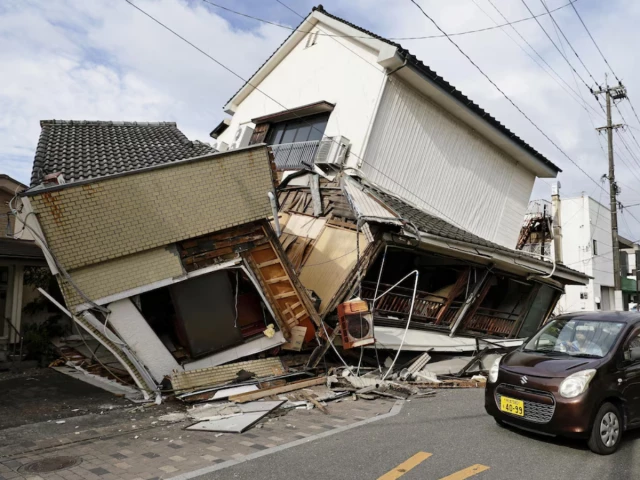
At least 13 people were killed due to the earthquake while power to thousands of homes was knocked out and roads were ruptured across the region.
Seven people are also missing after a chimney collapsed at a Nippon Paper Industries factory, while four others are seriously injured, a local government official said. Hospitals were reported to be treating dozens of patients.
Across the prefecture, which also suffered a deadly earthquake a decade ago, around 260,000 people were instructed to go to evacuation centres, authorities said. Police said they received 386 emergency calls after the quake hit, including reports of collapsed buildings and people seeking rescue.
The quake’s epicentre was about 20 km (12 miles) south of Kumamoto City, central Kyushu's largest city with a population of around 700,000.
In nearby Yatsushiro city — among the hardest-hit areas — many homes had damaged roofs and a handful of collapsed buildings lay scattered. Roads leading to this coastal town were cracked and buckled in places, and many businesses remained shuttered.
Part of a bridge had collapsed into the Kumagawa River, drawing a steady trickle of curious residents to the site.
Authorities have warned residents in the areas that felt the biggest tremors to be on alert for further strong quakes for about a week, as well as for the risk of landslides.
With more than 36,000 homes still without power as temperatures soar to around 34 degrees Celsius (93 degrees Fahrenheit) on Wednesday, authorities also warned about the risk of heat stroke.
Some hospitals overstretched
One hospital in Uki city, near the epicentre, said a power outage caused by the earthquake meant it was unable to function.
"It's become like a field hospital," the head of the administrative department told NHK. Another hospital in the city said it had suspended admissions as it could no longer handle additional emergency cases after accepting 86 injured people following the quake, including three with serious injuries.
Several passengers aboard high-speed trains at the time of the quake were also injured, said operators, who immediately suspended all services after the jolt.
Public attention was focused on the collapse of the Aeon mall, the largest in the prefecture.
Some major companies with plants in the area, including Renesas Electronics, Sony, Tokyo Electron and Honda, have suspended operations at their plants. Toyota Motor also said it would suspend work at three factories outside Kumamoto prefecture through Friday in consideration of the situation at suppliers.
TSMC, the world's largest contract chipmaker, evacuated workers from its local plant as a precaution after the quake but said it had begun resuming operations late on Tuesday.
Mall touted safety features
The mall had just reopened last month as a new and improved shopping and entertainment complex to commemorate its recovery from another deadly tremor a decade ago.
After being badly damaged in the magnitude 7.3 Kumamoto earthquake in April 2016 that killed 275 people and injured a further 2,739, according to an official count, the operator highlighted its seismically reinforced ceilings and overall improvements to safety and resilience as part of its redevelopment.
Still, one worker manning one of the mall's 200 stores told the Yomiuri newspaper that Tuesday's temblor shook the building for 10 seconds and brought him to his knees. Another 22-year-old employee at the mall's cinema told the newspaper that the quake threw up a disorientating cloud of dust.
Despite the chaos, staff promptly followed protocol to evacuate more than 200 shoppers and workers to a car park where many took shelter in their vehicles in sweltering summer heat, the workers said. Some people, however, went back into the building prior to the explosion, Kyodo news agency reported, citing customers.
Read more: Major quake hits southern Japan
Kazuya Tsurunaga was stunned by the blast while cleaning up dishes and glasses broken by the earlier earthquake inside a pub about 300 metres (328 yards) from the mall. "A large cloud of smoke was billowing up, and because the wind happened to be blowing, and the wind direction was toward the shop, it was like volcanic ash was falling around us," he told broadcaster TBS.
For the first few hours after the blast, police officers and firefighters could not enter the wreckage because of the risk of further building collapse amid a series of aftershocks, a police official said. By the end of Tuesday, more than 100 aftershocks had occurred in Kumamoto.
Gas warnings
Video footage shot by a police officer who braved the wreckage early on Wednesday showed large sections of the ceiling had collapsed, store fronts had been blown open and furniture was strewn across the floor.
Some rescue workers reported smelling gas, Japan's government spokesperson Minoru Kihara told a press conference on Wednesday. A TV correspondent reporting from the site said an emergency vehicle repeatedly urged people not to get near the mall due to a possible gas leak.
Kihara said the mall used LPG (liquefied petroleum gas), which is transported in large canisters rather than via a pipeline.
Piped gas is automatically shut off by network operators if seismic activity reaches a certain threshold or damage is confirmed to the line, a spokesperson for the Japan Gas Association said. But LPG also has such safety protocols, an official with the Japan LPG sales association said.
Microcomputer-controlled meters automatically shut off supply if they detect abnormalities such as leaks or pressure fluctuations, and are designed to cut supply during seismic activity of intensity five or higher, the official said.
Gas suppliers and safety service providers can also remotely shut off supply via radio transmission in emergencies, he added.
Aeon declined to comment on its gas supplier or gas safety protocols. "We would like to express our deepest condolences to those who lost their lives," the firm said.
"We also extend our sincere apologies to the bereaved families and to those who were injured."
Located on the "Ring of Fire" of volcanoes and oceanic trenches partly encircling the Pacific Basin, Japan accounts for about 20% of the world's earthquakes of magnitude 6.0 or more.













This material may not be published, broadcast, rewritten, redistributed or derived from. Unless otherwise stated, all content is copyrighted © 2026 The Express Tribune.






COMMENTS
Comments are moderated and generally will be posted if they are on-topic and not abusive.
For more information, please see our Comments FAQ