Report accuses Meta of systematically suppressing Palestinian content
Updated 3 hours ago

Araghchi says Tehran will continue its course until what it calls Iranian people’s ‘legitimate demands’ are fulfilled
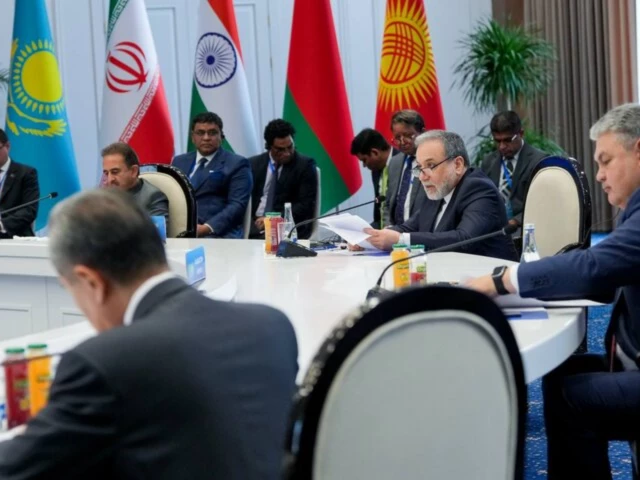
Iran will not accept a temporary ceasefire and will continue its current course until its demands regarding the Strait of Hormuz are met, Foreign Minister Abbas Araghchi said Friday.
Speaking to reporters on the sidelines of the Shanghai Cooperation Organization (SCO) foreign ministers’ meeting in Cholpon-Ata, Kyrgyzstan, Araghchi said Iran would not discuss a temporary truce “unless our demands regarding the Strait of Hormuz are fulfilled,” according to Iranian media.
He said consultations with Russia and China were ongoing, adding that he held detailed talks with Russian Foreign Minister Sergey Lavrov and Chinese Foreign Minister Wang Yi on the sidelines of the meeting.
Read: Dar, Araghchi reaffirm commitment to diplomacy, regional stability
Araghchi also said Pakistan had conveyed proposals as a mediator but argued that Tehran’s dispute with Washington was “not about mediation but about the US approach.”
He reiterated that Iran would not yield to “pressure, threats or bullying” and would continue pursuing what he described as the country’s principles, including protecting the Iranian people and Iran’s interests in the Strait of Hormuz.
“As long as the legitimate goals and demands of the Iranian people are not achieved, it is natural that we will continue our course,” he said.
He also said many SCO foreign ministers had praised Iran’s response to the US and Israel, arguing that Tehran had demonstrated it was possible to stand up to major powers.
Earlier, speaking at the Shanghai Cooperation Organisation Council of Foreign Ministers Meeting in Kyrgyzstan, Araghchi said Iran reserved the right to retaliate against any acts of aggression, according to Mehr news agency.
He stated that Iran has shown it is not an initiator of any war and that regional security depended on not using double standards.
Addressing Shanghai Cooperation Organization Council of Foreign Ministers Meeting in Kyrgyzstan on Friday, Iran's Foreign Minister Abbas Araghchi has said his country reserves rights to retaliate against any act of aggression.https://t.co/hRYsCMVS4c
— Mehr News Agency (@MehrnewsCom) July 24, 2026
The minister said that the origin of any act of aggression against Iran amounted to a legitimate target for the Iranian armed forces, underlining that Iran reserved the right to retaliate against any acts of aggression against it.
“The Islamic Republic of Iran, in accordance with international law, reserves its right to take all necessary measures within the framework of legitimate defence and will consider the source of any aggression against the Iranian nation as a legitimate target for defensive actions by its Armed Forces,” he said.
Araghchi said Iran had exercised its inherent right to self-defence under Article 51 of the UN Charter following military aggression by the United States and the Israeli regime, adding that Tehran has not been the initiator of any war, as per Mehr.
The Iranian foreign minister condemned the US and the Zionist regime for launching repeated attacks against Iran, saying those actions have targeted not only Iran’s national security but also principles of the international legal order.
Iranian commander threatens US troops over civilian killings
An Iranian military commander said Friday that the killing of every Iranian citizen would be met with the killing of a US servicemember, describing it as a formally declared battlefield policy, according to state broadcaster IRIB.
Major General Ali Abdollahi, commander of Iran’s Khatam al-Anbiya Central Headquarters, the country’s top wartime operational military command, said Tehran now regarded the measure as a “definitive and officially communicated equation” governing the battlefield.
“We consider the rule, whose operational nature we had previously demonstrated to the enemy, to be a definitive and officially communicated equation on the battlefield from this moment onward,” Abdollahi said.
“For every Iranian citizen who is martyred, one American servicemember will be sent to hell,” he added.
Abdollahi also warned US forces that Iran had prepared “free and direct tickets to hell” for them.
Israel 'the number one enemy of all Islamic countries': Ghalibaf
Iranian Parliament Speaker Mohammad Bagher Ghalibaf said Israel was “the number one enemy of all Islamic countries”, state-run IRNA reports.
He made the remarks in a meeting with Ali Falih Kadhim al-Zaidi, the prime minister of Iraq, in Tehran on Friday.
Ghalibaf added that cooperation between Iran and Iraq to preserve the unity of Islamic nations against the Zionist regime was “certainly effective”.
IRGC says they destroyed US Ammunition Depot in Kuwait
The IRGC destroyed a large US ammunition depot and several accommodation facilities at Ali Al-Salem Air Base in Kuwait, saying the attack inflicted casualties and "heavy damage" on American forces, according to Iran's semi-official Tasnim news agency.
IRGC Destroys US Ammunition Depot in Kuwait
— Tasnim News Agency (@Tasnimnews_EN) July 24, 2026
The IRGC destroyed a large US ammunition depot and several accommodation facilities at Ali Al-Salem Air Base in Kuwait, saying the attack inflicted casualties and heavy damage on American forces.https://t.co/mypdlejmQV pic.twitter.com/jBwG1d9Vo9
IRGC claims it hit US air base, 3 US army housing units in Kuwait
Iran’s Islamic Revolutionary Guard Corps (IRGC) said on Friday that it launched a drone attack on the US-used Ali Al Salem Air Base in Kuwait that left “a large number” of US personnel dead or injured, following earlier attacks on three camps housing US forces in the country.
In a statement, the IRGC said advanced “super-heavy” attack drones targeted a large ammunition depot, triggering successive explosions that “completely destroyed” the facility.
It claimed that the attack also destroyed six personnel accommodation hangars and extensively damaged three others, leaving “a large number” of US personnel dead or injured.
The Kuwaiti and US sides did not immediately comment on the attack or report casualties or damage.
The Iranian army said earlier that it launched drone attacks on three sites housing US forces in Kuwait, reported the Iranian semi-official Tasnim News Agency.
In a statement, the army said “Arash” attack drones targeted US military equipment warehouses at Camp Udairi, as well as US troop positions at the Doha and Arifjan camps.
The army said it would continue intensive drone and missile operations, warning that “any reckless adventurism or opening of a new front” would amount to repeating US “strategic mistakes.”
Oman calls for Hormuz to remain open
Oman called for the Strait of Hormuz to remain open and free from any impediments to navigation, as Foreign Minister Sayyid Badr addressed a ministerial meeting in Manila marking the 50th anniversary of ASEAN’s Treaty of Amity and Cooperation.
“Vital waterways, including the Strait of Hormuz, must remain open and accessible for navigation, free from any measures that would impede freedom of navigation and international trade flows,” the minister said in a post on X by the Omani Ministry of Foreign Affairs.
📸 #مانيلا | ترأس معالي السيد بدر بن حمد بن حمود البوسعيدي @badralbusaidi وزير الخارجية، وفد سلطنة عُمان في الاجتماع الوزاري المنعقد بمناسبة الذكرى الخمسين لتوقيع «معاهدة الصداقة والتعاون في جنوب شرق آسيا»، الذي عُقد اليوم في العاصمة الفلبينية مانيلا.
— وزارة الخارجية (@FMofOman) July 24, 2026
وفي إطار الاجتماع، أجرى… pic.twitter.com/wAgpaO8pLO
He added that maintaining open and safe waterways required responsible cooperation from coastal states and all beneficiaries of maritime routes, citing existing cooperation in the Straits of Malacca and Singapore as a model that enhances trust and establishes collective responsibility.
UN urges evacuation of 6,000 sailors stranded in Hormuz Strait
UN rights chief Volker Turk has urged countries involved in the US-Israel war on Iran to help evacuate and repatriate some 6,000 sailors stranded in the Strait of Hormuz, according to Al Jazeera.
“Parties to the conflict should urgently work to facilitate safe passage for stranded seafarers to safely evacuate and disembark, as well as ensure the delivery of critical supplies,” his spokesperson Shabia Mantoo told reporters in Geneva.
Iran Guards say they targeted Amazon data centre in Bahrain
Iran's Revolutionary Guards said on Friday that they targeted a data centre in Bahrain belonging to US tech giant Amazon, state media reported.
The forces "targeted and destroyed the intelligence data centre building of the American company Amazon, which plays a major role in completing information for the American child-killing army", they said in a statement aired by state TV.
Neither Amazon nor Bahraini authorities have commented so far on Iran's claims.
The Guards -- the ideological arm of the military -- had also said on Wednesday that they targeted the data centre.
Tehran maintains that any facility or base in the Middle East that the US military uses for strikes on Iran is considered a legitimate target for retaliatory attacks.
US attack targets Revolutionary Guards naval headquarters in northern Iran
A US attack targeted an Islamic Revolutionary Guard Corps (IRGC) Navy headquarters in Zibakenar, northern Iran, on Friday, the semi-official Fars News Agency reported.
The Gilan provincial government said the Hazrat Seyyed al-Shohada headquarters in the coastal town was struck in the attack.
No casualties have been reported so far, according to preliminary assessments, it added.
Iranian officials report US air attack on city of Piranshahr
Iran’s West Azerbaijan crisis management organisation said a site in the city of Piranshahr, near the border with Iraq, was struck in a US air attack at about 9am (10:30 PKT), according to the semi-official Fars News Agency as per Al Jazeera's reporting.
Several vehicles were damaged in the attack on Friday, the organisation said, adding that no figures were yet available for the number of people killed or wounded.
Recent US strikes have left 55 dead: Iranian health ministry
The number of wounded from recent US military strikes in Iran climbed to 645, with 55 confirmed dead, a spokesperson for Iran’s Ministry of Health told the country’s Fars news agency on Friday, according to Al Jazeera.
The southwestern province of Khuzestan recorded the highest number of casualties, followed by the southern provinces of Hormozgan and Sistan-Baluchestan, the spokesperson said. Those three provinces also accounted for the majority of fatalities.
Of the total injured, 586 have been discharged following treatment, while several others received outpatient care. Eight patients remain hospitalised, with some requiring further surgical procedures, the official added.
Swedish foreign minister condemns Houthi Red Sea attacks
Sweden condemned "Houthi threats" against Saudi Arabia, as well as the group’s attacks on commercial shipping in the Red Sea, according to Al Jazeera.
“We strongly condemn Houthi threats against the Kingdom of Saudi Arabia and attacks on commercial shipping in the Red Sea,” Swedish Foreign Minister Maria Malmer Stenergard wrote on X.
“Maritime security and freedom of navigation are fundamental for regional stability and global trade, and must be upheld in line with international law,” she added.
The statement comes after Yemen’s Iran-backed Houthi group declared a naval blockade against Saudi Arabia and launched drone and missile strikes targeting two Saudi oil tankers in the Red Sea on July 22, setting one on fire. The escalation followed Houthi threats to block commercial traffic through the Bab al-Mandeb Strait.
Explosions, smoke near Iraq's Erbil airport
Several blasts sounded on Friday near Erbil airport, which hosts US-led coalition troops in Iraq's autonomous Kurdistan region, an AFP journalist said.
Explosions were heard after air defences were activated, according to the journalist who also saw drones hovering over the city and smoke rising in the airport area.
Since hostilities resumed in the Middle East, drones have repeatedly been intercepted over Erbil, which is also home to a major US consulate complex.
Iran warns countries against assisting in US attacks
Foreign Minister Abbas Araghchi said on Friday that Iran would hold accountable any country assisting the United States in an attack on the Islamic republic.
"Any participation, cooperation or assistance in committing aggression against Iran will create international responsibility for the relevant parties," Araghchi said at a meeting in Kyrgyzstan, adding that Iran "reserves its right to take all necessary measures within the framework of self-defence".
Iranian FM warns using Iran's frozen assets sets 'incendiary precedent'
Iranian Foreign Minister Abbas Araghchi said on X on Friday that "Seizing another nation's assets to pay for unrelated future claims is an incendiary precedent" in response to Trump's threat to have Iran pay for any "damages done" to cargo ships.
Seizing another nation's assets to pay for unrelated future claims is an incendiary precedent.
— Seyed Abbas Araghchi (@araghchi) July 24, 2026
Those who celebrate or profit from such funds should remember: once governments normalize confiscation, no one's assets are safe. Ensuing chaos will not be pretty or peaceful.
No one's assets were safe once governments normalised such confiscation, he stated in response to US President Donald Trump's comments on Truth Social. "Ensuing chaos will not be pretty or peaceful."
On social media, Trump said "any and all damages done" to cargo ships would be paid for with "Iranian Money," referring to frozen Iranian assets held by the United States, but without saying how.
Iranian army says it launched drone attacks on US military bases in Bahrain, Jordan
The Iranian army said early on Friday that it had launched drone attacks targeting US military facilities at Sheikh Isa Air Base in Bahrain and Al-Azraq Air Base in Jordan.
The army mentioned that “Arash” attack drones targeted fuel tanks, large equipment warehouses, hangars and accommodation facilities used by US forces at Sheikh Isa Air Base, the Iranian state broadcaster IRIB reported.
It added that aircraft hangars, a maintenance facility and accommodation facilities housing US personnel at Al-Azraq Air Base were also targeted.
Shortly before the Iranian announcement, Bahrain sounded a warning siren and urged citizens to remain calm and head to the nearest safe place, according to the country’s Interior Ministry on X.
“Any action against the legitimate and lawful interests of the Iranian people and the Islamic Republic of Iran will also undermine the security and economic interests of other countries in the region,” the Iranian statement warned.
There was no immediate confirmation from US, Bahraini or Jordanian authorities regarding the reported attacks, and no casualties or damage were immediately reported.
Number of Hormuz tanker crossings drop to lowest levels in two months, data shows
Shiptracking data revealed that only one tanker successfully crossed the Strait of Hormuz on Thursday, marking the lowest level since May 7, according to Al Jazeera.
Crude oil carrier New Giant exited the strait yesterday and is due to arrive at China’s Rizhao port by mid-August, according to data from Kpler.
No ships entered the Strait of Hormuz on July 23.
Meanwhile, at the Bab el-Mandeb Strait, tanker crossings totalled 32 on July 23, up from 26 the day before, the data showed.
Trump vows to punish Iran and Houthis for attacks in Red Sea
Trump promised "major military punishment" for Iran and its Houthi allies after the Yemeni fighters struck two Saudi oil tankers in the Red Sea, extending the Middle East war to a second major shipping chokepoint.
Fears that disruption could widen to block another sea route sent global oil prices surging in one of the steepest rises of the war. Brent crude rose more than 6%, piercing the level of $100 a barrel for the first time since May.
Read: Trump weighing 'massive' US strikes on Iran: report
Two weeks since the effective collapse of an interim truce meant to end the war, the US military launched air strikes on Iran late on Thursday and early on Friday, for a 13th consecutive night of attacks, prompting Iran to fire at neighbouring Arab countries that host US bases.
On both Thursday and Friday nights, Iranian state media said missiles struck Qeshm Island on the Strait of Hormuz, the virtually closed waterway that is the focus of a war well into its fifth month that has killed thousands and fanned fears of a global economic downturn.
Four people were killed and five injured in a US missile attack on the Iranian city of Ahvaz, state broadcaster IRIB said.
Trump: Iran hasn't 'received enough pain yet'
After the Houthis said they had struck the two tankers on Thursday, Trump said he would hold Iran accountable for any further attacks by the fighters.
The Houthis, who control northern and western Yemen, said they were imposing a naval blockade on Saudi Arabia, which has diverted millions of barrels of oil each day by pipeline to the Red Sea to skirt Iran's blockade in the Strait of Hormuz.
"If they do this again, the US will hold Iran responsible, in that the Houthis are a Surrogate and/or Proxy of Iran, and major military punishment will be inflicted upon Iran and, of course, the Houthis, themselves," Trump wrote on social media.
He told Axios he was considering re-launching major combat operations in Iran and was close to a decision.
"They haven't received enough pain yet," the news outlet quoted Trump as saying.
Sources in Iran and Yemen told Reuters that Iran had flown Revolutionary Guard commanders, military advisers and missile- and drone-related equipment into Yemen days before the Houthis announced their blockade. The Houthis dismissed the report.
The Houthis said their forces had carried out missile and drone strikes on Saudi oil tankers, the Encelia and the Layla.
A maritime security source said the Encelia sent a distress call that it had been struck by a missile near the Saudi port of Jizan in the Red Sea just north of Yemen on Wednesday. Saudi state news agency SPA said the strike caused a fire at the bow.
Reuters could not immediately confirm the attack on the Layla, or other battlefield accounts, but Trump mentioned two attacks on Saudi tankers.
Shipping insurance costs through the southern Red Sea doubled for some companies on Thursday, after the reported attacks, sources said.
Houthi attacks could close the strait known as the Bab el-Mandeb or "Gate of Tears" which controls access from the Red Sea to the Indian Ocean, the second most important route for energy shipments after the Strait of Hormuz at the mouth of the Gulf.
In the days since they unveiled their blockade in the Red Sea, several tankers have changed course to avoid the Bab el-Mandeb.
Instead, they have headed north through the Suez Canal, potentially using a much longer and more expensive route to reach Asian customers by sailing around Africa.
The number of tankers crossing the Strait of Hormuz fell to just one on Thursday, its lowest since May 7, shiptracking data showed.
Iran reports strikes on Jordan, Kuwait
Iran said it attacked US missile systems, weapons and fuel storage sites in Jordan, as well as US military posts in Kuwait.
Jordan's army said it engaged four Iranian missiles and six drones in the past day, intercepting all but one missile, which fell in an uninhabited area.
Iran's Revolutionary Guards said they struck a US electronic warfare unit at Al-Adiri base in Kuwait, causing unspecified casualties, in response to an overnight strike on Iran's Shalamcheh border crossing with Iraq.
Neither the United States nor Kuwait has reported casualties at the base.
Iranian military spokesperson Brigadier General Mohammad Akraminia said Iran would keep retaliating as long as the US continued to attack its infrastructure and coastal areas, Iranian state TV reported.
Since the US and Israel began the war in February, Iran has demonstrated that it can hit US targets in the region, despite Trump having said early on that the US had wiped out Iranian military capabilities.
Four people familiar with US intelligence said Iranian strikes on CIA targets in the Gulf earlier in the war had prompted US intelligence to investigate whether Russia was assisting Iran with targeting information or drone technology.
Congress
High oil prices are stoking inflation globally, putting Trump's Republican allies under pressure ahead of congressional elections in November.
The Republican-led US House of Representatives backed legislation on Thursday directing Trump to halt US military action against Iran, for the latest rebuke by Congress, which has the exclusive power to "declare War" under the US Constitution.
Repeated similar resolutions passed in recent months have not led to cessation of the war. The Senate voted hours later to block a separate, similar measure.








This material may not be published, broadcast, rewritten, redistributed or derived from. Unless otherwise stated, all content is copyrighted © 2026 The Express Tribune.






COMMENTS
Comments are moderated and generally will be posted if they are on-topic and not abusive.
For more information, please see our Comments FAQ