PR freight services extended in K-P, Balochistan
Updated 2 hours ago

Future of 191 education centres hangs in the balance
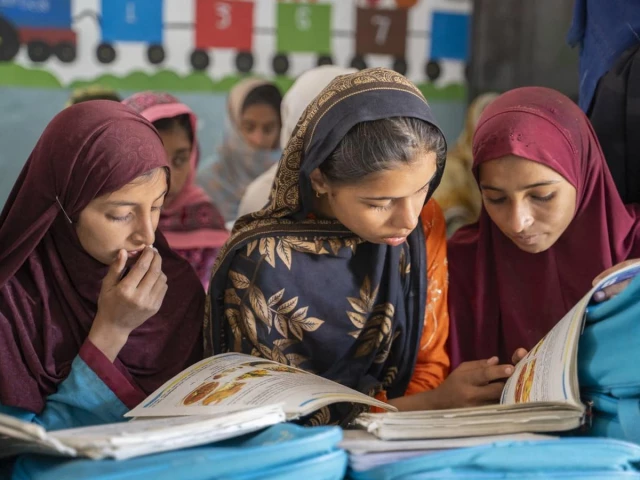
The future of the Literacy for All in FATA programme, launched in 2016 to provide education to out-of-school children in the merged tribal districts, has once again become uncertain due to financial and administrative delays. Around 269 male and female teachers have gone without salaries for more than 30 months, while the education of over 18,000 students enrolled in 191 operational Community-Based Education (CBE) centres has also been put at risk.
Teachers working under the programme say they have continued teaching despite mounting financial hardship. Zehra Bibi (name changed), a teacher from Parachinar in Kurram district, said she has served at a community education centre for the past eight years, where nearly 70 girls are currently enrolled. Several graduates of the centre have progressed to higher education, yet teachers have not received salaries for almost three years.
She said she travels daily by taxi from Parachinar city to a remote village, paying transportation costs from her own pocket despite receiving no salary. Although she repeatedly approached the Chief Minister's Complaint Cell, she said no practical relief was provided. She urged the government to release pending salaries without further delay.
Hafsa Begum (name changed), who teaches in Utmankhel tehsil of Bajaur district, said salaries have remained unpaid for the past 34 months. She recalled that when the project began in 2016, convincing parents to educate their daughters was a major challenge. Teachers formed women's committees and conducted door-to-door awareness campaigns, resulting in a significant increase in enrolment.
According to Hafsa, many students from these centres are now excelling academically. She cited the example of Sabeela, who secured first position in first-year examinations, while another student, Saira Nemat Jan, continues to perform exceptionally in secondary school.
Teachers from Orakzai and Bajaur also highlighted the programme's importance in remote areas lacking government or private schools. Nik Mar Khan, who runs a centre in Orakzai with 120 students, said education had virtually been absent in the area before the centre was established. Noor Muhammad, another teacher from Bajaur, said his centre currently educates 175 students despite operating without adequate furniture, chairs or whiteboards.
Kashmala (name changed), another teacher from Parachinar, called for immediate payment of outstanding salaries and expansion of community education centres to reach more children in remote regions.
According to official documents, the Literacy for All in FATA project was launched in 2016 to provide basic education in underserved areas where no formal schools existed. Before the 25th Constitutional Amendment, it operated under the FATA Annual Development Programme. Following the merger of the tribal districts, the project has been managed by the Merged Areas Education Foundation (MEAF) under the Khyber-Pakhtunkhwa Elementary and Secondary Education Department.
The programme initially established 209 Community-Based Education Centres across the merged districts and adjoining subdivisions, including Khyber, Bajaur, Mohmand, Kurram, Orakzai, North and South Waziristan, Hasan Khel, Dara Adam Khel, Wazir Bannu, Bettani Lakki, Jandola and Darazinda. Of these, 191 remain operational while 18 have closed for various reasons.
The project employs 269 teachers and seven literacy supervisors, the majority of them women. More than 18,000 students are enrolled, with girls forming the larger share. Most centres operate in homes or hujras provided free of cost by local communities, keeping government expenditure relatively low.
Official estimates suggest that more than 1.2 million children in the merged tribal districts remain out of school. Education experts believe community-based education centres provide a cost-effective model for expanding access to education and recommend integrating the programme permanently into the provincial education system, similar to community schools operating in settled districts with government and donor support.
Sources said the project was scheduled to be shifted to the government's recurrent budget during the 2024-25 financial year and was also included in the 2025-26 Annual Development Programme. However, despite preparation of the PC-I and its submission for consideration, the proposal was not approved.











This material may not be published, broadcast, rewritten, redistributed or derived from. Unless otherwise stated, all content is copyrighted © 2026 The Express Tribune.






COMMENTS
Comments are moderated and generally will be posted if they are on-topic and not abusive.
For more information, please see our Comments FAQ