No party meetings as Zardari leaves Lahore
Updated 1 hour ago

Petrol pumps held off on selling fuel until prices were announced; fares hiked again
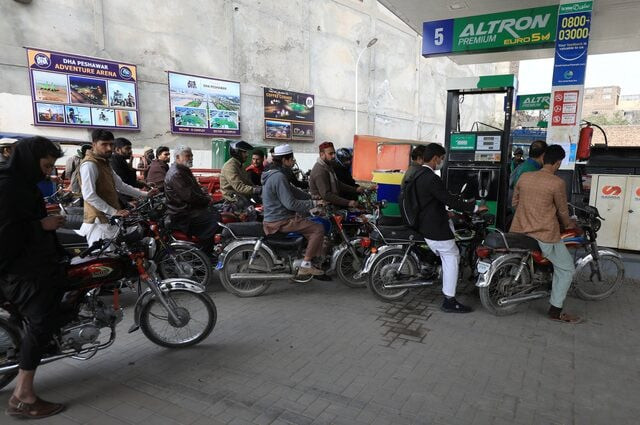
The federal government's newly introduced policy of frequent revisions to petroleum prices has sparked widespread concern across the transport and business sectors, prompting immediate increases in public transport fares, higher freight charges and a nationwide strike threat from petrol pump operators.
Following the latest increase in petrol and diesel prices announced on Friday night, transport operators in Rawalpindi and Islamabad revised fares with immediate effect. Public transport fares have risen by 15 to 17%, while goods transport operators have increased freight charges by 20%. Transport associations have also warned that fares will now be adjusted whenever fuel prices are revised.
Pick-and-drop services for office workers and students have likewise announced that their charges will fluctuate in line with changes in petrol and diesel prices. The minimum stop-to-stop fare on public transport in the twin cities has been increased to Rs60.
Long-haul transporters have also revised their tariffs, with the freight charge for container, trailer and wheeler transport between Karachi and Peshawar reportedly rising to Rs800,000.
The latest fuel price increase triggered panic buying across Rawalpindi and Islamabad on Friday night. Following reports of the impending increase, petrol stations in the twin cities temporarily suspended fuel sales, resulting in long queues of motorists from around 9pm until midnight. Fuel sales resumed after the revised prices came into effect.
According to transport operators, inter-city fares in Rawalpindi district have increased by 15%, fares on intra-district routes by 17%, while services operating between Rawalpindi and Islamabad have raised fares by 20%. Long-distance transport operators have also increased fares by 17%.
The Inter-City Transport Association and the Transport Federation rejected the government's policy of frequent fuel price revisions, describing it as the equivalent of introducing a "mini-budget" on a near-daily basis. They warned that if fuel prices continue to be revised frequently, transport fares would inevitably rise just as often.
The Pakistan Petrol Pumps Owners Association also criticised the policy and demanded its withdrawal. The association warned that if the government failed to abandon the system of revising petrol and diesel prices daily or every few days, petrol pumps across the country would observe a nationwide strike and suspend operations.
The Rawalpindi District Bar Association announced that it would challenge the government's fuel pricing mechanism before the Rawalpindi Bench of the Lahore High Court, terming it unconstitutional and unlawful.
District Bar President Tariq Mahmood Sajid Awan said frequent increases in petroleum prices were tantamount to imposing repeated mini-budgets without due legal process.
Meanwhile, the Transport Federation reiterated that continued increases in fuel prices would inevitably result in corresponding increases in passenger fares.
Political parties, including the Markazi Muslim League and Pakistan Tehreek-e-Insaf (PTI) Rawalpindi, staged demonstrations at Faizabad and Chandni Chowk on Friday night, demanding that the government withdraw the new pricing policy.
Petrol pump owners Niaz Ali and Sheikh Waheed warned that the policy would destabilise the country's petroleum supply system and urged the government to reconsider its decision.
The fare increases led to disputes between passengers and transport operators throughout Saturday, while officials of the district administration and the Regional Transport Authority were also reportedly facing uncertainty over the implementation of the frequently changing fuel pricing mechanism.








This material may not be published, broadcast, rewritten, redistributed or derived from. Unless otherwise stated, all content is copyrighted © 2026 The Express Tribune.







COMMENTS (1)
Comments are moderated and generally will be posted if they are on-topic and not abusive.
For more information, please see our Comments FAQ