US targets Palestine Action in counterterrorism effort against 'far-left' groups
Updated 5 hours ago

Chinese president warns against single-country dominance in AI, urges multilateral governance
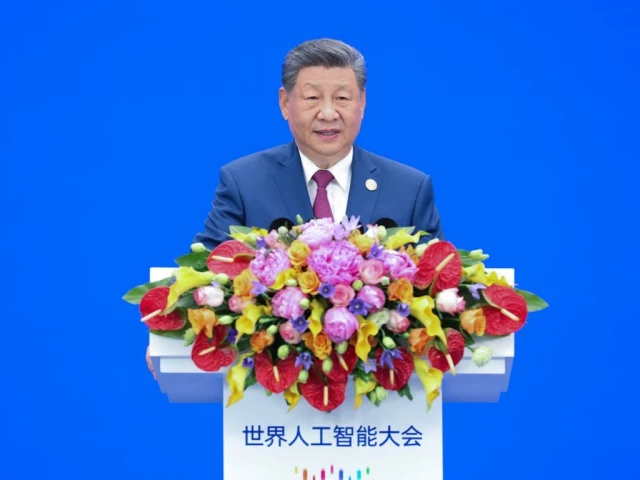
Chinese President Xi Jinping on Friday urged the international community to “join hands” in building a “just and equitable” system for global artificial intelligence (AI) governance, warning that rapid technological advances were reshaping economies and societies while posing complex risks that no country could tackle alone.
“AI development should not be a solo performance by a single country, but a symphony of international cooperation,” the Chinese leader said in his keynote address at the opening ceremony of the 2026 World Artificial Intelligence Conference and a High-Level Meeting on global AI governance in Shanghai.
The world has entered an “unprecedented period of active innovation” driven by a new wave of technological revolution, he added, according to the text of the speech available on Xinhua news agency.
Tracing the origins of AI to the 1956 Dartmouth workshop in the United States, Xi said decades of global scientific effort had brought humanity to a critical juncture, where intelligent technologies were now transforming both the digital and physical worlds.
“AI carries within it great opportunities as well as challenges to governance,” he said, raising key questions on how humans would coexist with intelligent machines, ensure security in algorithm-driven decision-making, address ethical dilemmas, and bridge widening technological divides.
Xi stressed that countries must adopt a people-centred approach to ensure AI serves as a force for shared prosperity and collective security, rather than deepening inequalities or geopolitical rivalries.
He outlined a four-point proposal to guide global AI governance.
First, Xi called for openness, collaboration and innovation-driven development, describing AI as a new engine of global economic growth. He urged countries to promote open-source development, deepen international cooperation, and accelerate the integration of AI across industries to unlock productivity gains and support emerging sectors.
Read: China opposes any US military action against Cuba
Second, he stressed the importance of managing risks and ensuring AI remains “secure and controllable.” He called for stronger regulatory frameworks, technological monitoring systems, and emergency response mechanisms to prevent misuse and safeguard human oversight. At the same time, Xi cautioned against the “overstretching” of national security concerns in the AI domain, warning that placing one country’s security above others could hinder global progress.
Third, Xi underscored the need for inclusivity and respect for cultural diversity, arguing that AI development should not erode the uniqueness of civilisations. Instead, he said, AI should be shaped by “humanity’s common values” and used to promote dialogue, understanding and cooperation among nations.
Fourth, he called for enhanced global coordination and multilateral governance, reaffirming the central role of the United Nations in shaping international norms. He urged countries to align their development strategies, regulatory approaches and technical standards to build a consensus-based global governance framework.
“AI is an invaluable asset that encapsulates humanity’s collective wisdom,” Xi said, adding that true multilateralism was essential to ensuring the technology benefits all.
The Chinese president placed particular emphasis on the needs of developing countries, warning that unequal access to AI could deepen global disparities. He called for expanded capacity-building efforts to bridge the digital divide and prevent what he described as “new historical injustice” in the age of AI.
Highlighting China’s domestic progress, Xi said the country had integrated AI into its economic and social development strategy, fostering innovation through a combination of market mechanisms and state support. He added that China’s core smart economy industries were now valued at over one trillion yuan, while AI-powered applications were increasingly improving livelihoods and driving industrial modernisation.
At the same time, he said China had prioritised safety and governance, developing legal frameworks, ethical guidelines and policy mechanisms to ensure that AI evolves in a “safe, secure and controllable” manner.
Positioning China as an active contributor to global AI governance, Xi pointed to a series of initiatives, including the Global AI Governance Initiative, the adoption of a United Nations General Assembly resolution on international AI cooperation, and the rollout of an AI Capacity-Building Action Plan.
Read more: China's Moonshot unveils world's largest open AI model, closing in on US rivals
He also highlighted the establishment of the World Artificial Intelligence Cooperation Organisation (WAICO), describing it as a “major move” to strengthen international collaboration, particularly among countries of the Global South. The organisation, formally launched in Shanghai, aims to promote cooperation in AI development, governance and capacity-building.
In a set of new announcements, Xi said China would provide 5,000 training opportunities in AI-related fields for developing countries over the next five years. He also pledged to establish international AI cooperation centres with regional organisations, including ASEAN, the League of Arab States, the African Union, the Community of Latin American and
Caribbean States, the Shanghai Cooperation Organisation and BRICS.
China will also expand access to its AI-powered meteorological early warning system, known as MAZU, enabling 30 countries to better respond to natural disasters and climate-related risks.
“AI development should not be a solo performance by a single country, but a symphony of international cooperation,” Xi said, invoking a Chinese proverb to underscore the importance of collective action.
The conference comes at a time of intensifying global competition in AI technologies, alongside growing calls for international rules to address concerns over safety, ethics, data governance and geopolitical fragmentation.
Xi said China was ready to further open up and work with all countries to harness the opportunities presented by AI while managing its risks. “We must ensure that AI develops for the good of humanity,” he said, adding that human wisdom and international consensus must guide the technology so it becomes “a mighty force” for advancing human civilisation.








This material may not be published, broadcast, rewritten, redistributed or derived from. Unless otherwise stated, all content is copyrighted © 2026 The Express Tribune.












COMMENTS
Comments are moderated and generally will be posted if they are on-topic and not abusive.
For more information, please see our Comments FAQ