Eleven bodies recovered after boat carrying migrants sinks off Tunisia
Updated 4 hours ago

UN sticks to freedom of navigation stance amid Trump's Hormuz fee reports
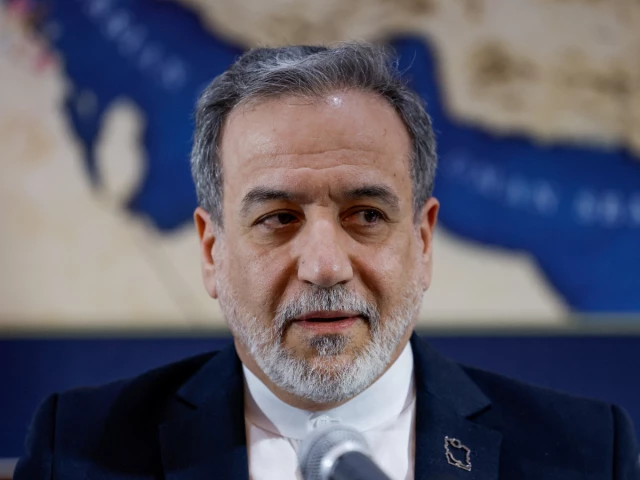
Iran's Foreign Minister Abbas Araghchi said on Monday that Tehran would remain the “guardian” of the Strait of Hormuz, after US President Donald Trump’s threat to impose fees on shipping in the strategic waterway.
"POTUS (president of the US) is absolutely right. Whoever provides secure and safe passage of commercial vessels through the Strait of Hormuz should be compensated for this service,” Araghchi said on X.
"Iran has always been the guardian of the strait and will remain so forever," he added.
Trump said earlier today that the US would blockade Iran in the Strait of Hormuz and would charge ships a 20% toll for a safe passage.
"20% is of course too much. We will be fair," Araghchi said.
POTUS is absolutely right. Whoever provides secure and safe passage of commercial vessels through the Strait of Hormuz should be compensated for this service.
— Seyed Abbas Araghchi (@araghchi) July 13, 2026
Iran has always been the GUARDIAN of the Strait and will remain so FOREVER.
20% is of course too much. We will be fair
UN sticks to freedom of navigation stance amid Trump's Hormuz fee reports
Meanwhile, the United Nations reiterated its call for freedom of navigation in the Strait of Hormuz amid reports that Washington plans to impose a 20% fee on ships passing through the waterway.
Asked whether UN Secretary-General Antonio Guterres accepts the premise that any member state can impose a fee on cargo passing through the strait, Stephane Dujarric told a news conference, "The secretary-general's position has been consistent ... he wants to see freedom of navigation in the Strait of Hormuz."
The remarks came as the US and Iran exchanged renewed strikes over the weekend, and Trump said the US was "reinstating" a blockade on Iran, and that it will charge ships for safe passage in the Strait of Hormuz.
Dujarric also confirmed that the officer-in-charge of the UN Special Coordinator for Lebanon, Jean Arnault, met Araghchi on his first visit to Iran.
Arnault outlined UN efforts for the implementation of Resolution 1701 and his understanding of the challenges ahead, and sought Iran's views on the situation and the support regional countries can provide to Lebanese aspirations to peace, sovereignty and territorial integrity, according to Dujarric.
US forces strike Iranian naval base with sea drones for first time: CENTCOM
Separately, the US military's Central Command (CENTCOM) announced that its forces struck a submarine and ship maintenance facility in Iran using unmanned surface vessels for the first time in combat operations.
"Yesterday, using multiple one-way attack surface drones, CENTCOM forces successfully struck a submarine and ship maintenance facility in Iran," CENTCOM said in a post on X.
"Three Corsair unmanned surface vessels hit the port at Bandar Abbas Naval Base, marking the first time American forces have employed sea drones in combat operations."
"Last night's strikes degraded Iran's ability to continue attacking commercial shipping," it added.
CENTCOM also shared footage of the drone attack on the naval base.
Yesterday, using multiple one-way attack surface drones, CENTCOM forces successfully struck a submarine and ship maintenance facility in Iran. Three Corsair unmanned surface vessels hit the port at Bandar Abbas Naval Base, marking the first time American forces have employed sea… pic.twitter.com/bOM2kmgRxz
— U.S. Central Command (@CENTCOM) July 13, 2026
Trump reinstates blockade of Iranian ports, says US will be 'guardian' of Strait of Hormuz
Earlier, Trump said that the US would probably take over the Strait of Hormuz and should be reimbursed for controlling the vital waterway, later announcing the resumption of the Iranian blockade.
"We're going to keep the strait, and we'll probably run it. We'll become the guardian of the strait. Maybe we'll call it the guardian angel of the strait. And we should be reimbursed for that," he said in a phone interview on Fox News' "Fox & Friends" programme.
Control of the Strait of Hormuz, a vital route for global oil supplies, has become one of the main battlegrounds of the conflict. Iran's effective blockade of the strait has pushed up energy prices and increased concerns about inflation globally.
"We're going to guard it. We're going to get paid for guarding it — a lot of money," Trump said.
"We're going to be reimbursed, because the other nations are very wealthy. They're on our side, and we can't be expected to do that for nothing," he said.
After announcing the waterway's closure on Saturday following what it described as an unauthorised transit, Tehran said on Sunday that passage remained suspended and that permits would be issued once "stability and calm" were restored.
"We had a deal. It was a done deal, and then they broke it. They always break it. We've had 10 deals with these people, and so we're just going to hit them very hard," Trump said.
.@POTUS on Iran: "It was a done deal, and then they broke it. They always break it. We've had 10 deals with these people — and so we're just going to hit them very hard... They're a bad group of people. They've been this way for a long time." pic.twitter.com/7Ye70MrxN8
— Rapid Response 47 (@RapidResponse47) July 13, 2026
"It looks like they're back at their business trying to take over the Strait..."@POTUS: "We’re taking over the Strait. They have nothing... yesterday, they had an 11-hour meeting... and everything was agreed to yesterday, and they leave the room, and they call back and they… pic.twitter.com/kvVbrTS3yD
— Rapid Response 47 (@RapidResponse47) July 13, 2026
In a post on Truth Social later, he said: "The Hormuz Strait is open, and will remain open, with or without Iran. We are reinstating the Iranian blockade, so named because it is only stopping Iran’s ships or customers from entering or leaving. All other countries will have fair and open use of the strait. The USA will be, from this point forward, known as 'The Guardian of the Hormuz Strait', but as such, and as a matter of fairness, will be reimbursed, at the rate of 20% on all cargo shipped, for any and all costs necessary to do the job of providing safety and security to this very volatile section of the world. The process and formation will begin immediately."
— Rapid Response 47 (@RapidResponse47) July 13, 2026
Iran's military said it “does not and will not allow” the US to "interfere" in the management of the Strait of Hormuz.
Washington's "repeated adventures mischief to interfere in the management of the Strait of Hormuz have seriously jeopardised the security of the region", the Khatam al-Anbiya Central Headquarters said in a statement carried by the state broadcaster IRIB.
Tehran "will deal severely with any disruption and insecurity to the passage of commercial ships and tankers by the aggressive and bandit American army outside of Iran's designated route and without the permission of the armed forces", it vowed.
Iran will never allow US to interfere in Hormuz, warns central military commandhttps://t.co/4gyFzqIVG8
— Press TV 🔻 (@PressTV) July 13, 2026
The military also warned countries of the region against cooperating with the US army.
Spokesman for Iran's Revolutionary Guards Corps also said that Tehran “will continue to assert Iran's sovereignty and control over the Strait of Hormuz with strength and determination”.
"We will compel foreign powers and their allies to submit to the will of the Iranian nation," the official added.
IRGC vows ‘greater humiliation’ for US over Strait of Hormuz mischiefhttps://t.co/jJWxwkfuYb
— Press TV 🔻 (@PressTV) July 13, 2026
Iran continuing talks with Pakistan, other mediators to prevent further escalation: Esmaeil Baghaei
Iranian Foreign Ministry spokesman Esmaeil Baghaei said on Monday that Iran was continuing talks with mediators from Qatar, Pakistan and Oman in an effort to prevent any further escalation.
Iran also said that it will not fulfil its obligations under the Pakistan-mediated Islamabad memorandum of understanding with the US as long as Washington continues to violate its commitments.
Baghaei told the press conference that Tehran's position remains based on the principle of “commitment in exchange for commitment.”
“We have said from the beginning that it is a matter of 'commitment in exchange for commitment.' If the other party (US) adheres to its commitments, we will also fulfil our commitments,” Baqaei said in his comments cited by the semi-official Tasnim News Agency.
“No one can accuse the Islamic Republic of Iran of violating agreements. In all cases, our obligations and those of the other party are clear and can be documented,” he said, accusing Washington of “violating various sections” of the memorandum “under different pretexts.”
“As long as the other party continues to violate its commitments, the Islamic Republic of Iran will, in turn, refrain from fulfilling the obligations it has undertaken,” he added.
Baghaei added that pursuing justice for the assassination of Ayatollah Ali Khamenei is “a serious principle” for the Islamic Republic.
“The government has a clear duty. The Ministry of Foreign Affairs is part of this process,” he said.
“We will use all legal and international tools and opportunities at the international level to document their [US-Israeli] crimes and to pursue the implementation of justice,” Baghaei added.
He said that Iran is trying to agree a joint mechanism with Oman for the Strait of Hormuz, but US pressure on Muscat has hindered efforts, he said.
Iran entered “every negotiation with meticulousness and seriousness, keeping in mind the interests and concerns of the Iranian nation”, the spokesperson said.
“Once an understanding has been reached, it has acted in good faith and with seriousness in fulfilling its commitments,” Baghaei told reporters in Tehran.
“The Islamic Republic of Iran has never been the first to violate its commitments.”
Oil gains over 2% as fresh military strikes threaten Hormuz shipments
Oil prices surged more than 2% on Monday after renewed military strikes between the United States and Iran reignited concerns over energy shipments through the Strait of Hormuz.
Brent crude futures were up $1.67, or 2.2%, to $77.68 at 0955 GMT, while U.S. West Texas Intermediate crude was up $1.59, or 2.23%, to $73.00 a barrel.
"The focus will remain on the number of inbound tankers as a lower number could impact production, so currently we see a risk premium but as well a disruption risk supporting prices," said UBS analyst Giovanni Staunovo.
Before the conflict began in late February, the Strait of Hormuz handled about one-fifth of global daily oil and liquefied natural gas supplies.
"Shipping operators are adopting a cautious approach and inbound movements have slowed under heightening security concerns," ANZ analysts said.
Vessel traffic through the strait fell to a five-week low on Sunday, ship-tracking data showed. Six vessels transited the strait on Sunday, according to Kpler.
The escalating attacks cast doubt on the future of an interim U.S.-Iranian agreement signed last month that aimed to reopen the strait and end the war after a further 60 days of negotiations.
US President Donald Trump said on Sunday that the Strait of Hormuz remained open to commercial traffic, despite Iran's earlier declaration that it had closed the waterway after a vessel travelled on an unauthorised route and was struck.
Goldman Sachs estimated that expanding pipeline capacity in the Middle East could shield more than 60% of pre-war Gulf oil exports from any future Hormuz disruptions by end-2028.
The bank's base-case forecast assumes pipeline capacity bypassing Hormuz will rise by 3.8 million bpd by end-2027 and 7.3 million bpd cumulatively by end-2028, taking total effective bypass capacity to more than 14 million bpd by end-2028.
Iranian oil supplies held at sea are rising after Tehran boosted exports during the interim peace deal with the U.S. However, sales have been slow as China's independent refiners have turned to cheaper crude from Iraq, the UAE and Qatar.
The Abu Dhabi National Oil Company set the August official selling price of its benchmark Murban crude at $80.01 a barrel, it said on Monday, down from $101.48 a barrel the month before.
At least 2 killed in US strikes on Iran’s Abadan
US missiles hit three locations in the city of Abadan in the western province of Khuzestan, according to Al Jazeera.
Mehr news agency, quoting the deputy governor, reported the attack took place at 2:45pm PKT.
At least two unidentified people were killed and three wounded in the attack, it said.
New explosions heard near Bandar Abbas, Qeshm Island in southern Iran
Iranian media reported new explosions on Monday noon near the port city of Bandar Abbas and Qeshm Island in southern Iran.
Mehr News Agency, citing local residents and sources, said the explosions were heard west of Bandar Abbas and appeared to originate from coastal areas.
The agency also reported possible clashes in the Gulf and the Strait of Hormuz, although no official confirmation was immediately available.
In response to the explosions, the southern Hormozgan governorate said there were no reports of civilian casualties or damage to residential or commercial infrastructure.
The new explosions came hours after the state news agency IRNA reported at least two powerful blasts in Bandar Abbas early Monday.
China reiterates call for 'free, safe' Hormuz passage amid renewed US-Iran hostilities
China on Monday reiterated its call for "free" and "safe" passage through the Strait of Hormuz amid renewed military strikes between the US and Iran.
"The Strait of Hormuz is a strait for international navigation. Resuming free and safe passage in the strait at an early date serves interests of all sides," Chinese Foreign Ministry spokesperson Lin Jian told reporters in Beijing.
Lin said passage through the strait should be "properly handled."
Beijing's statement came after the US and Iran on Monday claimed renewed retaliatory strikes.
Iran's Islamic Revolutionary Guard Corps said it targeted US military facilities in Bahrain and radar systems in neighbouring Oman, according to Iran's state broadcaster IRIB.
Earlier, the US military said it "completed a new wave of offensive" strikes against Iran, targeting dozens of military sites in an effort to degrade Iran's ability to continue attacking international shipping through the Strait of Hormuz.
EU’s Kallas says Strait of Hormuz must return to status quo
European Commission Vice President Kaja Kallas says officials will meet Gulf nations to discuss security in the region, according to Al Jazeera.
Noting the Iran-US interim deal is “not really holding”, she said EU foreign ministers will discuss “what kind of messages we can send that the Strait of Hormuz has to be opened, freedom of navigation has to be respected, there cannot be no tolls, no fees for navigation there”.
Iran has warned against any “foreign” interference in the Gulf after some European countries suggested deploying naval forces to get commercial shipping flowing through the critical strait.
Iran expands attacks on Gulf states after US strikes, says Strait of Hormuz closed
US and Iranian forces have exchanged heavy missile and drone assaults, with Tehran targeting US facilities in states across the Gulf on Sunday and saying it had again closed the vital Strait of Hormuz.
On Monday, Iran's ISNA news agency stated that one was killed and seven were injured in a US attack near Nain county in Iran's Isfahan province.
The renewed violence casts further doubt on the future of an interim US-Iranian agreement signed last month that aimed to reopen the strait and end the war after a further 60 days of negotiations.
The strikes were the latest in a cycle of attacks and counter-attacks as Iran seeks to assert control over shipping through the Strait of Hormuz. However, the barrage marked an escalation in pace and range.
Iran's strikes extended to US bases in Qatar, a mediator in ceasefire talks that had not come under attack since April. The United Arab Emirates, which had not been targeted since early May, said its air defences had engaged missiles and drones from Iran.
The US military began launching more strikes against Iran at 2am PKT on Monday, Central Command said in a statement on the social media platform X, “to continue degrading their ability to attack civilian mariners and commercial ships freely transiting the Strait of Hormuz.”
US Central Command spokesperson Tim Hawkins told CNN that US aircraft shot down an Iranian cruise missile and a one-way attack drone.
In a brief phone interview with Reuters on Sunday afternoon, US President Donald Trump referred to the weekend's strikes on Iran. "We're beating them up," he said.
Read: US conducts strikes on Iran missile systems around Strait of Hormuz, Axios reports
Iranian media said on Sunday there had been missile attacks and explosions around the port cities of Sirik and Bandar Abbas, home to military facilities on the strait, and nearby Qeshm Island.
In a statement, Iran's foreign ministry condemned "aggressive" US attacks against Iran over the weekend. The ministry also said talks between Iran and Oman on Saturday in Muscat — focused on arrangements for managing the strait and transit routes — were unable to reach a result because of "overt and covert" US pressure on Oman.
In the past week, Trump has said he considers the ceasefire over, while leaving the door open to more talks.
Iran's top negotiator, Mohammad Bagher Ghalibaf, posted on X on Sunday: "The era of one-sided deals is OVER. We told you: keep your word or pay the price. Reality is knocking."
The war that the US and Israel launched against Iran on February 28 has destabilised the Gulf, where Iran has struck countries hosting US bases. Iran's effective blockade of the strait has driven energy prices higher and fuelled global inflation.
Higher prices, especially for gasoline, are politically sensitive for Trump ahead of November's congressional elections.
Iran says it struck US military facilities in Bahrain, radar systems in Oman
Iran's Islamic Revolutionary Guard Corps (IRGC) on Monday said that it targeted US military facilities in Bahrain and radar systems in neighboring Oman, according to Iran's state broadcaster IRIB.
Citing an IRGC Navy statement, IRIB reported that missile and drone strikes targeted US military infrastructure in Juffair, Bahrain, as well as long-range air surveillance and maritime surveillance radar systems in Oman.
Shortly after the Iranian announcement, Bahrain's Interior Ministry said air raid sirens sounded again across the country and urged citizens and residents to remain calm and proceed to the nearest safe place.
The IRGC said the only way to reopen the Strait of Hormuz to maritime traffic was for the US to end its military interference in the strategic waterway and respect the sovereignty of coastal states.
It also warned that continued US military activities in the Strait of Hormuz would lead to "greater incidents" affecting the global oil and gas sector.
Iran’s army claims downing of US drone over Bandar Abbas
Iran's army claimed Monday that its air defenses shot down a US drone over the southern city of Bandar Abbas, according to the semi-official Mehr News Agency.
Mehr, citing an army statement, said air defense forces in southeastern Iran identified, intercepted, and destroyed “a hostile Lucas-type” aircraft over the skies of Bandar Abbas County near Hajiabad.
The army said the interception occurred while air defense units were responding to “enemy attacks and securing the country's airspace.”
The reported interception came hours after the US launched a new wave of strikes on military and infrastructure targets across Iran, including sites in the Bushehr, Khuzestan, and Hormozgan provinces, as well as rail infrastructure linking Tehran and Mashhad.
Tehran, in turn, announced missile and drone attacks targeting US military facilities in Bahrain, Kuwait, and Qatar, while accusing Washington of violating a June 17 memorandum of understanding reached through Pakistani mediation.
Flurry of strikes
Iran has sought to establish a permanent system for collecting fees in the strait, which carried one-fifth of the world's oil and liquefied natural gas shipments before the war, and has warned vessels not to sail without its authorisation.
It said late on Saturday it had closed the waterway after firing a warning shot that struck a vessel travelling on an unauthorised route. On Sunday, it said it had disabled a second vessel.
India said one of its nationals was missing after an attack on the container ship GFS Galaxy off the coast of Oman. Oman said 23 crew members had been rescued. Qatar advised all vessels, including leisure boats, fishing boats and jet skis, to suspend activities.
Iran's recently created Persian Gulf Strait Authority said on Sunday that passage through the strait was not currently possible due to "recent illegal movements of the United States military forces in the region". Permits would be issued "as soon as stability and calm are restored," it said.
The US, which revoked the licence authorising the sale of Iranian crude on Tuesday following earlier attacks on shipping, said its forces were positioned to safeguard freedom of navigation despite what it described as "aggression, harassment, threats, and arbitrary declarations" from Iran.
"Iran does not control the strait. Traffic is flowing," it said.
The US Navy-led Joint Maritime Information Centre reiterated guidance that, despite a severe security threat, an "expanded" southern route near Oman was available for two-way traffic.
On Saturday, US Central Command said US forces had hit 140 Iranian military targets, and that more than 300 had been struck over three nights this week "to degrade Iran’s ability to attack civilian mariners and commercial vessels freely transiting the strait."
In response, Iran's Revolutionary Guards said they had destroyed a command-and-control centre and drone hangars in US ally Jordan, targeted a US radar site and later rocket launcher systems in Kuwait, attacked US aircraft carrier support and refuelling platforms in Oman and destroyed a jet maintenance centre and command facility in Qatar.
'Keep your word or pay the price,' Iran says
Qatar, which has previously said it would not act as a mediator so long as it was under attack, said three people, including a child, had been injured by falling shrapnel. It said Iran was "fully legally responsible" for the attack.
The UAE said it detected missile threats outside its borders, while Bahrain said it intercepted several Iranian aerial attacks, Jordan reported missile strikes and Oman reported being targeted with drones. Kuwait's army later reported damage from strikes and said an attack on an oil drilling platform injured a worker.
Oman said it had summoned Iran's ambassador to protest over drone attacks in two regions and the US embassy in Oman told its nationals in Duqm and Musandam to shelter in place.
Iran’s army says ‘drone attacks continue against US bases in the region’
The IRGC, carried by the IRNA news agency as per Al Jazeera, said drone attacks were continuing on US bases in the region and that the army launched “destructive drone” assaults on US forces in Kuwait, including defence and missile systems, bunkers and support shelters.
The army went on to condemn what it described as repeated US attacks on military sites, civilian infrastructure and civilians in Iran, calling them a “blatant violation” of the fundamental principles of the United Nations Charter.
The army said Iran’s armed forces would use their full capabilities to defend the country’s sovereignty, territorial integrity, independence, and population against any further aggression.
Iran’s IRGC earlier claimed attacks on Kuwait’s Ali Salem and Ahmad Al-Jaber bases.
Iran accuses US of ‘overt and covert pressure’ on Oman
The Iranian Foreign Ministry condemned the US’s “aggressive” attacks against the country in a statement and also addressed the talks between Iran and Oman on Saturday in Muscat, according to Al Jazeera.
It said the talks focused on arrangements for managing the Strait of Hormuz and that, “unfortunately, the US prevented a result on this issue through overt and covert pressure on Oman”. It also rejected Trump’s claims about the outcome of the talks as “pure falsehoods born of desperation”.
Trump had told US media that Iran had agreed to a deal on Saturday, where “they were giving up everything”, but “then, all of a sudden, two hours after that, they hit a ship with a drone”.
Earlier, sources told Al Jazeera that during Iranian Foreign Minister Abbas Araghchi’s meeting with his Omani counterpart, Badr Albusaidi, on Saturday, Muscat had proposed two separately-controlled routes in the Strait of Hormuz, one through Iranian territorial waters and one through Omani waters.



This material may not be published, broadcast, rewritten, redistributed or derived from. Unless otherwise stated, all content is copyrighted © 2026 The Express Tribune.






COMMENTS (1)
Comments are moderated and generally will be posted if they are on-topic and not abusive.
For more information, please see our Comments FAQ