Bangladesh to positively consider joining Makkah pact if invited: FM
Updated 2 hours ago

IRGC claims Strait closed; CENTCOM disputes assertion US strikes about 140 Iranian military targets Tehran targe
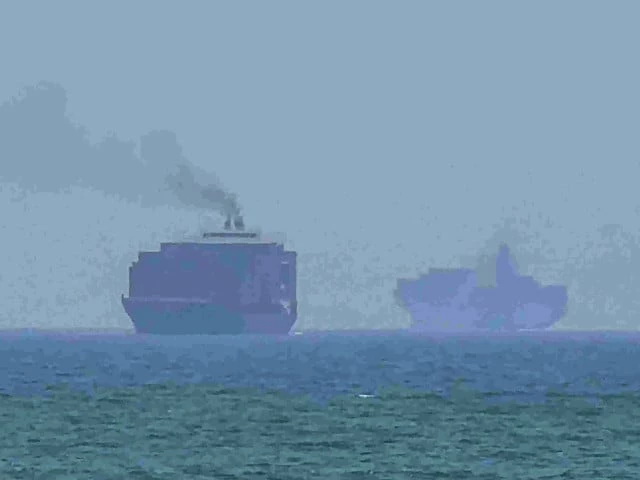
The United States and Iran exchanged heavy missile, drone and air strikes on Sunday as Tehran expanded attacks on Gulf states, declared the Strait of Hormuz closed again and warned commercial shipping to stay away, while Washington said it had struck hundreds of Iranian military targets and vowed to keep the strategic waterway open.
The latest escalation followed Iranian attacks on commercial shipping in the Strait of Hormuz. Iran's Revolutionary Guards said they had struck a Cyprus-flagged commercial vessel for ignoring instructions to use an approved shipping corridor, forcing its crew to abandon ship, while one Indian crew member remained missing. They also said a second vessel had been targeted for allegedly violating regulations.
"Following this incident... the Strait of Hormuz will be closed until further notice and until the end of American interventions in this region," the Revolutionary Guards said.
Iran's newly established Persian Gulf Strait Authority said passage through the waterway was currently impossible because of the "recent illegal movements of the United States military forces in the region", adding that permits would be issued "as soon as stability and calm are restored".
The United States rejected Iran's claim that it had shut the waterway. "Iran does not control the strait. Traffic is flowing," US Central Command (Centcom) said on X, adding in a later statement that the Strait of Hormuz "remains an international waterway. US forces are positioned and prepared to keep it that way."
Centcom said the US forces had carried out a third round of strikes this week, hitting about 140 military targets across Iran, including missile and drone sites, naval capabilities, ammunition storage facilities, communications networks and coastal surveillance positions.
It added that more than 300 targets had been struck over three nights "to degrade Iran's ability to attack civilian mariners and commercial vessels freely transiting the strait".
"The United States is imposing a heavy cost by continuing to degrade Iran's ability to attack civilian mariners and commercial ships freely transiting the strait," Centcom said. US Defence Secretary Pete Hegseth said: "Iran made a poor choice. Now they pay."
US President Donald Trump defended the strikes, telling CNN: "We hit them very hard last night." He said Washington and Tehran had been close to "a deal" before Iran attacked a commercial ship with a drone. "They were giving up everything, and then all of a sudden two hours after that they hit a ship with a drone. These people, there is something wrong with them," Trump said.
Iranian media reported explosions in Bandar Abbas, Sirik, Jask, Qeshm Island and Khuzestan province, with an Iranian army officer reported killed. Iran's Revolutionary Guards said they had destroyed a command-and-control centre and drone hangars in Jordan, targeted a US radar site in Kuwait, attacked logistical support and refuelling facilities for US aircraft carriers at the port of Duqm in Oman and struck a jet maintenance centre and command facility in Qatar.
Iran also launched missiles and drones towards Gulf states, prompting air raid sirens in Bahrain and the activation of air defence systems in Qatar, the United Arab Emirates and Kuwait. Qatar said three people, including a child, were injured by falling shrapnel and held Iran "fully legally responsible" for the attack.
Jordan reported missile strikes inside its territory without casualties, while Kuwait said an attack on an oil drilling platform injured a worker.
Oman said it had rescued 23 crew members from the damaged commercial vessel off its coast and summoned the Iranian ambassador over drone attacks in two regions, describing them as "irresponsible acts". The US embassy in Oman advised its nationals in Duqm and Musandam to take precaution.
The latest round of hostilities came a day after talks in Oman between Iranian Foreign Minister Abbas Araqchi and Omani Foreign Minister Badr Albusaidi aimed at coordinating arrangements in the Strait of Hormuz. Iran said the discussions would continue with Qatari participation.
An adviser to Iran's supreme leader described the Strait of Hormuz as more important than "dozens of atomic bombs", saying: "This strategic passage is more important than dozens of atomic bombs, and the Islamic Republic of Iran will protect it."
Meanwhile, Iran's top negotiator Mohammad Baqer Qalibaf posted on X: "The era of one-sided deals is OVER. We told you: keep your word or pay the price. Reality is knocking."
In New York, the United Nations Secretary-General Antonio Guterres expressed "deep concern" over the serious escalation and renewed military confrontations in the Gulf and called on all parties to exercise maximum restraint, avoid further escalatory action and take immediate steps to de-escalate.
According to a statement issued by the spokesperson for the Secretary-General, Guterres reiterated that a return to full-scale hostilities would have catastrophic consequencesfor the peoples of the region, international peace and security, and for the global economy.
He reaffirmed the need for the restoration of full freedom of navigation in the Strait of Hormuz. "The Secretary-General urges Iran and the United States to urgently resume negotiations and to address outstanding issues through diplomacy," the statement said.








This material may not be published, broadcast, rewritten, redistributed or derived from. Unless otherwise stated, all content is copyrighted © 2026 The Express Tribune.










COMMENTS
Comments are moderated and generally will be posted if they are on-topic and not abusive.
For more information, please see our Comments FAQ