Banks urged to focus on private credit
Updated 3 hours ago

Govt seeks $10b cheap loans to retire expensive Chinese energy debt
As the government's search for $10 billion cheaper financing continues to pay off expensive energy loans, the outstanding dues of China-Pakistan Economic Corridor (CPEC) power projects remained at Rs423 billion by June due to non-resolution of the late payment surcharge issue.
After struggling to get loans from multilateral lenders, the government is looking to secure $10 billion from bilateral creditors at 1% interest rate to retire the expensive Chinese loans and then cut the price, according to government officials. The developments are taking place against the background of China's persistent reluctance to renegotiate its energy contracts that the government wanted to reopen to reduce tariffs, said the officials.
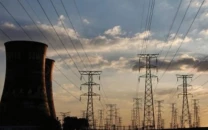
The sources said Pakistan was considering tapping Saudi loans in the range of $6 billion to $10 billion. These loans are planned to be utilised for settling the Chinese energy debt that had been taken by Chinese energy suppliers to set up power plants under CPEC.
In January this year, the government had also discussed the issue of taking cheaper foreign loans to repay the expensive debt for reducing prices. Its revised proposal suggests the prices can be reduced by 3 US cents per unit, but it will be extremely difficult to get financing at such low rates, the sources added.
The sources said the government wanted to get $1.1 billion to $1.4 billion per annum in new loans at 1% interest over the period of 2027 to 2034. The government wanted to make new debt repayments over a period of 15 years, subject to acceptance of its proposal by any of the multilateral or bilateral creditors.
Pakistan's Power Minister Sardar Awais Laghari and Finance Minister Muhammad Aurangzeb were scheduled to travel to Saudi Arabia on Saturday. When asked whether the purpose of the visit was to seek Saudi loans for the energy sector, Laghari said on Friday: "It is not on the agenda of our meeting." He said he was going for a meeting of the Energy group only, which was focusing on reforms and opportunities for investment in transmission and digitisation of the grid.
According to the government's proposal, the annual amount received will be utilised for tariff reduction and will be reflected in the financials of Central Power Purchase Agency-Guaranteed (CPPA-G) as a loan. The CPPA-G is the settlement agent between power producers and distribution companies. The loan will not be reflected in government borrowing, and repayment of each yearly tranche with 1% markup will commence after a grace period of three years and will be repaid in the next 15 years through consumer tariff via CPPA-G.
The Power Division is of the view that consumers in Pakistan bear a substantial debt-servicing burden, which now accounts for more than one-third of the average electricity tariff. The average electricity tariff is approximately 11 US cents, excluding taxes, of which nearly 4 US cents per unit is attributable to fixed debt-servicing obligations. Such inflexible costs limit the scope for further tariff rationalisation over and above measures already in place by the government.
The documents showed consumers are bearing the burden of $30.6 billion in power-producer debt repayments over the next 13 years. In addition, consumers are also paying a debt service surcharge to recover circular debt amounting to $5.7 billion, arising from lower recoveries, high distribution losses, and rising financing costs.
According to the proposal, the government was seeking multilateral institutions' support in structuring a clean energy integration financing facility, including sharia-compliant financing arrangements, dedicated to grid stabilisation and addressing the affordability and economic viability of policy objectives. However, with limited success in getting new loans or sorting out issues with Chinese investors, the payables to CPEC plants remained at Rs423 billion at the end of fiscal year 2025-26.
The Chinese financial institutions and the power producers have shown reluctance to write off about Rs170 billion in interest on late payments, which the government is seeking before making principal repayment of over Rs260 billion on account of energy purchase cost.
The sources said that due to a disagreement, the government was not able to fully utilise the Rs1.25 trillion banking facility that it had signed to retire the circular debt. The Power Division was now in the process of moving a summary for the approval of the cabinet to get a six-month extension in the facility that expired in June, the sources added. The Rs423 billion unpaid debts are in violation of the 2015 CPEC Energy Framework Agreement, which binds the government to fully clear the dues irrespective of whether the authorities can recover the amounts from the end consumers.
Under the CPEC Energy Framework Agreement, Pakistan was required to create a revolving fund with 21% of the power invoices to protect Chinese firms from the circular debt crisis. However, the previous government opened a Pakistan Energy Revolving Account at the State Bank of Pakistan in October 2022 with Rs48 billion in annual allocations. But it limited the withdrawals to Rs4 billion per month, leading to the current Rs423 billion debt stock.
The documents show Pakistan owed Rs85 billion to the imported coal-fired Sahiwal power plant. The country also owed Rs64 billion to the coal-fired Hub power project. The outstanding remaining dues of the coal-fired Port Qasim power plant were Rs76 billion. The Thar Coal project dues remained at Rs54 billion. The outstanding dues of Karot Power Company were Rs17.5 billion, Engro Powergen Thar Coal Rs43 billion, Matiari Lahore Transmission Line Rs28 billion, and Thar Energy Limited Rs11.5 billion.





This material may not be published, broadcast, rewritten, redistributed or derived from. Unless otherwise stated, all content is copyrighted © 2026 The Express Tribune.




COMMENTS (5)
Comments are moderated and generally will be posted if they are on-topic and not abusive.
For more information, please see our Comments FAQ