PSX recovers 664 points after rate-driven sell-off
Updated 9 hours ago

Global central banks bought record 289 tonnes in Q2; rupee closed at 277.80/$
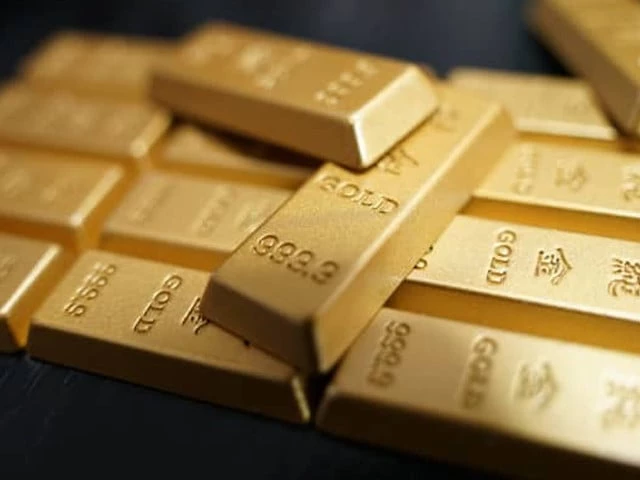
Gold prices in the local market increased on Friday even as international rates declined, with the yellow metal still heading for its first monthly gain in five months.
According to rates shared by the All-Pakistan Gems and Jewellers Sarafa Association (APGJSA), the price of gold per tola rose by Rs3,000 to Rs430,436. Ten-gram gold was sold at Rs369,029 after an increase of Rs2,572. A day earlier, on Thursday, gold per tola had closed at Rs427,436 following a more modest gain of Rs1,000.
In the international market, gold came under pressure as the US dollar rebounded from a more than one-month low. Spot gold was down 1.8% at $4,027.75 per ounce at 09:59 am EDT, after falling as much as 2% earlier in the session. US gold futures for August delivery dropped 1.9% to $4,025.10.
Despite the sharp daily decline, gold has still gained 0.5% so far this month, its strongest monthly performance since February. Weaker US inflation data had earlier reduced expectations of further Federal Reserve rate hikes, supporting the metal through most of July before Friday's dollar recovery triggered profit-taking.
Silver also moved higher in the domestic market, rising by Rs79 to Rs6,294 per tola.
Market participants noted that local prices often diverge from international trends in the short term because of currency movements, import premiums and domestic demand patterns. Friday's rise in Karachi and other jewellery markets came against the backdrop of continued physical buying interest.
Adnan Agar, Director at Interactive Commodities, pointed to strong official-sector demand as a key longer-term support for gold. Citing the latest World Gold Council report, he said central banks bought a record 289 tonnes of gold in the second quarter of 2026 – five times the volume purchased in the first quarter and the highest total for any second quarter on record.
Poland led the buying with 51 tonnes, lifting its reserves to 632 tonnes. China added another 33 tonnes. Other notable purchasers included Uzbekistan (16 tonnes), Kazakhstan (15 tonnes), and Jordan and the Czech Republic (6 tonnes each). Turkey sharply reduced its sales, while Russia was the only major seller, offloading 22 tonnes.
Agar said geopolitical tensions and ongoing financial uncertainty continue to drive central banks towards gold as a long-term reserve asset. A World Gold Council survey showed that 45% of central banks plan to increase their gold holdings further over the next 12 months.
The combination of solid official demand and the metal's positive monthly performance has kept sentiment constructive among local traders even on days when international prices retreat.
Meanwhile, the Pakistani rupee closed at 277.80 against the US dollar on Friday, gaining Rs0.01 from Thursday's close of 277.81. The slight appreciation came as the dollar recovered some ground globally, rising as much as 0.8% to 160.690 against the Japanese yen in early Friday trade. The greenback had fallen 2.4% in the previous session, its biggest single-day drop since January 2023, after Japan intervened by buying yen and selling dollars in the New York session overnight. South Korea also carried out dollar-selling intervention on Thursday in a rare coordinated move.













This material may not be published, broadcast, rewritten, redistributed or derived from. Unless otherwise stated, all content is copyrighted © 2026 The Express Tribune.





1727268465-0/Untitled-design-(42)1727268465-0-208x130.webp "the reverse renaissance")

COMMENTS
Comments are moderated and generally will be posted if they are on-topic and not abusive.
For more information, please see our Comments FAQ