Zardari, Shehbaz call truce on public sparring
Updated 1 hour ago

.
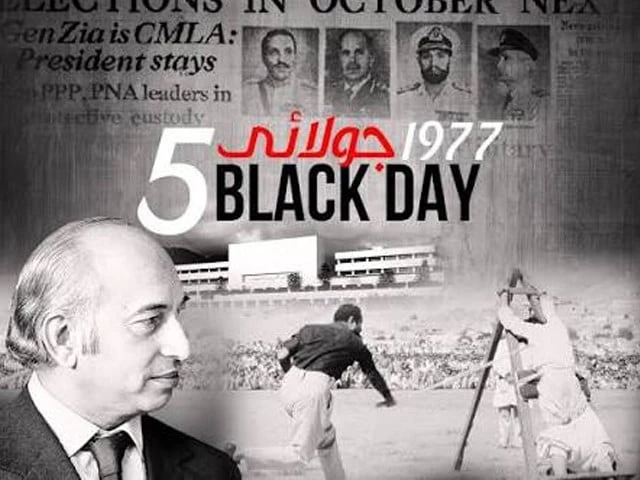
July 5 is a day in the history of Pakistan that is not a significant date but a turning point that has had an impact on the political, constitutional and democratic journey of the country. Some events in the history of nations can stand in every way to make us think about the passage of time, because they have power over it, how can they endure to strengthen the trust of the constitution, institutions and the people.
July 5, 1977 is also such a decisive phase in the history of Pakistan. At that time, the country was facing a situation. There was this difference between the government and the opposition, but the hope of this country remained that a solution to the political crisis would be found from the constitutional and democratic people. However, the situation took such a turn that the democratic process was interrupted and the effects of many years of entering a period in Pakistan were felt on the state institutions and behavior.
The real power to change you is that it provides a way to find a dialogue instead of conflict to find differences of opinion. Parliament, constitutional, political and public opinion are the pillars on which a genuine democratic state is based. Whenever there is a price in these pillars, its effects are not limited to the government alone but are paid in full.
When the martial law was imposed in the country on July 5, 1977, it was argued that this measure was for economic development and its purpose was to normalize the situation and pave the way for new elections, however, history has proven that this transitional period is long and Pakistan runs under a different political system for many years.
The study of history teaches us that the real strength of any state is not the change in governments but the supremacy of the constitution, its stability and the trust of the people. When all organizations promote state stability by fulfilling their responsibilities within their constitutional jurisdiction, while stagnation in the political process slows down the evolution.
Zulfiqar Ali Bhutto holds a prominent place in the political history of Pakistan. He made the common man a part of national politics and made the workers, youth and middle class feel that they could play an active role in the political process. The basic concept of his politics was that it was his real power, and that public opinion was the basis of national decisions.
Pakistan got the unanimous Constitution of 1973, which is still the basis of the country's constitutional structure. This Constitution is considered an important symbol of national consensus with the principles of federation, judicial system and fundamental rights. The references to state institutions, the basis of legal and constitutional order and structure.
Important landmarks for strengthening Pakistan's defense during the same period were also the strategy adopted by the National Defense Strategy, which included the decision to lay the foundation for a nuclear program, which was later declared a historical milestone in Pakistan's defense capability.
Of course, like every political era, there were different opinions on the reign of Shaheed Zulfiqar Ali Bhutto. His government faced criticism and political differences also existed, but it is impossible to deny the fact that he gave a new dimension to public politics in Pakistan and played an important role in promoting democratic consciousness.
The journey from an elected Prime Minister to a prisoner after July 5, 1977 is considered one of the most tragic chapters in Pakistan's political history. The case against Shaheed Zulfiqar Ali Bhutto, his conviction and subsequent execution are events that historians, legal experts and political observers still discuss from different angles. Questions have been raised from time to time on the legal and political aspects of this case, while different opinions still exist today. However, it is impossible to deny the fact that the name of Shaheed Bhutto has become a central reference in the political history of Pakistan, and the discussion on his personality and politics is still part of the national debate.
Shaheed Mohtarma Benazir Bhutto, in her autobiography "Daughter of the East, has described July 5, 1977, not only as a decisive tragedy in her life but also in the democratic history of Pakistan. According to her, that day did not only bring an end to an elected government but also dealt a severe blow to the country's democratic journey. She believed that the only lasting solution to political differences lies in the popular mandate, the supremacy of the constitution and the democratic process.
Mohtarma Benazir Bhutto's entire political life consists of the struggle for the restoration of democracy, constitutional supremacy and the right of the people to rule. Despite imprisonment, exile, political pressure and personal trauma, she did not give up her political struggle. Her position has always been that the development and stability of Pakistan is linked to strong democratic institutions, free elections and respect for the people's vote. According to her, the real strength of the state is the trust of the people, and this trust sustains the constitutional system.
Benazir Bhutto's struggle was not limited to the leadership of a political party, but is also seen as an important symbol of the continuity of the democratic tradition in Pakistan. She emphasized at every turn that tolerating dissent, strengthening constitutional institutions, and continuing the political process are the guarantees of national stability.
The period that began after July 5, 1977, left a profound impact on the political, social and constitutional development of Pakistan. During this period, such changes took place in the country's politics, state institutions and social attitudes, the effects of which were felt for a long time. The study of history shows that sustainable stability in any state is possible only when the opinion of the people is respected, the constitution has a decisive status and all institutions perform their duties within their constitutional limits.
The political history of the world is a witness to the fact that political solutions created through force often prove to be temporary, while lasting stability is always achieved through dialogue, constitutional process and public trust. The experiences of many countries, including Pakistan, confirm that the continuity of democratic institutions is the basis for national development, political stability and economic improvement.
After July 5, problems such as restrictions on political activities, limited space for dissent and stagnation in the democratic process also emerged. In different periods, political activists, journalists, lawyers and representatives of civil society faced difficulties in their own ways. All these experiences are a reminder of the fact that freedom of expression, political participation and fundamental civil rights are indispensable pillars of any democratic society.
Democracy is not just about holding elections but a comprehensive system in which the supremacy of the constitution, the rule of law, mutual respect for institutions, transparent accountability and public participation are fundamental. When all these elements are strengthened together, the state becomes more stable, accountable and a true spokesperson for the aspirations of the people.
The writer is a Sindh Senior Minister.












This material may not be published, broadcast, rewritten, redistributed or derived from. Unless otherwise stated, all content is copyrighted © 2026 The Express Tribune.







COMMENTS
Comments are moderated and generally will be posted if they are on-topic and not abusive.
For more information, please see our Comments FAQ