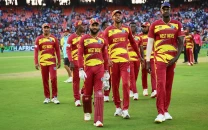
Pakistan step up England Test preparations
Updated 3 hours ago

The race is set to begin in Barcelona on Saturday before returning to France
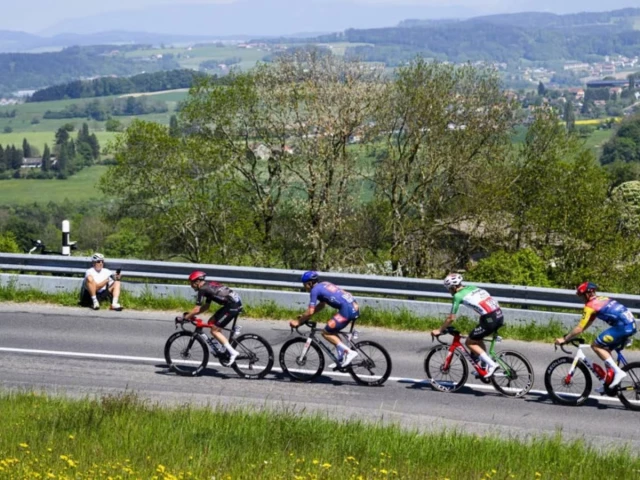
France has just endured a punishing heatwave, with another potentially on the way soon after the country's emblematic cycle race starts this weekend.
Heatwaves are an increasingly common nuisance -- or threat -- in France as all over the world.
And that threat hangs over the Tour de France, which begins in Barcelona on Saturday before returning to France on Monday.
It seems almost blasphemous to say it, but could July's Grande Boucle one day be forced to adapt, or even move to a different month?
Last weekend during the French championships, whose route through the southeastern region of Isere was shortened due to the scorching 40C temperatures during the week, supporters lining the streets spoke of suffocating while riders said it felt like they were cycling into a hairdryer.
Temperatures dropped just below 30C at the start of this week but are due to rise again next week, putting the peloton's powers of resistance to the test, even though professional cyclists "are not people like us" but rather "Formula One cars" accustomed to the heat, according to France coach Thomas Voeckler.
Heat during the Tour is also nothing new, as old black and white images of riders jumping into fountains or darting into cafes attest.
As recently as 2022, on a stage between Rodez and Carcassonne in the southwest, the temperature hit 40C without any untoward incidents.
Riders taking part in the Tour Down Under in Australia in January often face such scorching heat.
But the increasing frequency of heatwaves, and their intensity, have shun the spotlight on the possibility that one day a Tour stage might have to be cancelled or modified to protect riders and spectators.
'Critical moment' coming
"The Tour de France has had a lot of luck up until now in avoiding all the moments of extreme heat," said Benjamin Sultan, a researcher at France's Institute of Research and Development (IRD) who is the co-author of a 50-year-long study of the Tour.
"Given that we're going to have more than double the number of heatwaves at the end of this century, it's just a matter of time before the Tour arrives at a critical moment that can affect its planning," added the climatologist.
Local officials in the southern Tarn region forced a stage of the Route d'Occitanie in June 2022 to be shortened to just 36 kilometres due to the temperature rising over 41C.
Tour de France director Christian Prudhomme said that race organisers are already starting to adapt.
"As recently as six or seven years ago, the idea was that the route should be as open as possible so that technical connections work and so that people could make the most of seeing the riders," he told AFP.
"Now, our thinking is practically the opposite by looking for tree-lined streets because it is absolutely essential for us that the fans can stay in the shade."
Another consideration has been shortening stages.
'Focal point'
Once a race has begun, organisers can adapt to high temperatures by increasing the number of feed zones or even the time delay for riders to avoid elimination at the end of a stage.
But racing earlier in the day is a more complicated adjustment due to the huge number of people involved and television and sponsorship revenues to exploit.
"We have to realise that we are not at home on the roads," said Prudhomme.
"We have authorisation (from police and local authorities) for a certain time, not five hours earlier or later.
"You can't arrange that at the last moment. You can cut 15 kilometres or start half an hour earlier but that's about it."
As for the most radical solution -- moving the race to another time of year -- the problem is that the period of elevated heat is growing and the school holidays last for the two hottest months: July and August.
But even then, "our first heatwave (this year) was at the end of May," said Prudhomme.
And any such decision would have ramifications "even beyond" the whole cycling ecosystem.
The Tour de France is "the focal point of the season" around which everything else is organised, he added.












This material may not be published, broadcast, rewritten, redistributed or derived from. Unless otherwise stated, all content is copyrighted © 2026 The Express Tribune.






COMMENTS
Comments are moderated and generally will be posted if they are on-topic and not abusive.
For more information, please see our Comments FAQ