No catch for the day: Pakistan's tuna trade caught in US-Iran crossfire
Updated 33 minutes ago

Series of earthquakes jolts Pakistan
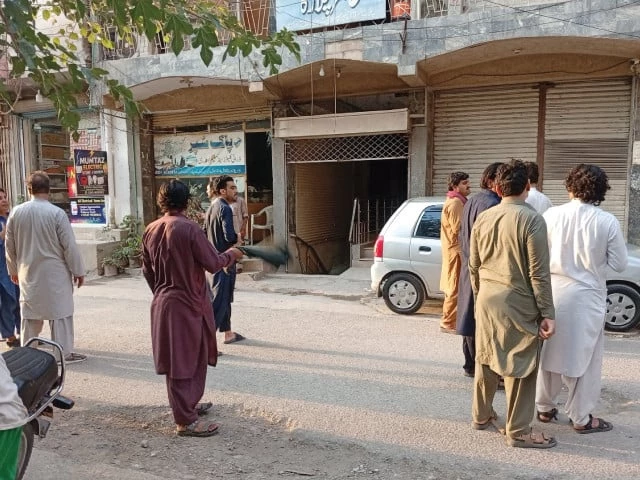
A strong earthquake struck Hindu Kush region on Saturday, the Pakistan Meteorological Department said, sending out tremors that could be felt in a large part of the country and across the border into neighbouring Afghanistan.
A series of moderate earthquakes continued to shake Balochistan over two days as five tremors measuring between 4.2 and 5.2 on the Richter scale struck different parts of the province.
Furthermore, a separate 5.9-magnitude earthquake originating in Afghanistan's Hindu Kush region sent tremors across Islamabad, Punjab and Khyber-Pakhtunkhwa on Saturday evening.
Seismologists linked the unusual sequence of earthquakes to heightened activity along the Eurasian tectonic plate, which stretches across Europe and Asia and underlies both Balochistan and Khyber-Pakhtunkhwa.
They said recent powerful earthquakes elsewhere in the world, including Venezuela, may have generated energy waves affecting interconnected tectonic plates, although they stressed that the exact timing and magnitude of future earthquakes cannot be predicted scientifically.
According to the Pakistan Meteorological Department (PMD), Balochistan experienced five earthquakes between Friday and Saturday, with tremors felt in Kohlu, Sibi, Zhob, Barkhan and Rakhni.
The first earthquake struck at 10:25am on Friday with a magnitude of 4.2. Its epicentre was located 57 kilometres northeast of Sibi at a depth of 42 kilometres.
Just over half an hour later, at 10:58am, a stronger 5.0-magnitude earthquake struck near Kohlu. The PMD said its epicentre was 65 kilometres northeast of Kohlu at a depth of 18 kilometres.
Another tremor measuring 5.1 struck the same area at 4:49pm on Friday, with its epicentre located 60 kilometres northeast of Kohlu and a depth of 17 kilometres. The PMD said the quake was also felt in Zhob, Barkhan and Rakhni.
The seismic activity continued on Saturday morning when a 4.3-magnitude earthquake struck north of Kohlu at a depth of 15 kilometres.
At 8:21am, the strongest tremor of the two-day spell, measuring 5.2, jolted the province. The quake originated 58 kilometres northeast of Barkhan at a depth of 19 kilometres and was felt in Kohlu, Barkhan and Rakhni.
More than 20 people were injured and dozens of houses were damaged in different areas of Musakhail district, Deputy Commissioner Abdul Razzaq Khajak told Reuters.
The disaster management authority in Balochistan said around 125 houses were damaged, adding that relief teams were sent to the affected area along with tents and food, solar panels, blankets and other items.
Later on Saturday evening, another earthquake measuring 4.2 was recorded at 8:30pm. Its epicentre was located about 50 kilometres northwest of Kohlu at a depth of 12 kilometres.
The National Seismic Monitoring Centre (NSMC) said the 5.2-magnitude earthquake struck 52 kilometres northeast of Barkhan at a depth of 19 kilometres. The United States Geological Survey (USGS) measured the same quake at magnitude 5.4 with a depth of 10 kilometres.
The earlier 4.3-magnitude earthquake also originated from the same area. While the NSMC recorded its depth at 42 kilometres, the USGS reported that it struck at 5:45am with a depth of 10 kilometres.
Meanwhile, a separate earthquake measuring 5.9 on the Richter scale struck at 6:35pm on Saturday. Its epicentre was located in Afghanistan's Hindu Kush region at a depth of 178 kilometres.
The tremors were felt in Islamabad, Rawalpindi, Mansehra, Shangla, Swat, Chakwal, Abbottabad, Taxila, Haripur and Buner, while the Punjab PDMA said Lahore, Faisalabad, Attock, Mianwali, Multan, the Potohar region and several other districts also experienced shaking.
People ran out of their doors in panic in Swat, resident Daniyal Ahmad told Reuters. There were no immediate reports of casualties. "It was very huge here in Swat and it lasted for quite a long time," he said.
"People came out of their houses and women and children were seen crying in panic."
Prime Minister Shehbaz Sharif expressed grief over the damage caused and ordered an urgent response from the authorities to help those affected, his office said.
In its preliminary report, the Punjab PDMA said relevant district administrations had been mobilised immediately to inspect buildings in the affected areas.
Director General PDMA said no casualties or property damage had been reported in Punjab so far. The provincial control room and district emergency operation centres remain operational round the clock to respond to any emergency, while citizens have been advised to report any earthquake-related incident through the PDMA helpline 1129.
Punjab Rescue 1122 spokesperson Farooq Ahmad also confirmed that no reports of injuries or damage had been received following the earthquake.
Global tectonic movements
Director of the National Seismic Centre Ameer Haider Laghari said Balochistan and Khyber Pakhtunkhwa lie on the Eurasian tectonic plate and the recent earthquakes were occurring along its upper surface.
He explained that the current wave of seismic activity was linked to broader global tectonic movements and said that the powerful earthquake recently recorded in Venezuela had generated underground energy waves that were travelling through interconnected tectonic plates, contributing to renewed seismic activity.
Laghari cautioned that additional earthquakes could occur along the Eurasian plate until these underground energy waves dissipate completely.
According to experts, the Eurasian tectonic plate is among the world's largest continental plates, extending across Europe, Russia, Central Asia, China and western and northern Pakistan.
Pakistan sits at the junction of the Eurasian, Indian and Arabian tectonic plates, making the Himalayan, Karakoram and Hindu Kush mountain ranges particularly vulnerable to frequent and sometimes powerful earthquakes resulting from the collision of these plates.
(With additional input from Reuters)









This material may not be published, broadcast, rewritten, redistributed or derived from. Unless otherwise stated, all content is copyrighted © 2026 The Express Tribune.





COMMENTS
Comments are moderated and generally will be posted if they are on-topic and not abusive.
For more information, please see our Comments FAQ