Meta, 29 states head to court in biggest test yet of youth social media litigation
Updated 39 minutes ago

China launches five-satellite Tianwu Constellation project under tech pact signed at Urumqi expo
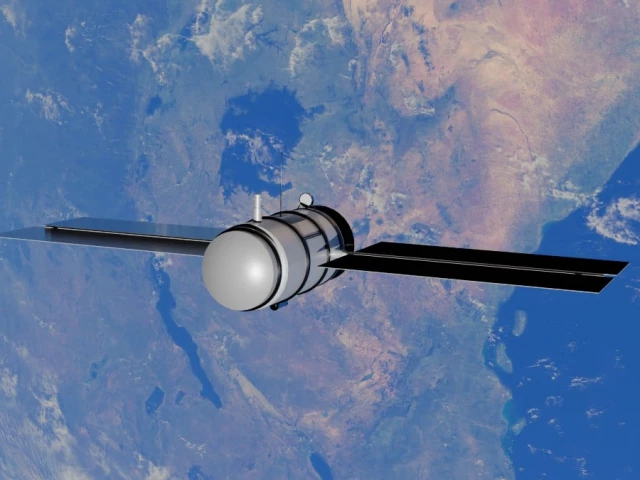
China and several Central Asian countries are planning to develop a satellite constellation to share remote-sensing data and tackle common threats, such as earthquakes, agricultural pests and glacial floods.
The tech cooperation agreement was signed on Thursday at the ongoing 9th China-Eurasia Expo held in Urumqi, capital of northwest China's Xinjiang Uygur Autonomous Region. Called "Tianwu Constellation," the space-based monitoring network will comprise an initial system of five satellites, according to scientists involved in the project.
Tong Qingxi, a remote-sensing specialist with the Chinese Academy of Sciences, said that China's Xinjiang, bordering several Central Asian countries, has similar geographic conditions and common geological threats to its neighbors, such as earthquakes, landslides, and floods caused by glacial melt. The joint constellation is designed to address shared disaster-prevention needs.
"It is a practical application of the Belt and Road cooperation and a shared effort to build a community with a shared future for humanity," Tong said.
Read More: Thousands feared dead in Venezuela quakes
The project is more than a satellite deployment; it is an air-space-ground integrated system that operates through intelligent coordination. Scientists said satellite data collected over the region will be processed by a computing center in Xinjiang, where artificial intelligence (AI) models will be developed for geological disaster prediction, agricultural pest detection, and glacial melt monitoring.
Chen Xi, an academician of the International Eurasian Academy of Sciences who has long studied glacial geology, noted that Xinjiang and neighboring Central Asian countries are linked by the same mountain ranges, and glaciers there have melted by 20 to 40 percent in recent years.
Regular and precise satellite monitoring of glacier changes will support water resource allocation and water supply security for the region, Chen said.
Scientists from Kazakhstan, Uzbekistan and Tajikistan attended the signing ceremony. They expressed confidence that the joint project would bring mutual benefits.
Akobir Mirzorakhimzoda, vice president of the National Academy of Sciences of Tajikistan, said that mastering advanced technologies such as satellite networking and AI enables real-time monitoring and analysis of environmental indicators, providing a reliable basis for informed decision-making.
"Such an initiative is a significant step toward scientific advancement, broader international cooperation, and stronger ties among nations," he told Xinhua.













This material may not be published, broadcast, rewritten, redistributed or derived from. Unless otherwise stated, all content is copyrighted © 2026 The Express Tribune.






COMMENTS
Comments are moderated and generally will be posted if they are on-topic and not abusive.
For more information, please see our Comments FAQ