Zelensky rejects rival's call for vote, says would 'split' Ukraine
Updated 3 hours ago

Negotiations involving Qatar, Pakistan mediation were paused after 80 minutes for internal consultations, report says
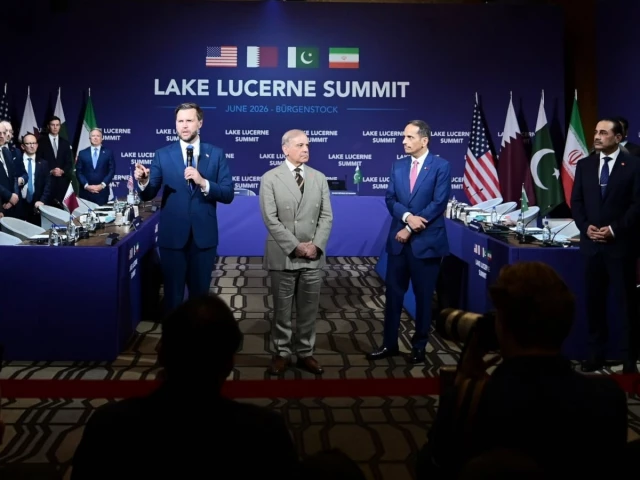
The first round of four-party talks involving Iran and the US, with mediation by Qatar and Pakistan, has concluded in Switzerland, Iran’s semi-official Fars news agency reported Sunday, citing a source familiar with the Iranian negotiating team.
According to the source, the initial round of the Swiss-hosted negotiations has now been completed.
The meeting was suspended after approximately 80 minutes of talks to allow the participating delegations to conduct internal consultations, the source added.
No further details were immediately released on when the next session would begin.
Earlier in the day, Qatar announced the start of US-Iran negotiations in Switzerland with the participation of Qatari and Pakistani mediators to discuss the implementation of the terms of an interim agreement between the two sides.
PM Shehbaz hopes for ‘peace, progress’ at Quad talks
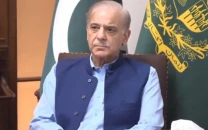
Quadripartite negotiations between the United States and Iran commenced in Bürgenstock, Switzerland with Qatar and Pakistan playing a mediatory role, as Prime Minister Shehbaz Sharif expressed hope that the process would lead to “peace, progress and prosperity globally.”
Speaking at the venue of the Quad meeting, the prime minister said the gathering marked “a significant step toward peace, progress and prosperity.”
He expressed gratitude to US President Donald Trump for his leadership and acknowledged the role of Vice President JD Vance, the Prime Minister of Qatar, and Field Marshal Syed Asim Munir in facilitating the process, while voicing hope for productive outcomes for regional and global stability.
Prime Minister Shehbaz Sharif says wonderful discussions that we have, here will hopefully lead to a productive meeting at the Quad talks in Bürgenstock, Switzerland. Thanking U.S. President Donald Trump, Vice President JD Vance, the Qatari Prime Minister, and Field Marshal Asim… pic.twitter.com/Lg2959rGC4
— Pakistan TV (@PakTVGlobal) June 21, 2026
PM Shehbaz said he was looking forward to constructive discussions and expressed satisfaction that joint efforts had culminated in the meeting in Bürgenstock.
“Wonderful discussions that we have, here will hopefully lead to a productive meeting at the Quad talks in Bürgenstock, Switzerland,” he said, adding: “When we go back, I hope we will have a good piece of paper in our hands about peace.”
Prime Minister Shehbaz Sharif, speaking at the venue of Quad meeting in Bürgenstock, Switzerland, says that this gathering marks a significant step toward peace, progress and prosperity. He expressed gratitude to US President Donald Trump for his leadership, acknowledged the role… pic.twitter.com/x00wZ2PKSw
— Pakistan TV (@PakTVGlobal) June 21, 2026
US Vice President JD Vance said President Donald Trump was committed to a “full regional ceasefire”, including Lebanon, noting that such processes were often complex.
“These kinds of ceasefires are always ‘a little bit messy’, but we have seen progress over the last few days,” he said.
He praised Field Marshal Asim Munir for his role in the peace process, describing him as a key figure in recent diplomatic engagement.
“I have joked that I have two very, very important people in my life. An Indian and a Pakistani. The Indian is my wife and the Pakistani is Field Marshal Munir. And I have probably talked to Field Marshal Munir more than I have talked to anybody else over the last three months.”
Vance further lauded Pakistan’s contribution to the negotiations and thanked PM Shehbaz and Field Marshal Munir, calling them “my best friends in the region.”
“Had it not been for the role of Asim Munir, we would not be here today,” he said, adding that Pakistan had played a key role in advancing the talks.
He noted that “never before have such high-level talks been held between us and Iran,” and thanked President Trump “for empowering us to find a diplomatic solution.”
US Vice President JD Vance has said the United States is seeking to turn over a new leaf with Iran through diplomacy, while praising Pakistan's role in advancing the process. Speaking at Quad meeting venue in Burgenstock, Switzerland, he credited Prime Minister Shehbaz Sharif for… pic.twitter.com/TuTDdwFgkb
— Pakistan TV (@PakTVGlobal) June 21, 2026
Vance said a great deal had “already been accomplished” and expressed optimism about further progress.
“We would not be here without his statesmanship,” Vance said while singling out Field Marshal Asim Munir for his peace efforts.
He said he had been in frequent contact with Field Marshal Munir over the past three months and described him as “a great military leader” who has also shown himself to be a great diplomat.
Prime Minister Sheikh Mohammed bin Abdulrahman bin Jassim Al Thani of Qatar also paid tribute to PM Shehbaz and Field Marshal Munir, acknowledging their leadership and role in initiating the process.
He said the progress achieved so far would not have been possible without their efforts, alongside those of other key leaders involved in the negotiations.
Sheikh Mohammed bin Abdulrahman bin Jassim Al Thani, Prime Minister of Qatar paid special tribute to Prime Minister Shehbaz Sharif and Field Marshal Asim Munir for their leadership, vision and commitment in helping initiate the process that brought all parties together in… pic.twitter.com/C4icA4wR9h
— Pakistan TV (@PakTVGlobal) June 21, 2026
Describing the meeting as historic, he said it was significant not only for regional security but also for global peace, expressing confidence that it marked the beginning of a path toward a lasting agreement.
Earlier, Qatar’s Foreign Ministry announced the launch of talks between the United States and Iran in Switzerland, held with the mediation of Qatar and Pakistan, Al Jazeera reported.
The ministry expressed “its aspiration that these meetings will lead to the conclusion of a comprehensive and permanent agreement addressing all aspects covered in the memorandum of understanding”.
Pezeshkian says Iran-US understanding benefits Iranian people
Iranian President Masoud Pezeshkian said the provisions of the understanding between Iran and the United States are “largely in the interests of the Iranian people”, adding that negotiations between the two sides would help Iran access its financial resources and decide how they are used.
Speaking at a seminar on monetary and banking policies in Tehran, Pezeshkian said Iran had exported more than 16 million barrels of oil in recent days and described the achievements of the talks as “very clear”.
“We will be able to access our own resources and make our own decisions regarding them,” he said.
Pezeshkian expressed hope that the $6 billion in Iranian funds held in Qatar would be unfrozen as negotiations progress, adding that Central Bank Governor Abdolnasser Hemmati was participating in the Switzerland talks to discuss how the funds should be utilised.
Referring to Washington’s position on Iran’s nuclear programme, Pezeshkian reiterated that the Islamic Republic would not seek to develop nuclear weapons, saying the stance was consistent with the country’s long-standing policy and religious decree against atomic arms.
He also said Israel was unhappy with the ongoing negotiations and accused it of seeking to prolong conflict in the region, particularly in Gaza and Lebanon.
Calling for national unity, Pezeshkian warned against internal divisions, saying Iran’s adversaries could seek to exploit any discord to advance their objectives.
President @drpezeshkian : Tehran-Washington understanding largely serves interests of Iranian peoplehttps://t.co/sebAQguTUQ pic.twitter.com/egs82tbxVX
— IRNA News Agency ☫ (@IrnaEnglish) June 21, 2026
Iran says US negotiations entered with ‘power and caution’
Hojjatoleslam Abdollah Haji Sadeghi, the main representative of Supreme Leader Ali Khamenei to the Islamic Revolutionary Guard Corps, said “negotiation is not the primary option” with the United States, Al Jazeera reported.
“We will enter negotiations with power and caution, but we are not passive,” Sadeghi was quoted as saying in a post on Telegram.
“Our primary option is the field of jihad, whether on the battlefield or in the streets,” he added, saying Iran is “not worried about the negotiations failing” and did not enter talks “out of desperation or helplessness”.
Iran says the ongoing conflict between Israel and Hezbollah in Lebanon will be a key topic in talks with the United States in Switzerland, AFP reported, citing Iran’s IRNA news agency.
“The Zionist (Israel) regime continues to violate its commitment in Lebanon; this issue will be the main topic of discussion in today’s talks,” Iran’s foreign ministry spokesman said.
He added that discussions will also cover “the issue of making available Iran’s frozen or restricted assets, as well as the discussion related to issuing the necessary licenses for the sale of Iranian oil”.
Iran says Switzerland talks focus on MoU implementation, key provisions
The Islamic Republic of Iran is determined to “meticulously and seriously pursue the process of implementing the other party’s commitments,” Ministry spokesman Esmaeil Baqaei wrote on X.
He said today’s meeting in Switzerland is aimed at following up on the implementation of the memorandum of understanding on the termination of the war dated June 18, 2026.
According to Baqaei, paragraph 13 of the MoU states that the start of negotiations for a final agreement is contingent upon the implementation of several provisions, including paragraphs 1, 4, 5, 10 and 11.
He added that without the implementation of these provisions, particularly paragraph 1 on the termination of the war on all fronts, including Lebanon, entry into the final negotiation phase would not be possible.
Baqaei said discussions in Switzerland are focused on implementing these provisions, especially paragraph 1, as well as reviewing steps related to paragraph 10 on Iran’s oil exports and paragraph 11 on the release of frozen Iranian assets.
جمهوری اسلامی ایران مصمم است روند اجرایی شدن تعهدات طرف مقابل را با وسواس و جدیت پیگیری کند.
— Esmaeil Baqaei (@IRIMFA_SPOX) June 21, 2026
نشست امروز در سوئیس، برای پیگیری اجرای مفاد یادداشت تفاهم خاتمه جنگ مورخ ۲۸ خرداد ۱۴۰۵ است. طبق بند ۱۳ یادداشت تفاهم، آغاز مذاکرات توافق نهایی، منوط به اجرای بندهای ۱، ۴، ۵، ۱۰ و ۱۱ است.…
Pezeshkian says $6b in frozen Iranian assets part of US agreement
Iran’s President Masoud Pezeshkian says $6 billion in frozen Iranian funds held in Qatar will be returned as part of a preliminary deal with the United States aimed at ending the war, Al Jazeera reported.
“All provisions of the memorandum of understanding are in our favour, and the achievements of these talks and negotiations will become evident,” Tasnim news agency quoted him as saying.
He said US President Donald Trump, “who had forbidden us from doing many things in his recent speech, declared all of them as the rights of the people and the nation”.
“Our $6 billion in Qatar will be returned,” he added.
Pezeshkian also said Israeli Prime Minister Benjamin Netanyahu would be “the first to be unhappy with the negotiations” in Switzerland.
He added that Washington’s only demand is that Iran not obtain an atomic bomb, referencing Iran’s long-standing religious edict against nuclear weapons, and said, “America said ‘write this down and sign’ — and we signed”.
Iran FM Araghchi holds 45-minute meeting with Swiss counterpart
The bilateral meeting between Iranian Foreign Minister Abbas Araghchi and his Swiss counterpart Ignazio Cassis lasted around 45 minutes at the Bürgenstock Hotel in Switzerland, IRNA news agency reported.
Quadrilateral talks between Iran, the United States, Pakistan and Qatar are expected to begin shortly at another venue within the same premises, it added.
After roughly 45 min, the bilateral meeting between FM @araghchi and his Swiss counterpart @ignaziocassis came to a close at Bürgenstock Hotel. Quadrilateral talks between Iran, the US, Pakistan, and Qatar are expected to commence shortly at another venue on the same premises. pic.twitter.com/hOmovguWFs
— IRNA News Agency ☫ (@IrnaEnglish) June 21, 2026
Iranian foreign minister meets Swiss counterpart
Iranian Foreign Minister Abbas Araghchi met Swiss Foreign Minister Ignazio Cassis in their first official engagement in Switzerland, IRNA news agency reported.
Foreign Minister @araghchi met with his Swiss counterpart @ignaziocassis in the first official engagement of the Iranian delegation in Switzerland. pic.twitter.com/0RAr38maaj
— IRNA News Agency ☫ (@IrnaEnglish) June 21, 2026
Technical-level talks could extend into tomorrow
“Technical-level talks between US and Iranian delegations could extend into tomorrow,” Pakistan TV reported.
Speaking live from the Bürgenstock Resort in Switzerland, Pakistan TV head Adil Shahzeb said the Pakistani delegation is expected to hold separate bilateral meetings with the US, Iran and Qatari delegations alongside ongoing diplomatic engagements.
“Technical-level talks could extend into tomorrow,” he said, adding that “no formal deadlines or timeframe have been announced for the negotiations”.
According to Adil Shahzeb, “discussions will continue for as long as necessary,” and Pakistan TV will maintain on-the-ground coverage throughout the duration of the talks.
Speaking live from the Burgenstock Resort in Switzerland, Pakistan TV head Adil Shahzeb has said the Pakistani delegation is expected to hold separate bilateral meetings with the US, Iran and Qatari delegations alongside the ongoing diplomatic engagements. He said the… pic.twitter.com/PHn9kDLy82
— Pakistan TV (@PakTVGlobal) June 21, 2026
Swiss Foreign Ministry welcomes Pakistani delegation
The Swiss Foreign Ministry welcomed the arrival of the Pakistani delegation in Switzerland, saying Islamabad was among the mediators of the memorandum of understanding (MoU) signed between the United States and Iran.
“As one of the mediators of the MoU signed between the United States and Iran, the Pakistani delegation is on its way to the Bürgenstock for the next phase of discussions,” the ministry said in a post on X.
We welcome the arrival of the Pakistani delegation in #Switzerland.
— Swiss MFA (@SwissMFA) June 21, 2026
As one of the mediators of the MoU signed between the #UnitedStates and #Iran, the Pakistani delegation is on its way to the Bürgenstock for the next phase of discussions. pic.twitter.com/BU7XoBmrnu
Vance arrives in Switzerland for Iran peace talks with Hormuz in spotlight
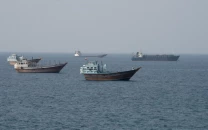
US Vice President JD Vance arrived in Switzerland on Sunday for peace talks with Iran as both nations seek a durable end to their war while disagreeing over Iran's claims that it had closed the vital Strait of Hormuz.
The US and Iran had agreed to a 60-day ceasefire for the negotiations, but Tehran's Islamic Revolutionary Guard Corps on Saturday declared the Strait of Hormuz shut in response to Israeli strikes in Lebanon, although the US military said commercial vessels kept operating.
Those developments could complicate talks in which both sides want to advance an interim deal brokered by Pakistan and signed on Wednesday by Presidents Donald Trump and Masoud Pezeshkian to end the almost four-month war.
Vance and second lady Usha Vance arrived at Emmen Air Base in Switzerland at 5:59am (0359 GMT), a vice presidential spokesperson said.
Iran’s parliament speaker says martyrs are watching his actions
“I consider the innocent children of Minab and all the martyrs of dear Iran to be watching over my every action and behavior at every moment. They see us and expect things of us,” Iranian Parliament Speaker Mohammad Bagher Ghalibaf wrote on X.
“God forbid that I should ever bring shame to the innocent martyrs and the people of Iran, and that I should join my companions with a clear conscience—companions for whose reunion I eagerly await,” he added.
کودکان مظلوم میناب و تمام شهدای ایران عزیز را هر لحظه ناظر اعمال و رفتار خود میدانم. آنها ما را میبینند و از ما انتظار دارند.
— محمدباقر قالیباف | MB Ghalibaf (@mb_ghalibaf) June 20, 2026
خدا کند که شرمندهٔ شهدای مظلوم و ملت ایران نباشم و روسفید به یارانم بپیوندم که برای دیدنشان لحظهشماری میکنم.
#Minab168
به یاد بچههای مدرسهٔ میناب pic.twitter.com/UDvZJOyJo2
Vance hopes for progress on nuclear issue, Lebanon
"I think we're going to hopefully make progress on the nuclear issue, make progress on the Lebanon ceasefire issue," with a "couple days of talks" likely, Vance told reporters at Joint Base Andrews in Maryland before departing.
Iran's Revolutionary Guards, accusing Israel of "crimes" in Lebanon that violated US commitments to the ceasefire, warned ships would be at risk if they approached the strait, which carried a fifth of global oil supplies before the US and Israel launched attacks on February 28.
Despite the Lebanon truce, Israeli forces and the Iran-backed militant group Hezbollah attacked each other on Saturday.
Read: Pakistan leads push for second phase of US-Iran peace process
US Central Command said 55 merchant ships transited the strait on Saturday, carrying more than 17 million barrels of oil bound for global markets, and vowed that US forces would ensure commercial traffic continued.
Trump said there would be no toll for passage through the strait during the 60-day ceasefire or after, unless the US imposed one should peace talks fail.
In a social media post, he cited the possibility of a toll levied by the United States "for services rendered as the Guardian Angel to the countries of the Middle East" if a peace deal is not completed.
Mohammad Mokhber, an adviser to Iran's supreme leader, Ayatollah Mojtaba Khamenei, accused the US of failing to implement the first of the Iran deal's 14 points, which include a ceasefire "on all fronts", including Lebanon.
As long as the agreement was only on paper, the flow of Middle East energy would stay halted, he added.
On the other hand, Iranian Oil Minister Mohsen Paknejad said that if Western stakeholders adhere to the spirit of the pact, hundreds of investment opportunities and contract formats stand ready, according to the ministry's news outlet, Shana.
Israel vows to defend its forces in Lebanon
The Iranian delegation to the talks in the Swiss mountaintop resort of Buergenstock is led by chief negotiator Mohammad Bagher Ghalibaf and includes Foreign Minister Abbas Araqchi as well as senior security, central bank and oil officials, Iranian media said.
In addition to Vance, the US negotiating team includes envoys Steve Witkoff and Jared Kushner, Trump's son-in-law.
Iranian Foreign Ministry spokesperson Esmaeil Baghaei said Iran would press for fulfilment of commitments, citing past failures by the other side to honour agreements.
PM Shehbaz and Field Marshal Munir had arrived in Switzerland to participate in this weekend's sessions.
In an interview with Fox News before leaving the United States, Vance said he was confident the ceasefire would hold, and he had seen no evidence of a closed Strait of Hormuz.
Read more: FO announces US-Iran technical talks in Switzerland on Sunday
A halt to fighting in Lebanon was one of the conditions for starting US-Iranian talks on Tehran's nuclear programme and other issues. But Lebanese civil defence officials said Israeli strikes had killed 20 people on Saturday, hours after a truce took effect.
Israel said it was responding to attacks from Hezbollah, while the group said it would not allow Israel "freedom of movement" in Lebanon.
Israel says it is not party to the Iran-US deal and will keep its forces in the Lebanese territory it occupies. In a statement, its military said Israel was committed to the ceasefire but would act against any threats.
Israeli broadcaster Channel 12 said the prime minister and defence minister had told the military to hold fire in Lebanon, but it would not withdraw from captured areas.
A poll by Israel's Hebrew University, provided to Reuters, showed about 92% of Israelis believe Iran benefited more than Israel from the joint Israeli-US military campaign, while just 8% see Israel as having emerged victorious.
Almost 90% of Israelis said war goals had not been met and fewer than 30% believe Prime Minister Benjamin Netanyahu's claims of major achievements.
Lebanon's health ministry says Israeli attacks have killed 4,057 since March 2, including medics, women and children, but not how many combatants are included.
Israeli authorities say at least 32 soldiers and four civilians have been killed in fighting with Hezbollah.






This material may not be published, broadcast, rewritten, redistributed or derived from. Unless otherwise stated, all content is copyrighted © 2026 The Express Tribune.


COMMENTS (2)
Comments are moderated and generally will be posted if they are on-topic and not abusive.
For more information, please see our Comments FAQ