No party meetings as Zardari leaves Lahore
Updated 2 hours ago

Experts warn valuable pre-Partition landmark could disappear without conservation
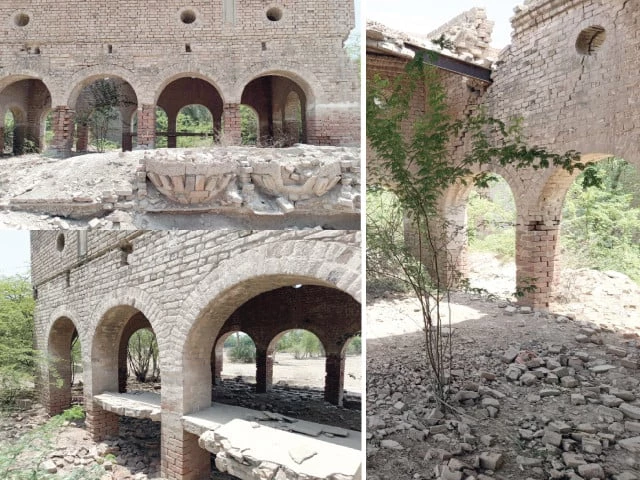
A centuries-old Hindu cremation ground in Khanewal, once an important site for the last rites of the region's Hindu community, has fallen into a state of neglect.
Located on Jahanian Road, the cremation ground, locally known as Shamshan Ghat, dates back to the pre-Partition era when Khanewal was home to sizeable Hindu, Sikh and Muslim communities.
Before the Partition of the subcontinent in 1947, the site served as a key religious facility where local Hindu families performed funeral rites in accordance with their traditions.
Historical accounts suggest that Khanewal's rapid development during the British colonial period, particularly after the establishment of the railway junction in the early 20th century, led to the growth of diverse religious communities.
Alongside places of worship, cemeteries and cremation grounds were established around the expanding town.
Following Partition, most Hindu and Sikh residents migrated to India, leaving behind numerous religious and cultural sites.
As a result, the cremation ground gradually lost its original purpose and over the decades faded from public memory.
According to historical sources and local accounts, the site once covered approximately 63 kanals and seven marlas. However, its exact boundaries are now difficult to determine without official land and revenue records.
Local historian Professor Ramesh said evidence from historical traditions and records indicates that the cremation ground was used by Khanewal's Hindu community for generations before Partition.
"After 1947, religious activities at the site virtually ceased. Nevertheless, the land remains an important historical and religious landmark," he said.
Residents say traces of old cremation platforms, ancient trees and remnants of historic structures could still be seen in parts of the site.
Local traditions also hold that the area was used for the cremation of Hindu adults and infants.
Elderly resident Moinuddin Qureshi said the cremation ground remained widely known among locals even decades after Partition.
"Before 1947, Hindu families from across the city performed their last rites here. Even today, people refer to the place as Shamshan Ghat," he said.
According to local historians, other nearby sites such as Ram Chautra and Lachhman Chautra also served as important centres for Hindu funeral rituals in the region.
A former teacher, Ehsanul Haq, explained that the cremation ground was established in accordance with Hindu religious traditions, which generally require such sites to be located in open areas away from dense residential settlements.
Hakim Karamat Ali said the property was likely managed by a local Hindu Panchayat or the Sanatan Dharam Sabha before Partition and later became part of the abandoned properties left behind after migration.
Historical maps, including Survey of India records from 1910 to 1945, British-era railway town plans, municipal archives and Evacuee Trust Property records, have helped identify the site's original location and significance.
Now under the supervision of Hindu religious authorities, the historic site is in a deteriorating condition. Local residents say parts of the structure are on the verge of collapse due to decades of neglect.
"If the government takes timely action, this valuable heritage can still be preserved for future generations," said local resident Mohsin Arain.














This material may not be published, broadcast, rewritten, redistributed or derived from. Unless otherwise stated, all content is copyrighted © 2026 The Express Tribune.







COMMENTS
Comments are moderated and generally will be posted if they are on-topic and not abusive.
For more information, please see our Comments FAQ