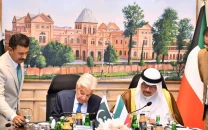
Pakistan, Kuwait protocol agreement builds on 2023 defence pact
Updated 1 hour ago

Government bans JAAC under anti-terror law, alleging involvement in terrorism and public intimidation
The Azad Jammu and Kashmir (AJK) government on Friday banned the Joint Awami Action Committee (JAAC), accusing it of involvement in terrorism, promoting hatred, and creating anarchy in the state, according to an official notification.
The ban follows the JAAC’s call for a protest on June 9. The organisation has previously spearheaded mass protests demanding economic relief and political rights, with some demonstrations ending in violence and fatalities during confrontations with law enforcement authorities in May 2024 and September 2025.
The notification, issued by the AJK Home Department, said the organisation had been added to the First Schedule of the Azad Jammu and Kashmir Anti-Terrorism Act (ATA), 2014, as a proscribed organisation.
“The Government of AJ&K has reasonable grounds to believe that Jammu Kashmir Joint Awami Action Committee (JK-JAAC) also known by names Joint Awami Action Committee (JAAC) and Awami Action Committee (AAC) is engaged in terrorism, acted in a manner prejudicial to the peace & security of the State, involved in creating anarchy in the State by intimidating public, promoting hatred & creating sense of insecurity in society and public at large etc,” the notification stated.
It further said: “THEREFORE, in exercise of powers conferred under section 12 of Azad Jammu and Kashmir Anti-Terrorism Act, 2014 the President, Azad Jammu and Kashmir has accorded approval to list Jammu Kashmir Joint Awami Action Committee (JK-JAAC), also known by names such as Joint Awami Action Committee (JAAC) and Awami Action Committee (AAC) etc. in the First Schedule of ATA, 2014, as Proscribed Organization for the purpose of the said Act”.
The Azad Jammu and Kashmir Anti-Terrorism Ordinance, 2014, was promulgated by the AJK government in July 2014. Under Section 12 of the law, the government may place an organisation in the First Schedule as a proscribed entity if it has reasonable grounds to believe that the group is involved in terrorism, promotes or supports terrorist activities, is linked to a banned organisation, or engages in activities deemed prejudicial to the peace and security of the state.
Responding to the move, the JAAC described the ban and its inclusion in the list of proscribed organisations as a “confusion”, saying it had nothing to lose and “the whole world left to gain”.
Meanwhile, reacting to reports of a suspension of mobile phone services in the region, the committee termed the measure “economic murder” of the people of the state.
“The shutdown of mobile and internet services is the economic murder of the people of the state,” the JAAC said in a post on X.
It added that the move would cut off 2.2 million Kashmiris from their homes, describing it as the worst form of “governmental terrorism”.
1,505 Islamabad police deployed to AJK
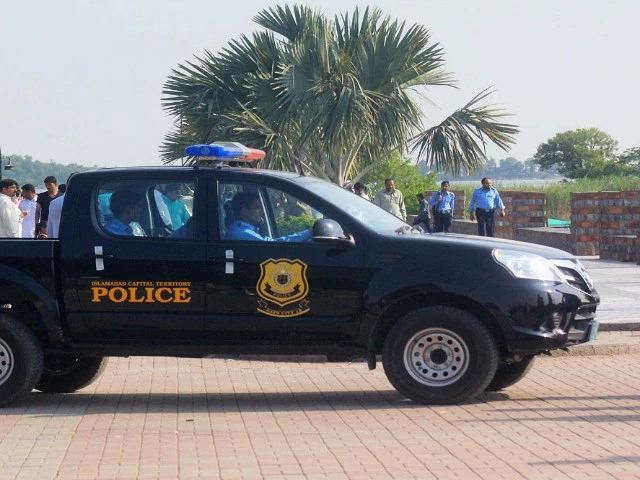
Earlier, a total of 1,505 Islamabad Police personnel were deployed to AJK on Friday in view of a protest call by the Joint Awami Action Committee (JAAC) for June 9, as authorities moved to tighten security arrangements in the region ahead of the upcoming AJK elections, a spokesperson confirmed.
According to police spokesperson Taqi Jawad, the deployment was approved by the Islamabad Inspector General of Police Nasir Rizvi as part of a special security plan aimed at maintaining law and order.
The move comes hours after the AJK Election Commission announced that general elections for the AJK Legislative Assembly will be held on July 27. The commission added that preparations are underway to ensure transparent, orderly, and impartial elections under judicial supervision.
The contingent includes senior officers as well as field formations, with one deputy inspector general, two senior superintendents of police, and four superintendents of police among those sent to supervise operations on the ground. The force also comprises eight assistant superintendents of police/deputy superintendents of police, 16 inspectors, two sub-inspectors, 70 assistant sub-inspectors, and 1,382 constables, forming a multi-tier security structure.
Jawad said the personnel are being deployed with full anti-riot gear, while units from the counter-terrorism department, Safe City, Operations, and Security Divisions have also been included in the arrangement.
Security has been placed on high alert across Azad Kashmir in view of the protest call by the Joint Awami Action Committee, with reserve forces kept on standby for further deployment if needed.
Meanwhile, Defence Minister Khawaja Asif said in a post on X that the demand to abolish 12 AJK Assembly seats elected from Pakistan ahead of the elections amounted to “disrupting the electoral process”, urging that such issues be taken to the public instead of being used to derail the vote.
27جولائ کو آزاد کشمیر کے الیکشن ھیں ۔ ایکشن کمیٹی ککا مطالبہ ھے کشمیر اسمبلی کی پاکستان سے منتخب ھونے والی 12 نشستیں ختم کی جائیں۔ الیکشن سے پہلے یہ مطالبہ انتخابی عمل کو سبو تاژ کرنے کے مترادف ھے۔ جمہوری سوچ کا تقاضا ھے کہ جو لوگ یہ مطالبہ کر رہے ھیں وہ اسکو 27جولائ کو عوام کے…
— Khawaja M. Asif (@KhawajaMAsif) June 5, 2026
“Democratic thinking requires that those making this demand should present it before the public on July 27,” he said, adding that voters should be allowed to decide and “shape the form of representation.”
He warned that raising such demands before polling would otherwise be seen as “blackmail”, arguing that electoral matters should be settled through a democratic mandate.
Referring to representation from Pakistan-based constituencies, Asif said Sialkot city and tehsil alone return one seat to the AJK Assembly, while two National Assembly seats also exist from the region, with other constituencies spread across Pakistan.
Read: JAAC boycotts APC as parties reject refugee seats proposal for AJK Assembly
He highlighted the presence of a large number of Kashmiri migrants, particularly from Jammu, saying they had settled in Sialkot after the 1947 partition at great human cost. “In October 1947, more than two hundred thousand migrants arrived in Sialkot city and tehsil after sacrificing their lives,” he said, adding that many families endured decades of hardship and deprivation of basic facilities. “How can you deprive these migrants of their rights?” he asked, stressing that they had “paid a very heavy price for freedom.”
Asif said that those raising concerns should pursue their objectives through “a democratic path” to ensure acceptance of their views.
Refugee seats dispute resurfaces in AJK
AJK's 53-member legislative assembly includes 12 seats reserved for Kashmiri refugees — people who fled Indian-controlled Kashmir in 1947 and 1965 and are now scattered across Pakistan. Six seats represent refugees from the Jammu division (~434,000 people) and six from the Kashmir Valley (~30,000 people) — an already lopsided arrangement that many see as unfair.
The issue of refugee representation has long been a key demand of the JAAC, which led a series of protests last year that turned violent and resulted in the deaths of several people.
The region witnessed one of its most turbulent periods in October last year when protests led by the JAAC erupted over demands for constitutional and governance reforms. At least nine people, including three policemen, were killed during the unrest.
The JAAC, which organised the protests and strike, had presented a wide-ranging charter of demands, including an end to the privileges enjoyed by the ruling elite, the abolition of 12 assembly seats reserved for refugees, and the scrapping of the quota system.
Two days after the violence, the government and the JAAC reached an agreement covering 12 core and 13 additional points. Under the accord, both sides agreed to constitute a high-level committee to examine the issue of refugee seats in the AJK Legislative Assembly.
The unrest also triggered political upheaval in the region. The Pakistan Peoples Party (PPP) subsequently moved a no-confidence resolution against then prime minister Chaudhry Anwarul Haq, with the Pakistan Muslim League-Nawaz (PML-N) joining the effort. Haq, who had been elected in April 2023 with 48 votes, chose to face the vote rather than resign.
On Nov 17, Raja Faisal Mumtaz Rathore secured 36 votes in the election and became the 16th prime minister of Azad Jammu and Kashmir.
With elections now approaching and the refugee seat issue still unresolved, the AJK government convened an All Parties Conference (APC) in Muzaffarabad to build consensus. Almost every major party attended — except PTI and the JAAC, who boycotted it.
The JAAC's position is that the government had already rejected its written proposals submitted on May 30, so attending would be futile. It had proposed either keeping symbolic refugee representation until the Kashmir dispute is permanently resolved, or replacing the 12 assembly seats with 4 seats in the AJK Council — a body chaired by the Prime Minister, which it argued would better preserve the political dimension of the Kashmir cause.
The APC rejected any changes outside the constitutional and legislative framework, saying only the elected assembly could alter refugee seat arrangements. The JAAC called the resolution "a page and a half of utterly trivial lines" and accused participants of gathering to serve their own interests rather than the public's.
The JAAC called a major protest for June 9 in Muzaffarabad, with caravans converging from across the region.






This material may not be published, broadcast, rewritten, redistributed or derived from. Unless otherwise stated, all content is copyrighted © 2026 The Express Tribune.

COMMENTS
Comments are moderated and generally will be posted if they are on-topic and not abusive.
For more information, please see our Comments FAQ